Advertisements
Advertisements
प्रश्न
Show that the function f : R → {x ∈ R : –1 < x < 1} defined by f(x) = `x/(1 + |x|)`, x ∈ R is one-one and onto function.
Advertisements
उत्तर
It is given that f : R → {x ∈ R : –1 < x < 1} is defined as f(x) = `x/(1+ |x|)`, x ∈ R.
Suppose f(x) = f(y), where x, y ∈ R.
⇒ `x/(1 +| x|) = y/(1 - |y|)`
⇒ 2xy = x – y
⇒ `x/(1 + x) = y/(1 - y) `
⇒ x + xy = y + xy
⇒ x = y
Since x is positive and y is negative:
x > y
⇒ x − y > 0
But, 2xy is negative.
Then, 2xy ≠ x – y
Thus, the case of x being positive and y being negative can be ruled out.
Under a similar argument, x being negative and y being positive can also be ruled out
∴ x and y have to be either positive or negative.
When x and y are both positive, we have:
⇒ f(x) = f(y)
⇒ `x/(1 + |x|) = y/(1 - |y|) `
⇒ `x/(1 + x) = y/(1 + y)`
⇒ x + xy = y + xy
⇒ x = y
When x and y are both negative, we have:
f(x) = f(y)
⇒ `x/(1 - x) = y/(1 - y) `
⇒ x – xy = y – yx
⇒ x = y
∴ f is one-one.
Now, let y ∈ R such that –1 < y < 1.
If x is negative, then there exists x = `y/(1 + y) ∈ R` such that
`f(x) = f(y/(1 + y)) `
= `((y/(1 + y)))/(1+ |y/(1 + y)|)`
= `(y/(1 + y))/(1 + (-y)/(1 + y))`
= `y/(1 + y - y)`
= y
If x is positive, then there exists x = `y/(1 - y) ∈ R` such that
`f(x) = f(y/(1 - y)) = (y/(1 - y))/(1 + |(y/(1 - y))|)`
= `(y/(1 - y))/(1 + y/(1 - y))`
= `y/(1 - y + y)`
= y
∴ f is onto.
Hence, f is one-one and onto.
संबंधित प्रश्न
Show that the function f : R* → R* defined by f(x) = `1/x` is one-one and onto, where R* is the set of all non-zero real numbers. Is the result true, if the domain R* is replaced by N with co-domain being same as R?
Check the injectivity and surjectivity of the following function:
f : R → R given by f(x) = x2
Prove that the greatest integer function f : R → R, given by f(x) = [x], is neither one-one nor onto, where [x] denotes the greatest integer less than or equal to x.
In the following case, state whether the function is one-one, onto or bijective. Justify your answer.
f : R → R defined by f(x) = 3 – 4x
Classify the following function as injection, surjection or bijection :
f : R → R, defined by f(x) = x3 − x
Classify the following function as injection, surjection or bijection :
f : R → R, defined by f(x) = `x/(x^2 +1)`
Set of ordered pair of a function ? If so, examine whether the mapping is injective or surjective :{(a, b) : a is a person, b is an ancestor of a}
Find gof and fog when f : R → R and g : R → R is defined by f(x) = x2 + 2x − 3 and g(x) = 3x − 4 .
Find fog (2) and gof (1) when : f : R → R ; f(x) = x2 + 8 and g : R → R; g(x) = 3x3 + 1.
Let R+ be the set of all non-negative real numbers. If f : R+ → R+ and g : R+ → R+ are defined as `f(x)=x^2` and `g(x)=+sqrtx` , find fog and gof. Are they equal functions ?
Let
f (x) =`{ (1 + x, 0≤ x ≤ 2) , (3 -x , 2 < x ≤ 3):}`
Find fof.
Let f : R `{- 4/3} `- 43 →">→ R be a function defined as f(x) = `(4x)/(3x +4)` . Show that f : R - `{-4/3}`→ Rang (f) is one-one and onto. Hence, find f -1.
If f : R → (−1, 1) defined by `f (x) = (10^x- 10^-x)/(10^x + 10 ^-x)` is invertible, find f−1.
Let A = {x &epsis; R | −1 ≤ x ≤ 1} and let f : A → A, g : A → A be two functions defined by f(x) = x2 and g(x) = sin (π x/2). Show that g−1 exists but f−1 does not exist. Also, find g−1.
Which one of the following graphs represents a function?
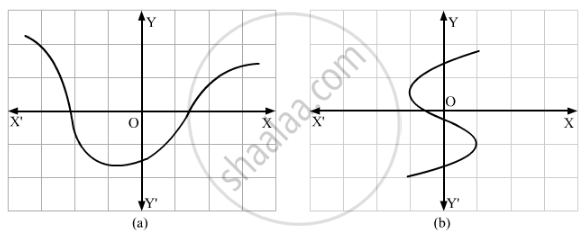
If f : R → R is defined by f(x) = x2, write f−1 (25)
If f : R → R, g : R → are given by f(x) = (x + 1)2 and g(x) = x2 + 1, then write the value of fog (−3).
If f : R → R is defined by f(x) = 3x + 2, find f (f (x)).
Let
f : R → R be given by
\[f\left( x \right) = \left[ x^2 \right] + \left[ x + 1 \right] - 3\]
where [x] denotes the greatest integer less than or equal to x. Then, f(x) is
(d) one-one and onto
Let
\[f : R - \left\{ n \right\} \to R\]
Let \[f\left( x \right) = x^2 and g\left( x \right) = 2^x\] Then, the solution set of the equation
Let \[f\left( x \right) = \frac{\alpha x}{x + 1}, x \neq - 1\] Then, for what value of α is \[f \left( f\left( x \right) \right) = x?\]
Let f: R → R be the function defined by f(x) = 4x – 3 ∀ x ∈ R. Then write f–1
Let D be the domain of the real valued function f defined by f(x) = `sqrt(25 - x^2)`. Then, write D
Let f: R → R be the function defined by f(x) = 2x – 3 ∀ x ∈ R. write f–1
Are the following set of ordered pairs functions? If so, examine whether the mapping is injective or surjective.
{(a, b): a is a person, b is an ancestor of a}
The function f : R → R defined by f(x) = 3 – 4x is ____________.
The function f : R → R given by f(x) = x3 – 1 is ____________.
If N be the set of all-natural numbers, consider f: N → N such that f(x) = 2x, ∀ x ∈ N, then f is ____________.
Let f : R `->` R be a function defined by f(x) = x3 + 4, then f is ______.
An organization conducted a bike race under 2 different categories-boys and girls. Totally there were 250 participants. Among all of them finally, three from Category 1 and two from Category 2 were selected for the final race. Ravi forms two sets B and G with these participants for his college project. Let B = {b1,b2,b3} G={g1,g2} where B represents the set of boys selected and G the set of girls who were selected for the final race.
Ravi decides to explore these sets for various types of relations and functions.
- Let R: B → G be defined by R = { (b1,g1), (b2,g2),(b3,g1)}, then R is ____________.
An organization conducted a bike race under 2 different categories-boys and girls. Totally there were 250 participants. Among all of them finally, three from Category 1 and two from Category 2 were selected for the final race. Ravi forms two sets B and G with these participants for his college project. Let B = {b1,b2,b3} G={g1,g2} where B represents the set of boys selected and G the set of girls who were selected for the final race.
Ravi decides to explore these sets for various types of relations and functions.
- Ravi wants to find the number of injective functions from B to G. How many numbers of injective functions are possible?
The solution set of the inequation log1/3(x2 + x + 1) + 1 > 0 is ______.
If f: [0, 1]→[0, 1] is defined by f(x) = `(x + 1)/4` and `d/(dx) underbrace(((fofof......of)(x)))_("n" "times")""|_(x = 1/2) = 1/"m"^"n"`, m ∈ N, then the value of 'm' is ______.
Which condition represents a one-one (injective) function?
Which condition represents an onto (surjective) function?
Which condition represents an into function?
