Advertisements
Advertisements
Question
The function f(x) = [x], where [x] denotes the greatest integer less than or equal to x; is continuous at ______.
Options
x = 1
x = 1.5
x = – 2
x = 1
Advertisements
Solution
The function f(x) = [x], where [x] denotes the greatest integer less than or equal to x; is continuous at x = 1.5.
Explanation:
We know that the biggest integer function is continuous only on non-integral points, not on integers.
APPEARS IN
RELATED QUESTIONS
Given examples of two functions f: N → N and g: N → N such that gof is onto but f is not onto.
(Hint: Consider f(x) = x + 1 and `g(x) = {(x-1, ifx >1),(1, if x = 1):}`
Classify the following function as injection, surjection or bijection :
f : R → R, defined by f(x) = `x/(x^2 +1)`
Let A = [-1, 1]. Then, discuss whether the following function from A to itself is one-one, onto or bijective : g(x) = |x|
Give examples of two one-one functions f1 and f2 from R to R, such that f1 + f2 : R → R. defined by (f1 + f2) (x) = f1 (x) + f2 (x) is not one-one.
If f : A → B and g : B → C are onto functions, show that gof is a onto function.
Find fog and gof if : f(x) = sin−1 x, g(x) = x2
Which of the following graphs represents a one-one function?
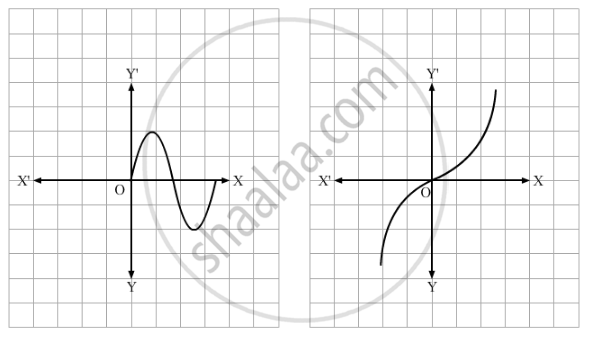
Let C denote the set of all complex numbers. A function f : C → C is defined by f(x) = x3. Write f−1(1).
If f : C → C is defined by f(x) = (x − 2)3, write f−1 (−1).
Write the domain of the real function
`f (x) = sqrt([x] - x) .`
What is the range of the function
`f (x) = ([x - 1])/(x -1) ?`
Let M be the set of all 2 × 2 matrices with entries from the set R of real numbers. Then, the function f : M→ R defined by f(A) = |A| for every A ∈ M, is
Which of the following functions form Z to itself are bijections?
Let \[f\left( x \right) = x^2 and g\left( x \right) = 2^x\] Then, the solution set of the equation
If the function
\[f : R \to R\] be such that
\[f\left( x \right) = x - \left[ x \right]\] where [x] denotes the greatest integer less than or equal to x, then \[f^{- 1} \left( x \right)\]
Let [x] denote the greatest integer less than or equal to x. If \[f\left( x \right) = \sin^{- 1} x, g\left( x \right) = \left[ x^2 \right]\text{ and } h\left( x \right) = 2x, \frac{1}{2} \leq x \leq \frac{1}{\sqrt{2}}\]
Mark the correct alternative in the following question:
If the set A contains 5 elements and the set B contains 6 elements, then the number of one-one and onto mappings from A to B is
Mark the correct alternative in the following question:
If the set A contains 7 elements and the set B contains 10 elements, then the number one-one functions from A to B is
Show that the function f: R → R defined by f(x) = `x/(x^2 + 1)`, ∀ ∈ + R , is neither one-one nor onto
The function f : A → B defined by f(x) = 4x + 7, x ∈ R is ____________.
Let f : R `->` R be a function defined by f(x) = x3 + 4, then f is ______.
Let f : R → R, g : R → R be two functions such that f(x) = 2x – 3, g(x) = x3 + 5. The function (fog)-1 (x) is equal to ____________.
An organization conducted a bike race under 2 different categories-boys and girls. Totally there were 250 participants. Among all of them finally, three from Category 1 and two from Category 2 were selected for the final race. Ravi forms two sets B and G with these participants for his college project. Let B = {b1,b2,b3} G={g1,g2} where B represents the set of boys selected and G the set of girls who were selected for the final race.
Ravi decides to explore these sets for various types of relations and functions.
- Ravi wants to know among those relations, how many functions can be formed from B to G?
Let f: R → R defined by f(x) = x4. Choose the correct answer
Let [x] denote the greatest integer ≤ x, where x ∈ R. If the domain of the real valued function f(x) = `sqrt((|[x]| - 2)/(|[x]| - 3)` is (–∞, a) ∪ [b, c) ∪ [4, ∞), a < b < c, then the value of a + b + c is ______.
Difference between the greatest and least value of f(x) = `(1 + (cos^-1x)/π)^2 - (1 + (sin^-1x)/π)^2` is ______.
The graph of the function y = f(x) is symmetrical about the line x = 2, then ______.
Let f(x) be a polynomial of degree 3 such that f(k) = `-2/k` for k = 2, 3, 4, 5. Then the value of 52 – 10f(10) is equal to ______.
A function is called into if:
