Advertisements
Advertisements
Question
Prove that the function f : N → N, defined by f(x) = x2 + x + 1, is one-one but not onto
Advertisements
Solution
f : N → N, defined by f(x) = x2 + x + 1
Injectivity:
Let x and y be any two elements in the domain (N), such that f(x) = f(y).
⇒ `x^2 + x +1 = y^2 + y +1`
⇒ `(x^2 - y^2 ) + (x - y ) = 0 `
⇒ (x +y) (x- y ) + (x-y ) = 0
⇒ ( x - y) ( x + y + 1) = 0
⇒ x - y = 0 [ x + y + 1 can not be zero because x and y are natural numbers
⇒ x =y
So, f is one-one.
Surjectivity:
when x = 1
`x^2 + x +1 = 1 +1 +1 = 3`
⇒ x + x +1 ≥ 3 , for every x in N.
⇒ f(x) will not assume the values 1 and 2.
So, F is not onto.
APPEARS IN
RELATED QUESTIONS
Check the injectivity and surjectivity of the following function:
f : N → N given by f(x) = x2
Let A = {1, 2, 3}, B = {4, 5, 6, 7} and let f = {(1, 4), (2, 5), (3, 6)} be a function from A to B. Show that f is one-one.
Classify the following function as injection, surjection or bijection :
f : Q − {3} → Q, defined by `f (x) = (2x +3)/(x-3)`
Classify the following function as injection, surjection or bijection :
f : Q → Q, defined by f(x) = x3 + 1
Set of ordered pair of a function? If so, examine whether the mapping is injective or surjective :{(x, y) : x is a person, y is the mother of x}
Let A = {1, 2, 3}. Write all one-one from A to itself.
Show that the logarithmic function f : R0+ → R given by f (x) loga x ,a> 0 is a bijection.
Find gof and fog when f : R → R and g : R → R is defined by f(x) = 8x3 and g(x) = x1/3.
Let A = {1, 2, 3, 4}; B = {3, 5, 7, 9}; C = {7, 23, 47, 79} and f : A → B, g : B → C be defined as f(x) = 2x + 1 and g(x) = x2 − 2. Express (gof)−1 and f−1 og−1 as the sets of ordered pairs and verify that (gof)−1 = f−1 og−1.
Consider f : R → R+ → [4, ∞) given by f(x) = x2 + 4. Show that f is invertible with inverse f−1 of f given by f−1 `(x)= sqrt (x-4)` where R+ is the set of all non-negative real numbers.
Which one of the following graphs represents a function?
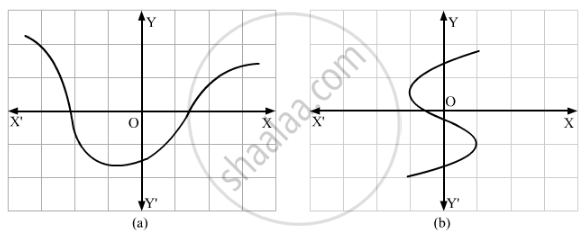
Let C denote the set of all complex numbers. A function f : C → C is defined by f(x) = x3. Write f−1(1).
If f : C → C is defined by f(x) = x4, write f−1 (1).
Let \[f : \left( - \frac{\pi}{2}, \frac{\pi}{2} \right) \to R\] be a function defined by f(x) = cos [x]. Write range (f).
Let f : R − {−1} → R − {1} be given by\[f\left( x \right) = \frac{x}{x + 1} . \text{Write } f^{- 1} \left( x \right)\]
Let `f : R - {- 3/5}` → R be a function defined as `f (x) = (2x)/(5x +3).`
f-1 : Range of f → `R -{-3/5}`.
Write the domain of the real function
`f (x) = 1/(sqrt([x] - x)`.
If f : {5, 6} → {2, 3} and g : {2, 3} → {5, 6} are given by f = {(5, 2), (6, 3)} and g = {(2, 5), (3, 6)}, then find fog. [NCERT EXEMPLAR]
Write the domain of the real function f defined by f(x) = `sqrt (25 -x^2)` [NCERT EXEMPLAR]
If a function\[f : [2, \infty )\text{ to B defined by f}\left( x \right) = x^2 - 4x + 5\] is a bijection, then B =
The function
\[f : R \to R\] defined by\[f\left( x \right) = \left( x - 1 \right) \left( x - 2 \right) \left( x - 3 \right)\]
(a) one-one but not onto
(b) onto but not one-one
(c) both one and onto
(d) neither one-one nor onto
Let
Which of the following functions from
\[A = \left\{ x \in R : - 1 \leq x \leq 1 \right\}\]
If \[g \left( f \left( x \right) \right) = \left| \sin x \right| \text{and} f \left( g \left( x \right) \right) = \left( \sin \sqrt{x} \right)^2 , \text{then}\]
If \[g\left( x \right) = x^2 + x - 2\text{ and} \frac{1}{2} gof\left( x \right) = 2 x^2 - 5x + 2\] is equal to
Mark the correct alternative in the following question:
If the set A contains 7 elements and the set B contains 10 elements, then the number one-one functions from A to B is
Write about strlen() function.
Let f: R → R be defined by f(x) = x2 + 1. Then, pre-images of 17 and – 3, respectively, are ______.
If f(x) = (4 – (x – 7)3}, then f–1(x) = ______.
The smallest integer function f(x) = [x] is ____________.
The function f : R → R defined by f(x) = 3 – 4x is ____________.
The mapping f : N → N is given by f(n) = 1 + n2, n ∈ N when N is the set of natural numbers is ____________.
The function f: R → R defined as f(x) = x3 is:
Raji visited the Exhibition along with her family. The Exhibition had a huge swing, which attracted many children. Raji found that the swing traced the path of a Parabola as given by y = x2.
Answer the following questions using the above information.
- Let f: N → N be defined by f(x) = x2 is ____________.
Let f(x) = ax (a > 0) be written as f(x) = f1(x) + f2(x), where f1(x) is an even function and f2(x) is an odd function. Then f1(x + y) + f1(x – y) equals ______.
If A = {x ∈ R: |x – 2| > 1}, B = `{x ∈ R : sqrt(x^2 - 3) > 1}`, C = {x ∈ R : |x – 4| ≥ 2} and Z is the set of all integers, then the number of subsets of the set (A ∩ B ∩ C) C ∩ Z is ______.
Which one of the following graphs is a function of x?
 |
 |
| Graph A | Graph B |
Which condition represents a many-one function?
