Advertisements
Advertisements
Question
Find gof and fog when f : R → R and g : R → R is defined by f(x) = x2 + 8 and g(x) = 3x3 + 1 .
Advertisements
Solution
Given, f : R → R and g : R → R
So, gof : R → R and fog : R → R
f(x) = x2 + 8 and g(x) = 3x3 + 1
(gof) (x)
= g ( f (x))
= g ( x2 + 8 )
= 3 ( x 2+8 )3 + 1
(fog) (x)
= f ( g ( x ))
= f ( 3x3 + 1 )
= ( 3x3+1 )2 + 8
= 9x6 + 6x3+ 1+ 8
=9x6+6x3+9
APPEARS IN
RELATED QUESTIONS
Check the injectivity and surjectivity of the following function:
f : Z → Z given by f(x) = x2
Let f : R → R be defined as f(x) = 3x. Choose the correct answer.
Let f: R → R be defined as f(x) = 10x + 7. Find the function g: R → R such that g o f = f o g = 1R.
Given examples of two functions f: N → N and g: N → N such that gof is onto but f is not onto.
(Hint: Consider f(x) = x + 1 and `g(x) = {(x-1, ifx >1),(1, if x = 1):}`
Classify the following function as injection, surjection or bijection :
f : R → R, defined by f(x) = sinx
Classify the following function as injection, surjection or bijection :
f : Q − {3} → Q, defined by `f (x) = (2x +3)/(x-3)`
Classify the following function as injection, surjection or bijection :
f : R → R, defined by f(x) = 1 + x2
Let A = {1, 2, 3}. Write all one-one from A to itself.
Give examples of two surjective functions f1 and f2 from Z to Z such that f1 + f2 is not surjective.
Find gof and fog when f : R → R and g : R → R is defined by f(x) = 2x + x2 and g(x) = x3
Let f = {(3, 1), (9, 3), (12, 4)} and g = {(1, 3), (3, 3) (4, 9) (5, 9)}. Show that gof and fog are both defined. Also, find fog and gof.
Let R+ be the set of all non-negative real numbers. If f : R+ → R+ and g : R+ → R+ are defined as `f(x)=x^2` and `g(x)=+sqrtx` , find fog and gof. Are they equal functions ?
Find fog and gof if : f (x) = x2 g(x) = cos x .
Find fog and gof if : f (x) = |x|, g (x) = sin x .
Let f be a real function given by f (x)=`sqrt (x-2)`
Find each of the following:
(i) fof
(ii) fofof
(iii) (fofof) (38)
(iv) f2
Also, show that fof ≠ `f^2` .
State with reason whether the following functions have inverse:
h : {2, 3, 4, 5} → {7, 9, 11, 13} with h = {(2, 7), (3, 9), (4, 11), (5, 13)}
Consider f : {1, 2, 3} → {a, b, c} and g : {a, b, c} → {apple, ball, cat} defined as f (1) = a, f (2) = b, f (3) = c, g (a) = apple, g (b) = ball and g (c) = cat. Show that f, g and gof are invertible. Find f−1, g−1 and gof−1and show that (gof)−1 = f −1o g−1
Let f be a function from R to R, such that f(x) = cos (x + 2). Is f invertible? Justify your answer.
Which of the following graphs represents a one-one function?
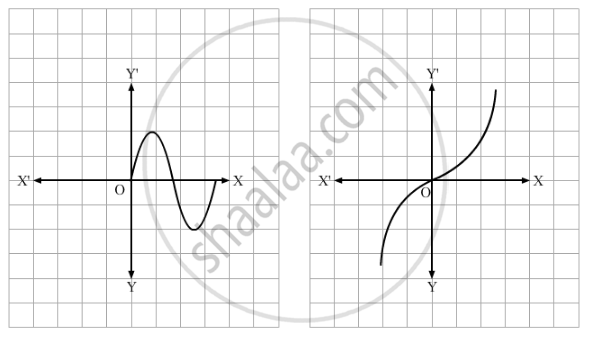
If A = {a, b, c} and B = {−2, −1, 0, 1, 2}, write the total number of one-one functions from A to B.
If f : R → R is given by f(x) = x3, write f−1 (1).
If f : {5, 6} → {2, 3} and g : {2, 3} → {5, 6} are given by f = {(5, 2), (6, 3)} and g = {(2, 5), (3, 6)}, then find fog. [NCERT EXEMPLAR]
If f(x) = 4 −( x - 7)3 then write f-1 (x).
If the function\[f : R \to \text{A given by} f\left( x \right) = \frac{x^2}{x^2 + 1}\] is a surjection, then A =
Let
\[f : R - \left\{ n \right\} \to R\]
Let
Let
\[A = \left\{ x \in R : x \leq 1 \right\} and f : A \to A\] be defined as
\[f\left( x \right) = x \left( 2 - x \right)\] Then,
\[f^{- 1} \left( x \right)\] is
If \[g\left( x \right) = x^2 + x - 2\text{ and} \frac{1}{2} gof\left( x \right) = 2 x^2 - 5x + 2\] is equal to
Write about strcmp() function.
Are the following set of ordered pairs functions? If so, examine whether the mapping is injective or surjective.
{(a, b): a is a person, b is an ancestor of a}
Let f : [0, ∞) → [0, 2] be defined by `"f" ("x") = (2"x")/(1 + "x"),` then f is ____________.
Range of `"f"("x") = sqrt((1 - "cos x") sqrt ((1 - "cos x")sqrt ((1 - "cos x")....infty))`
If f: R→R is a function defined by f(x) = `[x - 1]cos((2x - 1)/2)π`, where [ ] denotes the greatest integer function, then f is ______.
Let [x] denote the greatest integer ≤ x, where x ∈ R. If the domain of the real valued function f(x) = `sqrt((|[x]| - 2)/(|[x]| - 3)` is (–∞, a) ∪ [b, c) ∪ [4, ∞), a < b < c, then the value of a + b + c is ______.
For x ∈ R, x ≠ 0, let f0(x) = `1/(1 - x)` and fn+1 (x) = f0(fn(x)), n = 0, 1, 2, .... Then the value of `f_100(3) + f_1(2/3) + f_2(3/2)` is equal to ______.
A function is a rule that assigns each element of one set to exactly how many elements of another set?
