Advertisements
Advertisements
Question
Let f : N → N be defined by
`f(n) = { (n+ 1, if n is odd),( n-1 , if n is even):}`
Show that f is a bijection.
[CBSE 2012, NCERT]
Advertisements
Solution
We have,
`f (n) = {(n + 1 , if n is odd),(n - 1, if n is even):}`
Injection test :
Case I: If n is odd,
Let x, y ∈ N such that f (x)=f (y)
As, f (x)=f (y)
⇒ x + 1= y + 1
⇒ x = y
Case II: If n is even,
Let x, y ∈ N such that f (x)=f (y)
As, f (x)=f (y)
⇒ x − 1 = y − 1
⇒ x = y
So, f is injective.
Surjection test:
Case I: If n is odd,
As, for every n ∈ N, there exists y = n − 1 in N such that
f (y) = f (n−1)=n −1+1= n
Case II: If n is even,
As, for every n ∈ N, there exists y = n + 1 in N such that f (y)=f (n+1)=n +1−1 = n
So, f is surjective.
So, f is a bijection.
APPEARS IN
RELATED QUESTIONS
Check the injectivity and surjectivity of the following function:
f : R → R given by f(x) = x2
Given examples of two functions f: N → N and g: N → N such that gof is onto but f is not onto.
(Hint: Consider f(x) = x + 1 and `g(x) = {(x-1, ifx >1),(1, if x = 1):}`
Classify the following function as injection, surjection or bijection :
f : R → R, defined by f(x) = x3 + 1
Classify the following function as injection, surjection or bijection :
f : Q − {3} → Q, defined by `f (x) = (2x +3)/(x-3)`
If f : A → B is an injection, such that range of f = {a}, determine the number of elements in A.
Let A = [-1, 1]. Then, discuss whether the following function from A to itself is one-one, onto or bijective : `f (x) = x/2`
Let A = [-1, 1]. Then, discuss whether the following function from A to itself is one-one, onto or bijective : g(x) = |x|
If f : R → R be the function defined by f(x) = 4x3 + 7, show that f is a bijection.
Show that f : R→ R, given by f(x) = x — [x], is neither one-one nor onto.
Find gof and fog when f : R → R and g : R → R is defined by f(x) = 2x + 3 and g(x) = x2 + 5 .
Find fog and gof if : f (x) = ex g(x) = loge x .
Find fog and gof if : f(x) = sin−1 x, g(x) = x2
Find f −1 if it exists : f : A → B, where A = {0, −1, −3, 2}; B = {−9, −3, 0, 6} and f(x) = 3 x.
Consider f : R → R given by f(x) = 4x + 3. Show that f is invertible. Find the inverse of f.
A function f : R → R is defined as f(x) = x3 + 4. Is it a bijection or not? In case it is a bijection, find f−1 (3).
Which one of the following graphs represents a function?
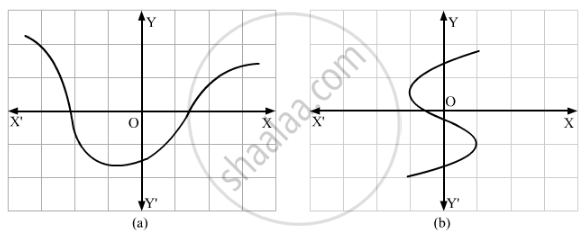
Write whether f : R → R, given by `f(x) = x + sqrtx^2` is one-one, many-one, onto or into.
Let f : R → R be the function defined by f(x) = 4x − 3 for all x ∈ R Then write f . [NCERT EXEMPLAR]
The function f : R → R defined by
`f (x) = 2^x + 2^(|x|)` is
If the function\[f : R \to \text{A given by} f\left( x \right) = \frac{x^2}{x^2 + 1}\] is a surjection, then A =
The function f : [-1/2, 1/2, 1/2] → [-π /2,π/2], defined by f (x) = `sin^-1` (3x - `4x^3`), is
Let
\[A = \left\{ x \in R : x \geq 1 \right\}\] The inverse of the function,
\[f : A \to A\] given by
\[f\left( x \right) = 2^{x \left( x - 1 \right)} , is\]
Write about strlen() function.
Let f, g: R → R be two functions defined as f(x) = |x| + x and g(x) = x – x ∀ x ∈ R. Then, find f o g and g o f
Let f: R → R be defined by f(x) = 3x – 4. Then f–1(x) is given by ______.
Let f: R → R be defined by f(x) = x2 + 1. Then, pre-images of 17 and – 3, respectively, are ______.
Are the following set of ordered pairs functions? If so, examine whether the mapping is injective or surjective.
{(a, b): a is a person, b is an ancestor of a}
If f(x) = (4 – (x – 7)3}, then f–1(x) = ______.
The smallest integer function f(x) = [x] is ____________.
If N be the set of all-natural numbers, consider f: N → N such that f(x) = 2x, ∀ x ∈ N, then f is ____________.
A general election of Lok Sabha is a gigantic exercise. About 911 million people were eligible to vote and voter turnout was about 67%, the highest ever

Let I be the set of all citizens of India who were eligible to exercise their voting right in the general election held in 2019. A relation ‘R’ is defined on I as follows:
R = {(V1, V2) ∶ V1, V2 ∈ I and both use their voting right in the general election - 2019}
- Three friends F1, F2, and F3 exercised their voting right in general election-2019, then which of the following is true?
Let f: R→R be a continuous function such that f(x) + f(x + 1) = 2, for all x ∈ R. If I1 = `int_0^8f(x)dx` and I2 = `int_(-1)^3f(x)dx`, then the value of I1 + 2I2 is equal to ______.
Consider a set containing function A= {cos–1cosx, sin(sin–1x), sinx((sinx)2 – 1), etan{x}, `e^(|cosx| + |sinx|)`, sin(tan(cosx)), sin(tanx)}. B, C, D, are subsets of A, such that B contains periodic functions, C contains even functions, D contains odd functions then the value of n(B ∩ C) + n(B ∩ D) is ______ where {.} denotes the fractional part of functions)
Difference between the greatest and least value of f(x) = `(1 + (cos^-1x)/π)^2 - (1 + (sin^-1x)/π)^2` is ______.
The graph of the function y = f(x) is symmetrical about the line x = 2, then ______.
For \(f(x)=x^2+x\), if \(y=1\), which two domain elements have the same image?
For \(f:\mathbb{R}\to\mathbb{R}\) defined by \(f(x)=1+x^2\), which statement is correct?
If every seat in a classroom is occupied by one student, the situation resembles:
