Advertisements
Advertisements
Question
Let R be the set of real numbers and f: R → R be the function defined by f(x) = 4x + 5. Show that f is invertible and find f–1.
Advertisements
Solution
Here the function f : R → R is defined as f (x) = 4x + 5 = y (say). Then
4x = y – 5 or x = `(y - 5)/4`.
This leads to a function g: R → R defined as
g(y) = `(y - 5)/4`.
Therefore, (gof) (x) = g(f(x) = g(4x + 5)
= `(4x + 5 - 5)/4`
= x
or
gof = IR
Similarly (fog) (y) = f(g(y))
= `f((y - 5)/4)`
= `4((y - 5)/4) + 5`
= y
or
fog = IR
Hence f is invertible and f-1 = g which is given by `f^-1 (x) = (x - 5)/4`
APPEARS IN
RELATED QUESTIONS
Show that the function f in `A=R-{2/3} ` defined as `f(x)=(4x+3)/(6x-4)` is one-one and onto hence find f-1
Check the injectivity and surjectivity of the following function:
f : Z → Z given by f(x) = x2
In the following case, state whether the function is one-one, onto or bijective. Justify your answer.
f : R → R defined by f(x) = 3 – 4x
Show that the function f : R → R given by f(x) = x3 is injective.
Give an example of a function which is neither one-one nor onto ?
Prove that the function f : N → N, defined by f(x) = x2 + x + 1, is one-one but not onto
Classify the following function as injection, surjection or bijection :
f : Z → Z, defined by f(x) = x − 5
Classify the following function as injection, surjection or bijection :
f : R → R, defined by f(x) = x3 − x
Consider f : N → N, g : N → N and h : N → R defined as f(x) = 2x, g(y) = 3y + 4 and h(z) = sin z for all x, y, z ∈ N. Show that ho (gof) = (hog) of.
Let f be any real function and let g be a function given by g(x) = 2x. Prove that gof = f + f.
if f (x) = `sqrt (x +3) and g (x) = x ^2 + 1` be two real functions, then find fog and gof.
If A = {1, 2, 3, 4} and B = {a, b, c, d}, define any four bijections from A to B. Also give their inverse functions.
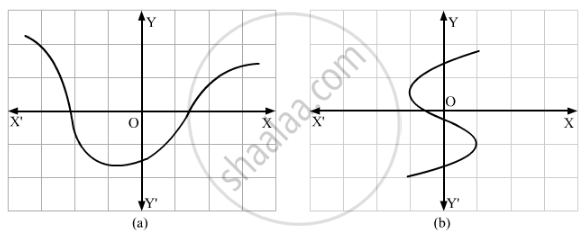
Which one of the following graphs represents a function?
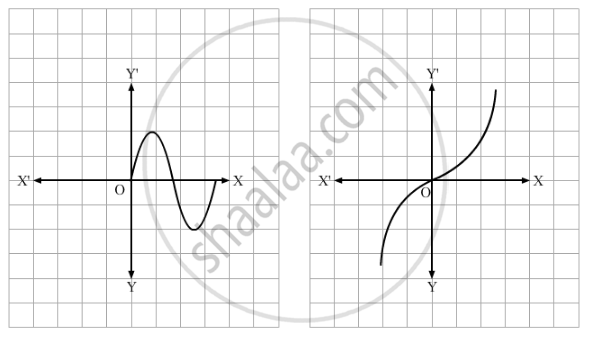
Which of the following graphs represents a one-one function?
Let `f : R - {- 3/5}` → R be a function defined as `f (x) = (2x)/(5x +3).`
f-1 : Range of f → `R -{-3/5}`.
If f : {5, 6} → {2, 3} and g : {2, 3} → {5, 6} are given by f = {(5, 2), (6, 3)} and g = {(2, 5), (3, 6)}, then find fog. [NCERT EXEMPLAR]
Let A = {a, b, c, d} and f : A → A be given by f = {( a,b ),( b , d ),( c , a ) , ( d , c )} write `f^-1`. [NCERT EXEMPLAR]
\[f : A \to \text{B given by } 3^{ f\left( x \right)} + 2^{- x} = 4\] is a bijection, then
Let the function
\[f : R - \left\{ - b \right\} \to R - \left\{ 1 \right\}\]
\[f\left( x \right) = \frac{x + a}{x + b}, a \neq b .\text{Then},\]
The function \[f : [0, \infty ) \to \text {R given by } f\left( x \right) = \frac{x}{x + 1} is\]
Which of the following functions from
\[A = \left\{ x \in R : - 1 \leq x \leq 1 \right\}\]
If \[g\left( x \right) = x^2 + x - 2\text{ and} \frac{1}{2} gof\left( x \right) = 2 x^2 - 5x + 2\] is equal to
Let A = R − (2) and B = R − (1). If f: A ⟶ B is a function defined by`"f(x)"=("x"-1)/("x"-2),` how that f is one-one and onto. Hence, find f−1.
If A = {a, b, c, d} and f = {a, b), (b, d), (c, a), (d, c)}, show that f is one-one from A onto A. Find f–1
Let f: R → R be the function defined by f(x) = 2x – 3 ∀ x ∈ R. write f–1
Let f: R → R be the functions defined by f(x) = x3 + 5. Then f–1(x) is ______.
Let A = {0, 1} and N be the set of natural numbers. Then the mapping f: N → A defined by f(2n – 1) = 0, f(2n) = 1, ∀ n ∈ N, is onto.
The function f : A → B defined by f(x) = 4x + 7, x ∈ R is ____________.
Raji visited the Exhibition along with her family. The Exhibition had a huge swing, which attracted many children. Raji found that the swing traced the path of a Parabola as given by y = x2.
Answer the following questions using the above information.
- The function f: Z → Z defined by f(x) = x2 is ____________.
If f; R → R f(x) = 10x + 3 then f–1(x) is:
Consider a set containing function A= {cos–1cosx, sin(sin–1x), sinx((sinx)2 – 1), etan{x}, `e^(|cosx| + |sinx|)`, sin(tan(cosx)), sin(tanx)}. B, C, D, are subsets of A, such that B contains periodic functions, C contains even functions, D contains odd functions then the value of n(B ∩ C) + n(B ∩ D) is ______ where {.} denotes the fractional part of functions)
The domain of function is f(x) = `sqrt(-log_0.3(x - 1))/sqrt(x^2 + 2x + 8)` is ______.
The graph of the function y = f(x) is symmetrical about the line x = 2, then ______.
For x ∈ R, x ≠ 0, let f0(x) = `1/(1 - x)` and fn+1 (x) = f0(fn(x)), n = 0, 1, 2, .... Then the value of `f_100(3) + f_1(2/3) + f_2(3/2)` is equal to ______.
ASSERTION (A): The relation f : {1, 2, 3, 4} `rightarrow` {x, y, z, p} defined by f = {(1, x), (2, y), (3, z)} is a bijective function.
REASON (R): The function f : {1, 2, 3} `rightarrow` {x, y, z, p} such that f = {(1, x), (2, y), (3, z)} is one-one.
Find the domain of sin–1 (x2 – 4).
Let f: R→Rbe defined as f (x) = `(x^2 + 1)/2`, then ______.
A function is onto when every element of the codomain has:
Which real-life situation resembles a one-one idea when no roll number is repeated?
