Advertisements
Advertisements
Question
Give an example of a function which is not one-one but onto ?
Advertisements
Solution
which is not one-one but onto
f: Z → N ∪ {0} given by f(x) = |x|
njectivity:
Let x and y be any two elements in the domain (Z), such that f(x) = f(y).
⇒ |x| = |y|
⇒ x= ± y
So, different elements of domain f may give the same image.
So, f is not one-one.
Surjectivity:
Let y be any element in the co domain (Z), such that f(x) = y for some element x in Z(domain).
f(x) = y
⇒ |x| = y
⇒ x = ± y
which is an element in Z (domain).
So, for every element in the co-domain, there exists a pre-image in the domain.
Thus, f is onto.
APPEARS IN
RELATED QUESTIONS
Show that the function f : R* → R* defined by f(x) = `1/x` is one-one and onto, where R* is the set of all non-zero real numbers. Is the result true, if the domain R* is replaced by N with co-domain being same as R?
Check the injectivity and surjectivity of the following function:
f : Z → Z given by f(x) = x2
Let A and B be sets. Show that f : A × B → B × A such that f(a, b) = (b, a) is bijective function.
If A = {1, 2, 3}, show that a onto function f : A → A must be one-one.
Suppose f1 and f2 are non-zero one-one functions from R to R. Is `f_1 / f^2` necessarily one - one? Justify your answer. Here,`f_1/f_2 : R → R is given by (f_1/f_2) (x) = (f_1(x))/(f_2 (x)) for all x in R .`
Find gof and fog when f : R → R and g : R → R is defined by f(x) = 8x3 and g(x) = x1/3.
Consider f : R → R+ → [4, ∞) given by f(x) = x2 + 4. Show that f is invertible with inverse f−1 of f given by f−1 `(x)= sqrt (x-4)` where R+ is the set of all non-negative real numbers.
If f : R → R be defined by f(x) = x3 −3, then prove that f−1 exists and find a formula for f−1. Hence, find f−1(24) and f−1 (5).
Consider the function f : R+ → [-9 , ∞ ]given by f(x) = 5x2 + 6x - 9. Prove that f is invertible with f -1 (y) = `(sqrt(54 + 5y) -3)/5` [CBSE 2015]
If f : R → (0, 2) defined by `f (x) =(e^x - e^(x))/(e^x +e^(-x))+1`is invertible , find f-1.
If A = {1, 2, 3, 4} and B = {a, b, c, d}, define any four bijections from A to B. Also give their inverse functions.
Let A and B be two sets, each with a finite number of elements. Assume that there is an injective map from A to B and that there is an injective map from B to A. Prove that there is a bijection from A to B.
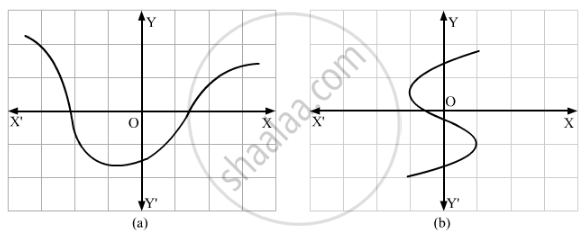
Which one of the following graphs represents a function?
Write the total number of one-one functions from set A = {1, 2, 3, 4} to set B = {a, b, c}.
If f : C → C is defined by f(x) = x4, write f−1 (1).
If f : C → C is defined by f(x) = (x − 2)3, write f−1 (−1).
Let A = {x ∈ R : −4 ≤ x ≤ 4 and x ≠ 0} and f : A → R be defined by \[f\left( x \right) = \frac{\left| x \right|}{x}\]Write the range of f.
Write the domain of the real function
`f (x) = sqrtx - [x] .`
Write the domain of the real function
`f (x) = sqrt([x] - x) .`
If f : R → R is defined by f(x) = 3x + 2, find f (f (x)).
If f(x) = 4 −( x - 7)3 then write f-1 (x).
The function
Let \[f\left( x \right) = \frac{\alpha x}{x + 1}, x \neq - 1\] Then, for what value of α is \[f \left( f\left( x \right) \right) = x?\]
Let the function f: R → R be defined by f(x) = 4x – 1, ∀ x ∈ R. Then, show that f is one-one.
If A = {a, b, c, d} and f = {a, b), (b, d), (c, a), (d, c)}, show that f is one-one from A onto A. Find f–1
Set A has 3 elements and the set B has 4 elements. Then the number of injective mappings that can be defined from A to B is ______.
Let f: R → R be the functions defined by f(x) = x3 + 5. Then f–1(x) is ______.
Let f: `[2, oo)` → R be the function defined by f(x) = x2 – 4x + 5, then the range of f is ______.
If f: R → R given by f(x) =(3 − x3)1/3, find f0f(x)
If f: R→R is a function defined by f(x) = `[x - 1]cos((2x - 1)/2)π`, where [ ] denotes the greatest integer function, then f is ______.
The solution set of the inequation log1/3(x2 + x + 1) + 1 > 0 is ______.
Consider a set containing function A= {cos–1cosx, sin(sin–1x), sinx((sinx)2 – 1), etan{x}, `e^(|cosx| + |sinx|)`, sin(tan(cosx)), sin(tanx)}. B, C, D, are subsets of A, such that B contains periodic functions, C contains even functions, D contains odd functions then the value of n(B ∩ C) + n(B ∩ D) is ______ where {.} denotes the fractional part of functions)
Difference between the greatest and least value of f(x) = `(1 + (cos^-1x)/π)^2 - (1 + (sin^-1x)/π)^2` is ______.
Let f(x) be a polynomial of degree 3 such that f(k) = `-2/k` for k = 2, 3, 4, 5. Then the value of 52 – 10f(10) is equal to ______.
For x ∈ R, x ≠ 0, let f0(x) = `1/(1 - x)` and fn+1 (x) = f0(fn(x)), n = 0, 1, 2, .... Then the value of `f_100(3) + f_1(2/3) + f_2(3/2)` is equal to ______.
The function f(x) = [x], where [x] denotes the greatest integer less than or equal to x; is continuous at ______.
A function is called one-one if different elements of the domain have:
A function is called many-one if two or more different elements of the domain have:
Which condition represents an into function?
