Advertisements
Advertisements
Question
Let A = R − (2) and B = R − (1). If f: A ⟶ B is a function defined by`"f(x)"=("x"-1)/("x"-2),` how that f is one-one and onto. Hence, find f−1.
Advertisements
Solution
A =R − {2}, B = R − {1}
f: A → B is defined as `"f"("x") = ("x"-1)/("x"-2)`.
Let x, y ∈ A such that f (x) = f (y).
⇒ `("x"-1)/("x"-2) = ("y"-1)/("y"-2)`
⇒ ( x -1) (y - 2) = (x - 2) (y - 1)
⇒ xy - 2x - y + 2 = xy - x - 2y + 2
⇒ -2x - y = -x - 2y
⇒ 2x - x = 2y - y
⇒ x = y
∴ f is one-one.
Let y ∈B = R − {1}. Then, y ≠ 1.
The function f is onto if there exists x ∈A such that f(x) = y.
Now,
f (x) = y
⇒`("x"-1)/("x"-2) = "y"`
⇒ x - 1 = y (x - 2)
⇒ x (1 - y) = 1 - 2y
⇒ `"x" = (1-2"y")/(1-"y")∈ "A"` .........[y ≠ 1]
Thus, for any y ∈ B, there exists `"x" = (1-2"y")/(1-"y")` ∈ A such that
`"f"((1-2"y")/(1-"y")) =((1-2"y")/(1-"y")-1)/((1-2"y")/(1-"y") - 2) = (1-2"y"-1+"y")/(1-2"y"-2+2"y") = (-"y")/-1 = "y"`
Therefore, f is onto.
Hence, function f is one-one and onto.
`"f"^-1("x") = (1-2"x")/(1-"x")`
APPEARS IN
RELATED QUESTIONS
Check the injectivity and surjectivity of the following function:
f : N → N given by f(x) = x2
Check the injectivity and surjectivity of the following function:
f : R → R given by f(x) = x2
Find the number of all onto functions from the set A = {1, 2, 3, ..., n} to itself.
Find gof and fog when f : R → R and g : R → R is defined by f(x) = 2x + 3 and g(x) = x2 + 5 .
Let f = {(1, −1), (4, −2), (9, −3), (16, 4)} and g = {(−1, −2), (−2, −4), (−3, −6), (4, 8)}. Show that gof is defined while fog is not defined. Also, find gof.
Let f : R → R and g : R → R be defined by f(x) = x2 and g(x) = x + 1. Show that fog ≠ gof.
If f(x) = 2x + 5 and g(x) = x2 + 1 be two real functions, then describe each of the following functions:
(1) fog
(2) gof
(3) fof
(4) f2
Also, show that fof ≠ f2
Which of the following graphs represents a one-one function?
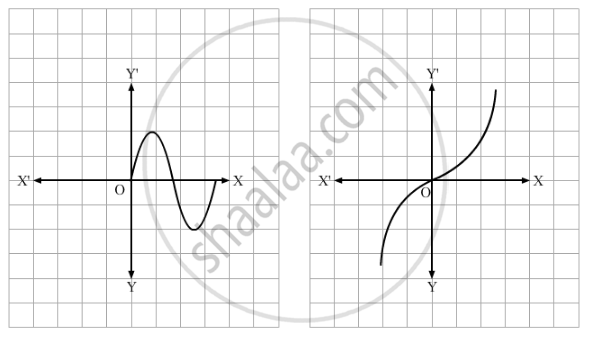
If f : R → R defined by f(x) = 3x − 4 is invertible, then write f−1 (x).
Let f : R → R be defined as `f (x) = (2x - 3)/4.` write fo f-1 (1) .
Write the domain of the real function
`f (x) = sqrtx - [x] .`
\[f : R \to R \text{given by} f\left( x \right) = x + \sqrt{x^2} \text{ is }\]
The function
f : A → B defined by
f (x) = - x2 + 6x - 8 is a bijection if
Let
\[A = \left\{ x \in R : - 1 \leq x \leq 1 \right\} = B\] Then, the mapping\[f : A \to \text{B given by} f\left( x \right) = x\left| x \right|\] is
Let [x] denote the greatest integer less than or equal to x. If \[f\left( x \right) = \sin^{- 1} x, g\left( x \right) = \left[ x^2 \right]\text{ and } h\left( x \right) = 2x, \frac{1}{2} \leq x \leq \frac{1}{\sqrt{2}}\]
A function f: R→ R defined by f(x) = `(3x) /5 + 2`, x ∈ R. Show that f is one-one and onto. Hence find f−1.
Let the function f: R → R be defined by f(x) = 4x – 1, ∀ x ∈ R. Then, show that f is one-one.
Let f, g: R → R be two functions defined as f(x) = |x| + x and g(x) = x – x ∀ x ∈ R. Then, find f o g and g o f
Let X = {1, 2, 3}and Y = {4, 5}. Find whether the following subset of X ×Y are function from X to Y or not
g = {(1, 4), (2, 4), (3, 4)}
Let A = R – {3}, B = R – {1}. Let f: A → B be defined by f(x) = `(x - 2)/(x - 3)` ∀ x ∈ A . Then show that f is bijective.
If the set A contains 5 elements and the set B contains 6 elements, then the number of one-one and onto mappings from A to B is ______.
Let A = {0, 1} and N be the set of natural numbers. Then the mapping f: N → A defined by f(2n – 1) = 0, f(2n) = 1, ∀ n ∈ N, is onto.
If `f : R -> R^+ U {0}` be defined by `f(x) = x^2, x ∈ R`. The mapping is
The domain of the function `cos^-1((2sin^-1(1/(4x^2-1)))/π)` is ______.
If f: R→R is a function defined by f(x) = `[x - 1]cos((2x - 1)/2)π`, where [ ] denotes the greatest integer function, then f is ______.
Let f: R→R be a continuous function such that f(x) + f(x + 1) = 2, for all x ∈ R. If I1 = `int_0^8f(x)dx` and I2 = `int_(-1)^3f(x)dx`, then the value of I1 + 2I2 is equal to ______.
Let [x] denote the greatest integer ≤ x, where x ∈ R. If the domain of the real valued function f(x) = `sqrt((|[x]| - 2)/(|[x]| - 3)` is (–∞, a) ∪ [b, c) ∪ [4, ∞), a < b < c, then the value of a + b + c is ______.
Let a and b are two positive integers such that b ≠ 1. Let g(a, b) = Number of lattice points inside the quadrilateral formed by lines x = 0, y = 0, x = b and y = a. f(a, b) = `[a/b] + [(2a)/b] + ... + [((b - 1)a)/b]`, then the value of `[(g(101, 37))/(f(101, 37))]` is ______.
(Note P(x, y) is lattice point if x, y ∈ I)
(where [.] denotes greatest integer function)
Let S = {1, 2, 3, 4, 5, 6, 7}. Then the number of possible functions f: S `rightarrow` S such that f(m.n) = f(m).f(n) for every m, n ∈ S and m.n ∈ S is equal to ______.
A perfect one-to-one matching between users and unique IDs is similar to:
