Advertisements
Advertisements
Question
Given examples of two functions f: N → N and g: N → N such that gof is onto but f is not onto.
(Hint: Consider f(x) = x + 1 and `g(x) = {(x-1, ifx >1),(1, if x = 1):}`
Advertisements
Solution
Define f: N → N by,
f(x) = x + 1
And, g: N → N by,
`g(x) = {(x -1, if x>1), (1, if x = 1):}`
We first show that g is not onto.
For this, consider element 1 in co-domain N. It is clear that this element is not an image of any of the elements in domain N.
∴ f is not onto.
Now, gof: N → N is defined by,
`gof(x) = g(f(x)) =g(x + 1) = (x +1) - 1` [x in N => (x + 1) > 1]
= x
Then, it is clear that for y ∈ N, there exists x = y ∈ N such that gof(x) = y.
Hence, gof is onto.
RELATED QUESTIONS
Prove that the greatest integer function f : R → R, given by f(x) = [x], is neither one-one nor onto, where [x] denotes the greatest integer less than or equal to x.
Show that the function f : R → {x ∈ R : –1 < x < 1} defined by f(x) = `x/(1 + |x|)`, x ∈ R is one-one and onto function.
Show that the function f : R → R given by f(x) = x3 is injective.
Classify the following function as injection, surjection or bijection : f : N → N given by f(x) = x3
Classify the following function as injection, surjection or bijection :
f : Z → Z, defined by f(x) = x2 + x
Classify the following function as injection, surjection or bijection :
f : R → R, defined by f(x) = x3 + 1
If f : A → B is an injection, such that range of f = {a}, determine the number of elements in A.
Find fog (2) and gof (1) when : f : R → R ; f(x) = x2 + 8 and g : R → R; g(x) = 3x3 + 1.
Find fog and gof if : f (x) = ex g(x) = loge x .
Find fog and gof if : f(x) = c, c ∈ R, g(x) = sin `x^2`
State with reason whether the following functions have inverse:
h : {2, 3, 4, 5} → {7, 9, 11, 13} with h = {(2, 7), (3, 9), (4, 11), (5, 13)}
Consider the function f : R+ → [-9 , ∞ ]given by f(x) = 5x2 + 6x - 9. Prove that f is invertible with f -1 (y) = `(sqrt(54 + 5y) -3)/5` [CBSE 2015]
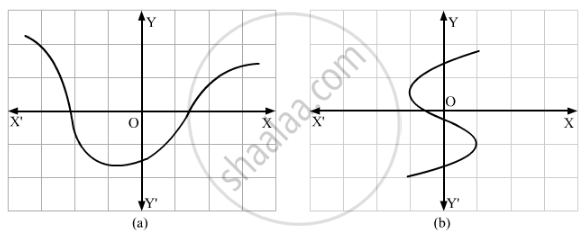
Which one of the following graphs represents a function?
If f : C → C is defined by f(x) = x4, write f−1 (1).
If f : R → R defined by f(x) = 3x − 4 is invertible, then write f−1 (x).
Write the domain of the real function
`f (x) = 1/(sqrt([x] - x)`.
Which one the following relations on A = {1, 2, 3} is a function?
f = {(1, 3), (2, 3), (3, 2)}, g = {(1, 2), (1, 3), (3, 1)} [NCERT EXEMPLAR]
If f(x) = 4 −( x - 7)3 then write f-1 (x).
Let\[A = \left\{ x \in R : - 1 \leq x \leq 1 \right\} = \text{B and C} = \left\{ x \in R : x \geq 0 \right\} and\]\[S = \left\{ \left( x, y \right) \in A \times B : x^2 + y^2 = 1 \right\} \text{and } S_0 = \left\{ \left( x, y \right) \in A \times C : x^2 + y^2 = 1 \right\}\]
Then,
\[f : R \to R \text{given by} f\left( x \right) = x + \sqrt{x^2} \text{ is }\]
Let the function
\[f : R - \left\{ - b \right\} \to R - \left\{ 1 \right\}\]
\[f\left( x \right) = \frac{x + a}{x + b}, a \neq b .\text{Then},\]
Let
Write about strcmp() function.
If A = {a, b, c, d} and f = {a, b), (b, d), (c, a), (d, c)}, show that f is one-one from A onto A. Find f–1
Let f, g: R → R be two functions defined as f(x) = |x| + x and g(x) = x – x ∀ x ∈ R. Then, find f o g and g o f
Let A be a finite set. Then, each injective function from A into itself is not surjective.
For sets A, B and C, let f: A → B, g: B → C be functions such that g o f is injective. Then both f and g are injective functions.
If f: R → R is defined by f(x) = x2 – 3x + 2, write f(f (x))
Let the function f: R → R be defined by f(x) = cosx, ∀ x ∈ R. Show that f is neither one-one nor onto
Let A = [–1, 1]. Then, discuss whether the following functions defined on A are one-one, onto or bijective:
k(x) = x2
Let A = {1, 2, 3, ...n} and B = {a, b}. Then the number of surjections from A into B is ______.
Let f: R → R be given by f(x) = tan x. Then f–1(1) is ______.
An organization conducted a bike race under 2 different categories-boys and girls. Totally there were 250 participants. Among all of them finally, three from Category 1 and two from Category 2 were selected for the final race. Ravi forms two sets B and G with these participants for his college project. Let B = {b1,b2,b3} G={g1,g2} where B represents the set of boys selected and G the set of girls who were selected for the final race.
Ravi decides to explore these sets for various types of relations and functions.
- Ravi wants to find the number of injective functions from B to G. How many numbers of injective functions are possible?
Prove that the function f is surjective, where f: N → N such that `f(n) = {{:((n + 1)/2",", if "n is odd"),(n/2",", if "n is even"):}` Is the function injective? Justify your answer.
Let f: R→R be defined as f(x) = 2x – 1 and g: R – {1}→R be defined as g(x) = `(x - 1/2)/(x - 1)`. Then the composition function f (g(x)) is ______.
For x ∈ R, x ≠ 0, let f0(x) = `1/(1 - x)` and fn+1 (x) = f0(fn(x)), n = 0, 1, 2, .... Then the value of `f_100(3) + f_1(2/3) + f_2(3/2)` is equal to ______.
Which one of the following graphs is a function of x?
 |
 |
| Graph A | Graph B |
The function \(f:\mathbb{N}\to\mathbb{N}\) defined by \(f(x)=5x\) is:
Many students choosing the same favourite subject resembles which type of function?
