Advertisements
Advertisements
प्रश्न
If A = {1, 2, 3, 4} and B = {a, b, c, d}, define any four bijections from A to B. Also give their inverse functions.
Advertisements
उत्तर
f1={ (1, a), (2, b), (3, c), (4, d)} ⇒ f1−1 ={(a, 1), (b, 2), (c, 3), (d, 4)}
f2={(1, b), (2, a), (3, c), (4, d)} ⇒f2−1 {(b, 1), (a, 2), (c, 3), (d, 4)}
f3= { (1, a), (2, b), (4, c), (3, d)} ⇒ f3−1 {(a, 1), (b, 2), (c, 4), (d, 3)}
f4 = {(1, b), (2, a), (4, c), (3, d)} ⇒ f4−1 = {(b, 1), (a, 2), (c, 4), (d, 3)}
Clearly, all these are bijections because they are one-one and onto.
APPEARS IN
संबंधित प्रश्न
Let f : N → N be defined by f(n) = `{((n+1)/2", if n is odd"),(n/2", if n is even"):}` for all n ∈ N.
State whether the function f is bijective. Justify your answer.
Let A = R – {3} and B = R – {1}. Consider the function f : A → B defined by f(x) = `((x - 2)/(x - 3))`. Is f one-one and onto? Justify your answer.
Which of the following functions from A to B are one-one and onto?
f2 = {(2, a), (3, b), (4, c)} ; A = {2, 3, 4}, B = {a, b, c}
Classify the following function as injection, surjection or bijection : f : Z → Z given by f(x) = x2
Classify the following function as injection, surjection or bijection :
f : R → R, defined by f(x) = x3 − x
If A = {1, 2, 3}, show that a onto function f : A → A must be one-one.
Let f : R → R and g : R → R be defined by f(x) = x2 and g(x) = x + 1. Show that fog ≠ gof.
If f(x) = |x|, prove that fof = f.
if f (x) = `sqrt (x +3) and g (x) = x ^2 + 1` be two real functions, then find fog and gof.
Let f be a real function given by f (x)=`sqrt (x-2)`
Find each of the following:
(i) fof
(ii) fofof
(iii) (fofof) (38)
(iv) f2
Also, show that fof ≠ `f^2` .
Show that the function f : Q → Q, defined by f(x) = 3x + 5, is invertible. Also, find f−1
Let A = R - {3} and B = R - {1}. Consider the function f : A → B defined by f(x) = `(x-2)/(x-3).`Show that f is one-one and onto and hence find f-1.
[CBSE 2012, 2014]
Let f : R `{- 4/3} `- 43 →">→ R be a function defined as f(x) = `(4x)/(3x +4)` . Show that f : R - `{-4/3}`→ Rang (f) is one-one and onto. Hence, find f -1.
If f : A → A, g : A → A are two bijections, then prove that fog is an injection ?
Which of the following graphs represents a one-one function?
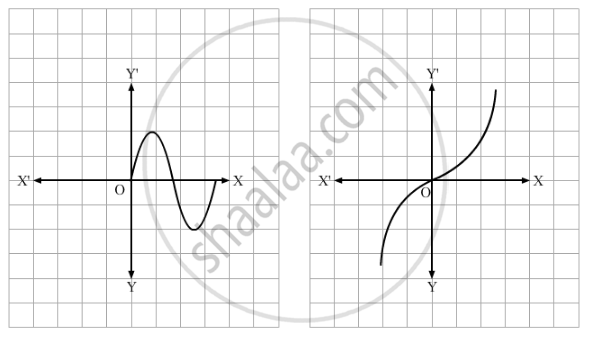
Let A = {x ∈ R : −4 ≤ x ≤ 4 and x ≠ 0} and f : A → R be defined by \[f\left( x \right) = \frac{\left| x \right|}{x}\]Write the range of f.
Let f : R → R be defined as `f (x) = (2x - 3)/4.` write fo f-1 (1) .
Which one the following relations on A = {1, 2, 3} is a function?
f = {(1, 3), (2, 3), (3, 2)}, g = {(1, 2), (1, 3), (3, 1)} [NCERT EXEMPLAR]
Let A = {a, b, c, d} and f : A → A be given by f = {( a,b ),( b , d ),( c , a ) , ( d , c )} write `f^-1`. [NCERT EXEMPLAR]
The function \[f : [0, \infty ) \to \text {R given by } f\left( x \right) = \frac{x}{x + 1} is\]
Which of the following functions form Z to itself are bijections?
The function f : [-1/2, 1/2, 1/2] → [-π /2,π/2], defined by f (x) = `sin^-1` (3x - `4x^3`), is
Let
\[f : R \to R\] be a function defined by
The inverse of the function
\[f : R \to \left\{ x \in R : x < 1 \right\}\] given by
\[f\left( x \right) = \frac{e^x - e^{- x}}{e^x + e^{- x}}\] is
Mark the correct alternative in the following question:
If the set A contains 5 elements and the set B contains 6 elements, then the number of one-one and onto mappings from A to B is
Write about strcmp() function.
Let A be a finite set. Then, each injective function from A into itself is not surjective.
Are the following set of ordered pairs functions? If so, examine whether the mapping is injective or surjective.
{(a, b): a is a person, b is an ancestor of a}
Let A = {0, 1} and N be the set of natural numbers. Then the mapping f: N → A defined by f(2n – 1) = 0, f(2n) = 1, ∀ n ∈ N, is onto.
The domain of the function `"f"("x") = 1/(sqrt ({"sin x"} + {"sin" ( pi + "x")}))` where {.} denotes fractional part, is
Consider a function f: `[0, pi/2] ->` R, given by f(x) = sinx and `g[0, pi/2] ->` R given by g(x) = cosx then f and g are
Let f(x) = ax (a > 0) be written as f(x) = f1(x) + f2(x), where f1(x) is an even function and f2(x) is an odd function. Then f1(x + y) + f1(x – y) equals ______.
Let S = {1, 2, 3, 4, 5, 6, 7}. Then the number of possible functions f: S `rightarrow` S such that f(m.n) = f(m).f(n) for every m, n ∈ S and m.n ∈ S is equal to ______.
Let f(x) be a polynomial function of degree 6 such that `d/dx (f(x))` = (x – 1)3 (x – 3)2, then
Assertion (A): f(x) has a minimum at x = 1.
Reason (R): When `d/dx (f(x)) < 0, ∀ x ∈ (a - h, a)` and `d/dx (f(x)) > 0, ∀ x ∈ (a, a + h)`; where 'h' is an infinitesimally small positive quantity, then f(x) has a minimum at x = a, provided f(x) is continuous at x = a.
ASSERTION (A): The relation f : {1, 2, 3, 4} `rightarrow` {x, y, z, p} defined by f = {(1, x), (2, y), (3, z)} is a bijective function.
REASON (R): The function f : {1, 2, 3} `rightarrow` {x, y, z, p} such that f = {(1, x), (2, y), (3, z)} is one-one.
Find the domain of sin–1 (x2 – 4).
If f : R `rightarrow` R is defined by `f(x) = (2x - 7)/4`, show that f(x) is one-one and onto.
The function \(f:\mathbb{N}\to\mathbb{N}\) defined by \(f(x)=5x\) is:
