Advertisements
Advertisements
प्रश्न
Let A = {–1, 0, 1, 2}, B = {–4, –2, 0, 2} and f, g : A → B be functions defined by f(x) = x2 – x, x ∈ A and g(x) = `2|x - 1/2| – 1`, x ∈ A. Are f and g equal?
Justify your answer. (Hint: One may note that two functions f : A → B and g : A → B such that f(a) = g(a) ∀ a ∈ A are called equal functions.)
Advertisements
उत्तर
It is given that A = {–1, 0, 1, 2}, B = {–4, –2, 0, 2}.
Also, it is given that f, g: A → B are defined by f(x) = x2 – x, x ∈ A and `g(x) = 2|x - 1/2| - 1, x ∈ A`.
It is observed that:
When x = –1,
f(–1) = 12 – (–1)
= 1 + 1
= 2
g(–1) = `2|(-1)-1/2| - 1`
= `2(3/2) - 1`
= 3 – 1
= 2
⇒ f(–1) = g(–1)
When x = 0,
f(0) = (0)2 – 0 = 0
g(0) = `2|0 - 1/2| - 1`
= `2(1/2) - 1`
= 1 – 1
= 0
⇒ f(0) = g(0)
When x = 1,
f(1) = (1)2 – 1
= 1 – 1
= 0
g(1) = `2|1 - 1/2| - 1`
= `2(1/2) - 1`
= 1 – 1
= 0
⇒ f(1) = g(1)
When x = 2,
f(2) = (2)2 – 2
= 4 – 2
= 2
g(2) = `2|2-1/2| - 1`
= `2(3/2)-1`
= 3 – 1
= 2
⇒ f(2) = g(2)
∴ f(a) = g(a) ∀ a ∈ A
Hence, the functions f and g are equal.
APPEARS IN
संबंधित प्रश्न
Show that the function f in `A=R-{2/3} ` defined as `f(x)=(4x+3)/(6x-4)` is one-one and onto hence find f-1
Check the injectivity and surjectivity of the following function:
f : Z → Z given by f(x) = x3
If the function `f(x) = sqrt(2x - 3)` is invertible then find its inverse. Hence prove that `(fof^(-1))(x) = x`
Give an example of a function which is one-one but not onto ?
Classify the following function as injection, surjection or bijection : f : N → N given by f(x) = x2
Classify the following function as injection, surjection or bijection :
f : Z → Z, defined by f(x) = x − 5
Classify the following function as injection, surjection or bijection :
f : R → R, defined by f(x) = 1 + x2
Let A = [-1, 1]. Then, discuss whether the following function from A to itself is one-one, onto or bijective : `f (x) = x/2`
Set of ordered pair of a function? If so, examine whether the mapping is injective or surjective :{(x, y) : x is a person, y is the mother of x}
Find the number of all onto functions from the set A = {1, 2, 3, ..., n} to itself.
Let f : N → N be defined by
`f(n) = { (n+ 1, if n is odd),( n-1 , if n is even):}`
Show that f is a bijection.
[CBSE 2012, NCERT]
Let A = {a, b, c}, B = {u v, w} and let f and g be two functions from A to B and from B to A, respectively, defined as :
f = {(a, v), (b, u), (c, w)}, g = {(u, b), (v, a), (w, c)}.
Show that f and g both are bijections and find fog and gof.
Let R+ be the set of all non-negative real numbers. If f : R+ → R+ and g : R+ → R+ are defined as `f(x)=x^2` and `g(x)=+sqrtx` , find fog and gof. Are they equal functions ?
Find fog and gof if : f(x) = `x^2` + 2 , g (x) = 1 − `1/ (1-x)`.
Let f(x) = x2 + x + 1 and g(x) = sin x. Show that fog ≠ gof.
` if f : (-π/2 , π/2)` → R and g : [−1, 1]→ R be defined as f(x) = tan x and g(x) = `sqrt(1 - x^2)` respectively, describe fog and gof.
Find f −1 if it exists : f : A → B, where A = {1, 3, 5, 7, 9}; B = {0, 1, 9, 25, 49, 81} and f(x) = x2
If f : R → (0, 2) defined by `f (x) =(e^x - e^(x))/(e^x +e^(-x))+1`is invertible , find f-1.
Which of the following graphs represents a one-one function?
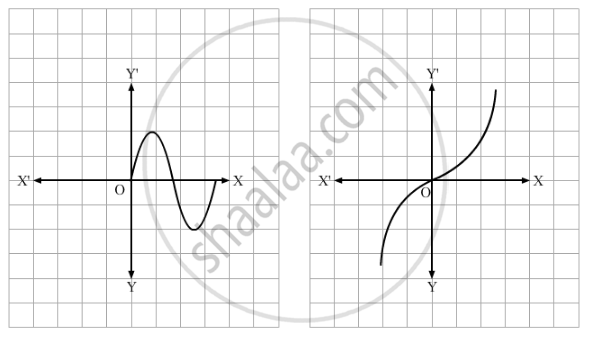
If A = {1, 2, 3} and B = {a, b}, write the total number of functions from A to B.
If f : C → C is defined by f(x) = (x − 2)3, write f−1 (−1).
If f : R → R is defined by f(x) = 10 x − 7, then write f−1 (x).
Let f : R → R+ be defined by f(x) = ax, a > 0 and a ≠ 1. Write f−1 (x).
Let f : R − {−1} → R − {1} be given by\[f\left( x \right) = \frac{x}{x + 1} . \text{Write } f^{- 1} \left( x \right)\]
\[f : R \to R \text{given by} f\left( x \right) = x + \sqrt{x^2} \text{ is }\]
Let
\[A = \left\{ x : - 1 \leq x \leq 1 \right\} \text{and} f : A \to \text{A such that f}\left( x \right) = x|x|\]
The function f : [-1/2, 1/2, 1/2] → [-π /2,π/2], defined by f (x) = `sin^-1` (3x - `4x^3`), is
If \[f : R \to R is given by f\left( x \right) = 3x - 5, then f^{- 1} \left( x \right)\]
Let f: R → R be the function defined by f(x) = 4x – 3 ∀ x ∈ R. Then write f–1
Show that the function f: R → R defined by f(x) = `x/(x^2 + 1)`, ∀ ∈ + R , is neither one-one nor onto
Which of the following functions from Z into Z is bijective?
Let A = {1, 2, 3}, B = {4, 5, 6, 7} and let f = {(1, 4), (2, 5), (3, 6)} be a function from A to B. Based on the given information, f is best defined as:
A function f: x → y is said to be one – one (or injective) if:
If f: [0, 1]→[0, 1] is defined by f(x) = `(x + 1)/4` and `d/(dx) underbrace(((fofof......of)(x)))_("n" "times")""|_(x = 1/2) = 1/"m"^"n"`, m ∈ N, then the value of 'm' is ______.
Let S = {1, 2, 3, 4, 5, 6, 7}. Then the number of possible functions f: S `rightarrow` S such that f(m.n) = f(m).f(n) for every m, n ∈ S and m.n ∈ S is equal to ______.

The given function f : R → R is not ‘onto’ function. Give reason.
The function \(f:\mathbb{N}\to\mathbb{N}\) defined by \(f(x)=5x\) is:
Which condition represents an into function?
Which condition represents a many-one function?
