Advertisements
Advertisements
प्रश्न
Consider f : {1, 2, 3} → {a, b, c} and g : {a, b, c} → {apple, ball, cat} defined as f (1) = a, f (2) = b, f (3) = c, g (a) = apple, g (b) = ball and g (c) = cat. Show that f, g and gof are invertible. Find f−1, g−1 and gof−1and show that (gof)−1 = f −1o g−1
Advertisements
उत्तर
f = { ( 1, a ) . (2, b) , (c , 3 ) } and g = {(a , apple) , (b , ball) , (c , cat)} Clearly , f and g are bijections.
So, f and g are invertible.
Now,
f -1 = {(a ,1) , (b , 2) , (3,c)} and g-1 = {(apple, a ) , (ball ,b), (cat , c)}
So, f-1 o g-1= {apple , 1} , (ball,2), (cat , 3 )} ......... (1)
f : {1,2,3,} → {a,b,c} and g : {a,b,c} → {apple , ball , cat}
So, gof : {1.2.3} → {apple , ball, cat}
⇒ (gof) (1) =g (f(1)) = g (a) = apple
(gof) (2) = g (f (2)) = g (b) = ball,
and (gof) (3) = g (f(3)) = g (c) cat
∴ gof = {(1 . apple) ,(2, ball) , (3 , cat)}
Clearly , gof is a bijection.
So, gof is invertible.
(gof)-1 = {(apple , 1), (ball,2),(cat , 3)} ....... (2)
Form (1) and (2) , we get :
(gof)-1 = f-1 o g -1
APPEARS IN
संबंधित प्रश्न
Let A = {–1, 0, 1, 2}, B = {–4, –2, 0, 2} and f, g : A → B be functions defined by f(x) = x2 – x, x ∈ A and g(x) = `2|x - 1/2| – 1`, x ∈ A. Are f and g equal?
Justify your answer. (Hint: One may note that two functions f : A → B and g : A → B such that f(a) = g(a) ∀ a ∈ A are called equal functions.)
Which of the following functions from A to B are one-one and onto?
f2 = {(2, a), (3, b), (4, c)} ; A = {2, 3, 4}, B = {a, b, c}
Classify the following function as injection, surjection or bijection :
f : Z → Z, defined by f(x) = x2 + x
Show that the function f : R − {3} → R − {2} given by f(x) = `(x-2)/(x-3)` is a bijection.
Set of ordered pair of a function ? If so, examine whether the mapping is injective or surjective :{(a, b) : a is a person, b is an ancestor of a}
Show that the exponential function f : R → R, given by f(x) = ex, is one-one but not onto. What happens if the co-domain is replaced by`R0^+` (set of all positive real numbers)?
Verify associativity for the following three mappings : f : N → Z0 (the set of non-zero integers), g : Z0 → Q and h : Q → R given by f(x) = 2x, g(x) = 1/x and h(x) = ex.
Give examples of two functions f : N → Z and g : Z → Z, such that gof is injective but gis not injective.
Find fog and gof if : f (x) = x2 g(x) = cos x .
Find fog and gof if : f (x) = x+1, g (x) = sin x .
Show that the function f : Q → Q, defined by f(x) = 3x + 5, is invertible. Also, find f−1
Consider f : R+ → [−5, ∞) given by f(x) = 9x2 + 6x − 5. Show that f is invertible with `f^-1 (x) = (sqrt (x +6)-1)/3 .`
If f : R → (0, 2) defined by `f (x) =(e^x - e^(x))/(e^x +e^(-x))+1`is invertible , find f-1.
If f : A → A, g : A → A are two bijections, then prove that fog is an injection ?
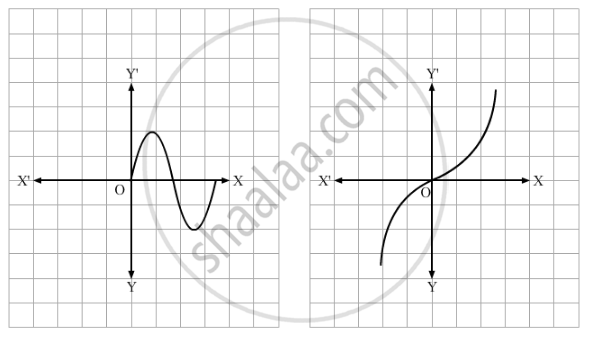
Which of the following graphs represents a one-one function?
If f : R → R is defined by f(x) = x2, write f−1 (25)
If f : C → C is defined by f(x) = x2, write f−1 (−4). Here, C denotes the set of all complex numbers.
If f : C → C is defined by f(x) = (x − 2)3, write f−1 (−1).
Let `f : R - {- 3/5}` → R be a function defined as `f (x) = (2x)/(5x +3).`
f-1 : Range of f → `R -{-3/5}`.
Let f be an invertible real function. Write ( f-1 of ) (1) + ( f-1 of ) (2) +..... +( f-1 of ) (100 )
If f(x) = x + 7 and g(x) = x − 7, x ∈ R, write fog (7).
Let f : R → R be the function defined by f(x) = 4x − 3 for all x ∈ R Then write f . [NCERT EXEMPLAR]
Let
\[f : R - \left\{ n \right\} \to R\]
The function
If \[f : R \to \left( - 1, 1 \right)\] is defined by
\[f\left( x \right) = \frac{- x|x|}{1 + x^2}, \text{ then } f^{- 1} \left( x \right)\] equals
Let \[f\left(x\right) = x^3\] be a function with domain {0, 1, 2, 3}. Then domain of \[f^{-1}\] is ______.
Let A = [–1, 1]. Then, discuss whether the following functions defined on A are one-one, onto or bijective:
f(x) = `x/2`
Let A = [–1, 1]. Then, discuss whether the following functions defined on A are one-one, onto or bijective:
h(x) = x|x|
Using the definition, prove that the function f: A→ B is invertible if and only if f is both one-one and onto
If f(x) = (4 – (x – 7)3}, then f–1(x) = ______.
Let A = {0, 1} and N be the set of natural numbers. Then the mapping f: N → A defined by f(2n – 1) = 0, f(2n) = 1, ∀ n ∈ N, is onto.
The function f : R → R defined by f(x) = 3 – 4x is ____________.
Which of the following functions from Z into Z is bijective?
The function f : R → R given by f(x) = x3 – 1 is ____________.
Range of `"f"("x") = sqrt((1 - "cos x") sqrt ((1 - "cos x")sqrt ((1 - "cos x")....infty))`
A general election of Lok Sabha is a gigantic exercise. About 911 million people were eligible to vote and voter turnout was about 67%, the highest ever

Let I be the set of all citizens of India who were eligible to exercise their voting right in the general election held in 2019. A relation ‘R’ is defined on I as follows:
R = {(V1, V2) ∶ V1, V2 ∈ I and both use their voting right in the general election - 2019}
- Mr. ’X’ and his wife ‘W’ both exercised their voting right in the general election-2019, Which of the following is true?
If f: R → R given by f(x) =(3 − x3)1/3, find f0f(x)
Find the domain of sin–1 (x2 – 4).
A function is called many-one if two or more different elements of the domain have:
