Advertisements
Advertisements
प्रश्न
Show that the function f : R → {x ∈ R : −1 < x < 1} defined by f(x) = `x/(1 + |x|)`, x ∈ R is one-one and onto function.
Advertisements
उत्तर
It is given that f : R → {x ∈ R : −1 < x < 1} is defined as f(x) = `x/(1+ |x|)`, x ∈ R.
Suppose f(x) = f(y), where x, y ∈ R.
⇒ `x/(1 +| x|) = y/(1 - |y|)`
⇒ 2xy = x − y
⇒ `x/(1 + x) = y/(1 - y) `
⇒ x + xy = y + xy
⇒ x = y
Since x is positive and y is negative:
x > y
⇒ x − y > 0
But, 2xy is negative.
Then, 2xy ≠ x − y
Thus, the case of x being positive and y being negative can be ruled out.
Under a similar argument, x being negative and y being positive can also be ruled out
∴ x and y have to be either positive or negative.
When x and y are both positive, we have:
⇒ f(x) = f(y)
⇒ `x/(1 +| x|) = y/(1 - |y|) `
⇒ `x/(1+x) = y/(1+y)`
⇒ x + xy = y + xy
⇒ x = y
When x and y are both negative, we have:
f(x) = f(y)
⇒ `x/(1 -x) = y/(1- y) `
⇒ x − xy = y − yx
⇒ x = y
∴ f is one-one.
Now, let y ∈ R such that −1 < y < 1.
If x is negative, then there exists x = `y/(1 + y) ∈ R` such that
`f(x) = f(y/(1+y)) `
`= ((y/(1+y)))/(1+ |y/(1 + y)|)`
`= (y/(1+y))/(1 + (-y)/(1+y))`
`= y/(1 +y - y)`
= y
If x is positive, then there exists x = `y/(1 - y) ∈ R` such that
`f(x) = f(y/(1-y)) = (y/(1-y))/(1 + |(y/(1-y))|)`
`= (y/(1-y))/(1+y/(1-y))`
`= y/(1 - y + y)`
= y
∴ f is onto.
Hence, f is one-one and onto.
संबंधित प्रश्न
Show that the modulus function f : R → R given by f(x) = |x| is neither one-one nor onto, where |x| is x if x is positive or 0 and |x| is − x if x is negative.
Let f : N → N be defined by f(n) = `{((n+1)/2", if n is odd"),(n/2", if n is even"):}` for all n ∈ N.
State whether the function f is bijective. Justify your answer.
Let f: R → R be defined as f(x) = 10x + 7. Find the function g: R → R such that g o f = f o g = 1R.
Give examples of two functions f: N → Z and g: Z → Z such that g o f is injective but gis not injective.
(Hint: Consider f(x) = x and g(x) =|x|)
Classify the following function as injection, surjection or bijection :
f : R → R, defined by f(x) = |x|
Classify the following function as injection, surjection or bijection :
f : R → R, defined by f(x) = 5x3 + 4
Let A = [-1, 1]. Then, discuss whether the following function from A to itself is one-one, onto or bijective : g(x) = |x|
Give examples of two one-one functions f1 and f2 from R to R, such that f1 + f2 : R → R. defined by (f1 + f2) (x) = f1 (x) + f2 (x) is not one-one.
Suppose f1 and f2 are non-zero one-one functions from R to R. Is `f_1 / f^2` necessarily one - one? Justify your answer. Here,`f_1/f_2 : R → R is given by (f_1/f_2) (x) = (f_1(x))/(f_2 (x)) for all x in R .`
Find fog (2) and gof (1) when : f : R → R ; f(x) = x2 + 8 and g : R → R; g(x) = 3x3 + 1.
Find fog and gof if : f(x) = `x^2` + 2 , g (x) = 1 − `1/ (1-x)`.
If f(x) = |x|, prove that fof = f.
Let f be a real function given by f (x)=`sqrt (x-2)`
Find each of the following:
(i) fof
(ii) fofof
(iii) (fofof) (38)
(iv) f2
Also, show that fof ≠ `f^2` .
Consider f : {1, 2, 3} → {a, b, c} and g : {a, b, c} → {apple, ball, cat} defined as f (1) = a, f (2) = b, f (3) = c, g (a) = apple, g (b) = ball and g (c) = cat. Show that f, g and gof are invertible. Find f−1, g−1 and gof−1and show that (gof)−1 = f −1o g−1
Consider f : R → R+ → [4, ∞) given by f(x) = x2 + 4. Show that f is invertible with inverse f−1 of f given by f−1 `(x)= sqrt (x-4)` where R+ is the set of all non-negative real numbers.
Let A = {x &epsis; R | −1 ≤ x ≤ 1} and let f : A → A, g : A → A be two functions defined by f(x) = x2 and g(x) = sin (π x/2). Show that g−1 exists but f−1 does not exist. Also, find g−1.
Let f be a function from R to R, such that f(x) = cos (x + 2). Is f invertible? Justify your answer.
Which one of the following graphs represents a function?
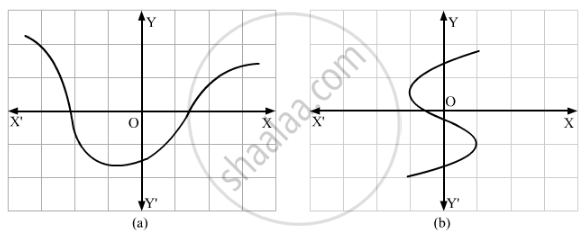
If f : R → R is defined by f(x) = 10 x − 7, then write f−1 (x).
Which one the following relations on A = {1, 2, 3} is a function?
f = {(1, 3), (2, 3), (3, 2)}, g = {(1, 2), (1, 3), (3, 1)} [NCERT EXEMPLAR]
Let the function
\[f : R - \left\{ - b \right\} \to R - \left\{ 1 \right\}\]
\[f\left( x \right) = \frac{x + a}{x + b}, a \neq b .\text{Then},\]
The function
f : A → B defined by
f (x) = - x2 + 6x - 8 is a bijection if
Let
\[f : R - \left\{ n \right\} \to R\]
Let
\[A = \left\{ x \in R : x \geq 1 \right\}\] The inverse of the function,
\[f : A \to A\] given by
\[f\left( x \right) = 2^{x \left( x - 1 \right)} , is\]
If \[g\left( x \right) = x^2 + x - 2\text{ and} \frac{1}{2} gof\left( x \right) = 2 x^2 - 5x + 2\] is equal to
If A = {a, b, c, d} and f = {a, b), (b, d), (c, a), (d, c)}, show that f is one-one from A onto A. Find f–1
Let R be the set of real numbers and f: R → R be the function defined by f(x) = 4x + 5. Show that f is invertible and find f–1.
Let C be the set of complex numbers. Prove that the mapping f: C → R given by f(z) = |z|, ∀ z ∈ C, is neither one-one nor onto.
Let A = [–1, 1]. Then, discuss whether the following functions defined on A are one-one, onto or bijective:
f(x) = `x/2`
Let A = {0, 1} and N be the set of natural numbers. Then the mapping f: N → A defined by f(2n – 1) = 0, f(2n) = 1, ∀ n ∈ N, is onto.
The function f : R → R given by f(x) = x3 – 1 is ____________.
Let f : R `->` R be a function defined by f(x) = x3 + 4, then f is ______.
The domain of the function `"f"("x") = 1/(sqrt ({"sin x"} + {"sin" ( pi + "x")}))` where {.} denotes fractional part, is
Let A = {1, 2, 3}, B = {4, 5, 6, 7} and let f = {(1, 4), (2, 5), (3, 6)} be a function from A to B. Based on the given information, f is best defined as:
A general election of Lok Sabha is a gigantic exercise. About 911 million people were eligible to vote and voter turnout was about 67%, the highest ever

Let I be the set of all citizens of India who were eligible to exercise their voting right in the general election held in 2019. A relation ‘R’ is defined on I as follows:
R = {(V1, V2) ∶ V1, V2 ∈ I and both use their voting right in the general election - 2019}
- Three friends F1, F2, and F3 exercised their voting right in general election-2019, then which of the following is true?
Students of Grade 9, planned to plant saplings along straight lines, parallel to each other to one side of the playground ensuring that they had enough play area. Let us assume that they planted one of the rows of the saplings along the line y = x − 4. Let L be the set of all lines which are parallel on the ground and R be a relation on L.
Answer the following using the above information.
- The function f: R → R defined by f(x) = x − 4 is ____________.
The domain of function is f(x) = `sqrt(-log_0.3(x - 1))/sqrt(x^2 + 2x + 8)` is ______.
The function defined by \[\mathrm{f}(x)=\frac{2x+3}{3x+4},x\neq-\frac{4}{3}\] is
