Advertisements
Advertisements
प्रश्न
The function
f : A → B defined by
f (x) = - x2 + 6x - 8 is a bijection if
पर्याय
A = (- ∞ , 3] and B = ( - ∞, 1 ]
A = [- 3 , ∞) and B = ( - ∞, 1 ]
A = (- ∞ , 3] and B = [ 1 ,∞)
A = [3 ,∞ ) and B = [ 1 ,∞ )
Advertisements
उत्तर
\[A = ( - \infty , 3] \text{and }B = ( - \infty , 1]\]
\[f\left( x \right) = - x^2 + 6x - 8 , \text{is a polynomial function}\]
\[\text{And the domain of polynomial function is real number} . \]
\[ \therefore x \in R\]
\[f(x) = - x^2 + 6x - 8\]
\[ = - \left( x^2 - 6x + 8 \right)\]
\[ = - \left( x^2 - 6x + 9 - 1 \right)\]
\[ = - \left( x - 3 \right)^2 + 1\]
\[\text{Maximum value of} - \left( x - 3 \right)^2 \text{woud be } 0\]
\[ \therefore \text{Maximum value of} - \left( x - 3 \right)^2 + 1 \text{woud be} 1\]
\[ \therefore f(x) \in ( - \infty , 1]\]
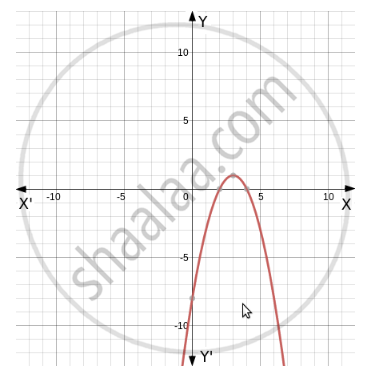
\[\text{We can see from the given graph that function is symmetrical about x = 3 & the given function is bijective .} \]
\[\text{So, x would be either} ( - \infty , 3 ] or [ 3, \infty )\]
\[\text{The correct option which satisfy A and B both is}: \]
\[A = ( - \infty , 3] \text{ and }B = ( - \infty , 1]\]
APPEARS IN
संबंधित प्रश्न
Show that the function f : R* → R* defined by f(x) = `1/x` is one-one and onto, where R* is the set of all non-zero real numbers. Is the result true, if the domain R* is replaced by N with co-domain being same as R?
Check the injectivity and surjectivity of the following function:
f : N → N given by f(x) = x2
Check the injectivity and surjectivity of the following function:
f : Z → Z given by f(x) = x3
Let S = {a, b, c} and T = {1, 2, 3}. Find F−1 of the following functions F from S to T, if it exists.
F = {(a, 3), (b, 2), (c, 1)}
Let S = {a, b, c} and T = {1, 2, 3}. Find F−1 of the following functions F from S to T, if it exists.
F = {(a, 2), (b, 1), (c, 1)}
Show that the function f: ℝ → ℝ defined by f(x) = `x/(x^2 + 1), ∀x in R`is neither one-one nor onto. Also, if g: ℝ → ℝ is defined as g(x) = 2x - 1. Find fog(x)
Which of the following functions from A to B are one-one and onto ?
f3 = {(a, x), (b, x), (c, z), (d, z)} ; A = {a, b, c, d,}, B = {x, y, z}.
Classify the following function as injection, surjection or bijection : f : N → N given by f(x) = x2
Classify the following function as injection, surjection or bijection :
f : R → R, defined by f(x) = `x/(x^2 +1)`
Let A = [-1, 1]. Then, discuss whether the following functions from A to itself is one-one, onto or bijective : h(x) = x2
Show that f : R→ R, given by f(x) = x — [x], is neither one-one nor onto.
Let f : N → N be defined by
`f(n) = { (n+ 1, if n is odd),( n-1 , if n is even):}`
Show that f is a bijection.
[CBSE 2012, NCERT]
Let R+ be the set of all non-negative real numbers. If f : R+ → R+ and g : R+ → R+ are defined as `f(x)=x^2` and `g(x)=+sqrtx` , find fog and gof. Are they equal functions ?
Give examples of two functions f : N → Z and g : Z → Z, such that gof is injective but gis not injective.
If f : A → B and g : B → C are one-one functions, show that gof is a one-one function.
Find fog and gof if : f (x) = |x|, g (x) = sin x .
Find fog and gof if : f (x) = x+1, g (x) = sin x .
If f : Q → Q, g : Q → Q are two functions defined by f(x) = 2 x and g(x) = x + 2, show that f and g are bijective maps. Verify that (gof)−1 = f−1 og −1.
If f : R → (−1, 1) defined by `f (x) = (10^x- 10^-x)/(10^x + 10 ^-x)` is invertible, find f−1.
Write the total number of one-one functions from set A = {1, 2, 3, 4} to set B = {a, b, c}.
If f : R → R is defined by f(x) = 10 x − 7, then write f−1 (x).
If a function g = {(1, 1), (2, 3), (3, 5), (4, 7)} is described by g(x) = \[\alpha x + \beta\] then find the values of \[\alpha\] and \[ \beta\] . [NCERT EXEMPLAR]
The function f : R → R defined by
`f (x) = 2^x + 2^(|x|)` is
Let
\[f : R \to R\] be a function defined by
\[f : Z \to Z\] be given by
` f (x) = {(x/2, ", if x is even" ) ,(0 , ", if x is odd "):}`
Then, f is
Let \[f\left( x \right) = \frac{1}{1 - x} . \text{Then}, \left\{ f o \left( fof \right) \right\} \left( x \right)\]
Let \[f\left( x \right) = \frac{\alpha x}{x + 1}, x \neq - 1\] Then, for what value of α is \[f \left( f\left( x \right) \right) = x?\]
Mark the correct alternative in the following question:
If the set A contains 7 elements and the set B contains 10 elements, then the number one-one functions from A to B is
Let A = R − (2) and B = R − (1). If f: A ⟶ B is a function defined by`"f(x)"=("x"-1)/("x"-2),` how that f is one-one and onto. Hence, find f−1.
Let f: R → R be the function defined by f(x) = 4x – 3 ∀ x ∈ R. Then write f–1
Consider the set A containing n elements. Then, the total number of injective functions from A onto itself is ______
Let X = {1, 2, 3}and Y = {4, 5}. Find whether the following subset of X ×Y are function from X to Y or not
f = {(1, 4), (1, 5), (2, 4), (3, 5)}
Let A = R – {3}, B = R – {1}. Let f: A → B be defined by f(x) = `(x - 2)/(x - 3)` ∀ x ∈ A . Then show that f is bijective.
Using the definition, prove that the function f: A→ B is invertible if and only if f is both one-one and onto
The solution set of the inequation log1/3(x2 + x + 1) + 1 > 0 is ______.
A function is called into if:
A function is called bijective if it is both:
For \(f:\mathbb{R}\to\mathbb{R}\) defined by \(f(x)=1+x^2\), which statement is correct?
Which real-life situation resembles a one-one idea when no roll number is repeated?
A perfect one-to-one matching between users and unique IDs is similar to:
