Advertisements
Advertisements
प्रश्न
Suppose f1 and f2 are non-zero one-one functions from R to R. Is `f_1 / f^2` necessarily one - one? Justify your answer. Here,`f_1/f_2 : R → R is given by (f_1/f_2) (x) = (f_1(x))/(f_2 (x)) for all x in R .`
Advertisements
उत्तर
We know that f1: R → R, given by f1(x)=x3 and f2(x)=x are one-one.
Injectivity of f1:
Let x and y be two elements in the domain R, such that
f1 (x) = f2 (y) ⇒ x3= y ⇒ x = `3 sqrty in R`
So, f1 is one-one.
Injectivity of f2:
Let x and y be two elements in the domain R, such that
f2(x) = f2 (y) ⇒ x= y ⇒ x∈R.
So, f2 is one-one
proving `f_1 / f_2` is not one - one :
Given that `f_1/f_2 (x) = f_1(x)/f_2(x) = x^2/x = x^2`
Let x and y be two elements in the domain R, such that
`f_1/(f_2) (x) = f_1/(f_2) (y)`
⇒ x2= y2
⇒ x = ±y
So, `f_1/f_2` is not one - one
APPEARS IN
संबंधित प्रश्न
Check the injectivity and surjectivity of the following function:
f : R → R given by f(x) = x2
Give an example of a function which is not one-one but onto ?
Which of the following functions from A to B are one-one and onto?
f1 = {(1, 3), (2, 5), (3, 7)} ; A = {1, 2, 3}, B = {3, 5, 7}
Classify the following function as injection, surjection or bijection : f : Z → Z given by f(x) = x3
Let A = [-1, 1]. Then, discuss whether the following functions from A to itself is one-one, onto or bijective : h(x) = x2
Find the number of all onto functions from the set A = {1, 2, 3, ..., n} to itself.
If f(x) = 2x + 5 and g(x) = x2 + 1 be two real functions, then describe each of the following functions:
(1) fog
(2) gof
(3) fof
(4) f2
Also, show that fof ≠ f2
If f(x) = sin x and g(x) = 2x be two real functions, then describe gof and fog. Are these equal functions?
Let A = {1, 2, 3, 4}; B = {3, 5, 7, 9}; C = {7, 23, 47, 79} and f : A → B, g : B → C be defined as f(x) = 2x + 1 and g(x) = x2 − 2. Express (gof)−1 and f−1 og−1 as the sets of ordered pairs and verify that (gof)−1 = f−1 og−1.
If f : R → (−1, 1) defined by `f (x) = (10^x- 10^-x)/(10^x + 10 ^-x)` is invertible, find f−1.
Let A = {x &epsis; R | −1 ≤ x ≤ 1} and let f : A → A, g : A → A be two functions defined by f(x) = x2 and g(x) = sin (π x/2). Show that g−1 exists but f−1 does not exist. Also, find g−1.
If A = {1, 2, 3, 4} and B = {a, b, c, d}, define any four bijections from A to B. Also give their inverse functions.
Which of the following graphs represents a one-one function?
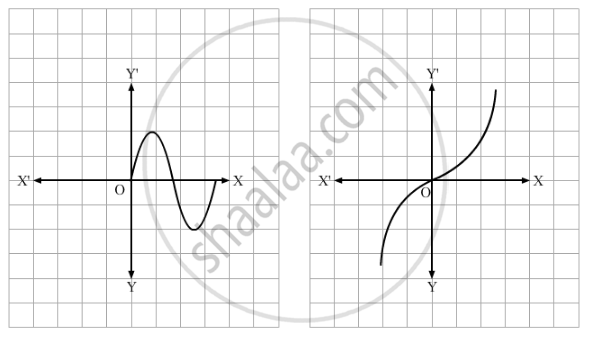
If f : R → R, g : R → are given by f(x) = (x + 1)2 and g(x) = x2 + 1, then write the value of fog (−3).
Let `f : R - {- 3/5}` → R be a function defined as `f (x) = (2x)/(5x +3).`
f-1 : Range of f → `R -{-3/5}`.
Let f : R → R be defined as `f (x) = (2x - 3)/4.` write fo f-1 (1) .
Let f : R → R be the function defined by f(x) = 4x − 3 for all x ∈ R Then write f . [NCERT EXEMPLAR]
Let
f : R → R be given by
\[f\left( x \right) = \left[ x^2 \right] + \left[ x + 1 \right] - 3\]
where [x] denotes the greatest integer less than or equal to x. Then, f(x) is
(d) one-one and onto
The function \[f : [0, \infty ) \to \text {R given by } f\left( x \right) = \frac{x}{x + 1} is\]
Let
\[A = \left\{ x \in R : x \leq 1 \right\} and f : A \to A\] be defined as
\[f\left( x \right) = x \left( 2 - x \right)\] Then,
\[f^{- 1} \left( x \right)\] is
Let
\[f : [2, \infty ) \to X\] be defined by
\[f\left( x \right) = 4x - x^2\] Then, f is invertible if X =
Let \[f\left(x\right) = x^3\] be a function with domain {0, 1, 2, 3}. Then domain of \[f^{-1}\] is ______.
Let f: R → R be defined by f(x) = x2 + 1. Then, pre-images of 17 and – 3, respectively, are ______.
For sets A, B and C, let f: A → B, g: B → C be functions such that g o f is surjective. Then g is surjective.
Using the definition, prove that the function f: A→ B is invertible if and only if f is both one-one and onto
Let A = {1, 2, 3, ...n} and B = {a, b}. Then the number of surjections from A into B is ______.
Let f: R → R be the functions defined by f(x) = x3 + 5. Then f–1(x) is ______.
The function f : A → B defined by f(x) = 4x + 7, x ∈ R is ____________.
An organization conducted a bike race under 2 different categories-boys and girls. Totally there were 250 participants. Among all of them finally, three from Category 1 and two from Category 2 were selected for the final race. Ravi forms two sets B and G with these participants for his college project. Let B = {b1,b2,b3} G={g1,g2} where B represents the set of boys selected and G the set of girls who were selected for the final race.
Ravi decides to explore these sets for various types of relations and functions.
- Ravi wants to find the number of injective functions from B to G. How many numbers of injective functions are possible?
If f: R → R given by f(x) =(3 − x3)1/3, find f0f(x)
Let the function f: R → R be defined by f(x) = 4x – 1, ∀ x ∈ R then 'f' is
If f; R → R f(x) = 10x + 3 then f–1(x) is:
Let f: R→R be defined as f(x) = 2x – 1 and g: R – {1}→R be defined as g(x) = `(x - 1/2)/(x - 1)`. Then the composition function f (g(x)) is ______.
The domain of function is f(x) = `sqrt(-log_0.3(x - 1))/sqrt(x^2 + 2x + 8)` is ______.
Let f(n) = `[1/3 + (3n)/100]n`, where [n] denotes the greatest integer less than or equal to n. Then `sum_(n = 1)^56f(n)` is equal to ______.
Let f(x) be a polynomial of degree 3 such that f(k) = `-2/k` for k = 2, 3, 4, 5. Then the value of 52 – 10f(10) is equal to ______.
Let f: R→Rbe defined as f (x) = `(x^2 + 1)/2`, then ______.
A function is called many-one if two or more different elements of the domain have:
The function \(f:\mathbb{N}\to\mathbb{N}\) defined by \(f(x)=5x\) is:
Which real-life situation resembles a one-one idea when no roll number is repeated?
