Advertisements
Advertisements
प्रश्न
Let A = {1, 2, 3, 4}; B = {3, 5, 7, 9}; C = {7, 23, 47, 79} and f : A → B, g : B → C be defined as f(x) = 2x + 1 and g(x) = x2 − 2. Express (gof)−1 and f−1 og−1 as the sets of ordered pairs and verify that (gof)−1 = f−1 og−1.
Advertisements
उत्तर
f(x)=2x+1
⇒ f= {(1, 2(1)+1), (2, 2(2)+1), (3, 2(3)+1), (4, 2(4)+1)}={(1, 3), (2, 5), (3, 7), (4, 9)}g(x)=x2−2
⇒ g= {(3, 32−2), (5, 52−2), (7, 72−2), (9, 92−2)}={(3, 7), (5, 23), (7, 47), (9, 79)}
Clearly f and g are bijections and, hence, f−1: B→A and g−1: C→B exist.
So, f−1= {(3, 1), (5, 2), (7, 3), (9, 4)}
and g−1= {(7, 3), (23, 5), (47, 7), (79, 9)}
Now, (f−1 o g−1) : C→A
f−1 o g−1={(7, 1), (23, 2), (47, 3), (79, 4)} ...(1)
Also, f : A→B and g : B → C,
⇒ gof : A → C, (gof) −1 : C→A
So, f−1 o g−1and (gof)−1 have same domains.
(gof)(x)=g (f (x))=g (2x+1)=(2x+1)2−2
⇒ (gof) (x) = 4x2+ 4x +1−2
⇒ (gof) (x) = 4x2+ 4x −1
Then, (gof) (1) = g (f (1)) = 4+4−1 =7,
(gof)(2)=g (f (2))=4+4−1=23,
(gof)(3)=g (f (3))=4+4−1=47 and
(gof)(4)=g (f (4))=4+4−1=79
So, gof={(1, 7), (2, 23), (3, 47), (4, 79)}
⇒(gof)−1={(7, 1), (23, 2), (47, 3), (79, 4)} ......(2)
From (1) and (2), we get:
(gof)−1 = f−1 o g−1
APPEARS IN
संबंधित प्रश्न
Let A = R – {3} and B = R – {1}. Consider the function f : A → B defined by f(x) = `((x - 2)/(x - 3))`. Is f one-one and onto? Justify your answer.
Let S = {a, b, c} and T = {1, 2, 3}. Find F−1 of the following functions F from S to T, if it exists.
F = {(a, 2), (b, 1), (c, 1)}
Classify the following function as injection, surjection or bijection : f : Z → Z given by f(x) = x2
Classify the following function as injection, surjection or bijection :
f : R → R, defined by f(x) = x3 − x
Set of ordered pair of a function ? If so, examine whether the mapping is injective or surjective :{(a, b) : a is a person, b is an ancestor of a}
Find gof and fog when f : R → R and g : R → R is defined by f(x) = x and g(x) = |x| .
Find fog and gof if : f (x) = x2 g(x) = cos x .
If f(x) = sin x and g(x) = 2x be two real functions, then describe gof and fog. Are these equal functions?
Let f be any real function and let g be a function given by g(x) = 2x. Prove that gof = f + f.
Show that the function f : Q → Q, defined by f(x) = 3x + 5, is invertible. Also, find f−1
A function f : R → R is defined as f(x) = x3 + 4. Is it a bijection or not? In case it is a bijection, find f−1 (3).
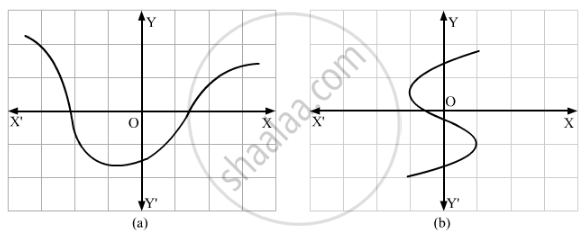
Which one of the following graphs represents a function?
Let f : R → R be the function defined by f(x) = 4x − 3 for all x ∈ R Then write f . [NCERT EXEMPLAR]
Let
\[A = \left\{ x : - 1 \leq x \leq 1 \right\} \text{and} f : A \to \text{A such that f}\left( x \right) = x|x|\]
If \[f : R \to R\] is given by \[f\left( x \right) = x^3 + 3, \text{then} f^{- 1} \left( x \right)\] is equal to
Let \[f\left(x\right) = x^3\] be a function with domain {0, 1, 2, 3}. Then domain of \[f^{-1}\] is ______.
A function f: R→ R defined by f(x) = `(3x) /5 + 2`, x ∈ R. Show that f is one-one and onto. Hence find f−1.
Write about strcmp() function.
Let the function f: R → R be defined by f(x) = 4x – 1, ∀ x ∈ R. Then, show that f is one-one.
Let f, g: R → R be two functions defined as f(x) = |x| + x and g(x) = x – x ∀ x ∈ R. Then, find f o g and g o f
For sets A, B and C, let f: A → B, g: B → C be functions such that g o f is surjective. Then g is surjective.
Are the following set of ordered pairs functions? If so, examine whether the mapping is injective or surjective.
{(x, y): x is a person, y is the mother of x}
Using the definition, prove that the function f: A→ B is invertible if and only if f is both one-one and onto
Let X = {-1, 0, 1}, Y = {0, 2} and a function f : X → Y defiend by y = 2x4, is ____________.
Let f : R → R be a function defined by f(x) `= ("e"^abs"x" - "e"^-"x")/("e"^"x" + "e"^-"x")` then f(x) is
Let g(x) = x2 – 4x – 5, then ____________.
Let f : R `->` R be a function defined by f(x) = x3 + 4, then f is ______.
Let A = {1, 2, 3}, B = {4, 5, 6, 7} and let f = {(1, 4), (2, 5), (3, 6)} be a function from A to B. Based on the given information, f is best defined as:
A function f: x → y is/are called onto (or surjective) if x under f.
Function f: R → R, defined by f(x) = `x/(x^2 + 1)` ∀ x ∈ R is not
Let f: R→R be defined as f(x) = 2x – 1 and g: R – {1}→R be defined as g(x) = `(x - 1/2)/(x - 1)`. Then the composition function f (g(x)) is ______.
If log102 = 0.3010.log103 = 0.4771 then the number of ciphers after decimal before a significant figure comes in `(5/3)^-100` is ______.
Number of integral values of x satisfying the inequality `(3/4)^(6x + 10 - x^2) < 27/64` is ______.
Let A = {1, 2, 3, ..., 10} and f : A `rightarrow` A be defined as
f(k) = `{{:(k + 1, if k "is odd"),( k, if k "is even"):}`.
Then the number of possible functions g : A `rightarrow` A such that gof = f is ______.
A function is called one-one if different elements of the domain have:
A function is called many-one if two or more different elements of the domain have:
A function is called into if:
Which condition represents a many-one function?
