Advertisements
Advertisements
प्रश्न
Classify the following function as injection, surjection or bijection : f : N → N given by f(x) = x2
Advertisements
उत्तर
f : N → N, given by f(x) = x2
Injection test :
Let x and y be any two elements in the domain (N), such that f(x) = f(y).
f(x)=f(y)
x2=y2
x=y (We do not get ± because x and y are in N)
So, f is an injection .
Surjection test :
Let y be any element in the co-domain (N), such that f(x) = y for some element x in N(domain).
f(x) = y
x2= y
x =`sqrty , ` which may not be in N.
For example, if y = 3 ,
x=`sqrt 3 ` is not in N.
So, f is not a surjection.
So, f is not a bijection.
APPEARS IN
संबंधित प्रश्न
Prove that the greatest integer function f : R → R, given by f(x) = [x], is neither one-one nor onto, where [x] denotes the greatest integer less than or equal to x.
Show that the modulus function f : R → R, given by f(x) = |x|, is neither one-one nor onto, where |x| is x, if x is positive or 0 and |x| is –x, if x is negative.
Let A = {1, 2, 3}, B = {4, 5, 6, 7} and let f = {(1, 4), (2, 5), (3, 6)} be a function from A to B. Show that f is one-one.
Let f : R → R be defined as f(x) = x4. Choose the correct answer.
Let f : R → R be defined as f(x) = 3x. Choose the correct answer.
Let f: R → R be the Signum Function defined as
f(x) = `{(1,x>0), (0, x =0),(-1, x< 0):}`
and g: R → R be the Greatest Integer Function given by g(x) = [x], where [x] is greatest integer less than or equal to x. Then does fog and gof coincide in (0, 1]?
Show that the function f: ℝ → ℝ defined by f(x) = `x/(x^2 + 1), ∀x in R`is neither one-one nor onto. Also, if g: ℝ → ℝ is defined as g(x) = 2x - 1. Find fog(x)
Give an example of a function which is neither one-one nor onto ?
Let A = [-1, 1]. Then, discuss whether the following function from A to itself is one-one, onto or bijective : `f (x) = x/2`
Find fog and gof if : f (x) = x+1, g(x) = `e^x`
.
Find fog and gof if : f(x) = `x^2` + 2 , g (x) = 1 − `1/ (1-x)`.
Let f(x) = x2 + x + 1 and g(x) = sin x. Show that fog ≠ gof.
` if f : (-π/2 , π/2)` → R and g : [−1, 1]→ R be defined as f(x) = tan x and g(x) = `sqrt(1 - x^2)` respectively, describe fog and gof.
Let A = R - {3} and B = R - {1}. Consider the function f : A → B defined by f(x) = `(x-2)/(x-3).`Show that f is one-one and onto and hence find f-1.
[CBSE 2012, 2014]
If f : A → A, g : A → A are two bijections, then prove that fog is a surjection ?
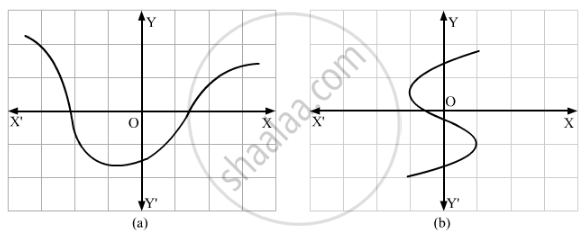
Which one of the following graphs represents a function?
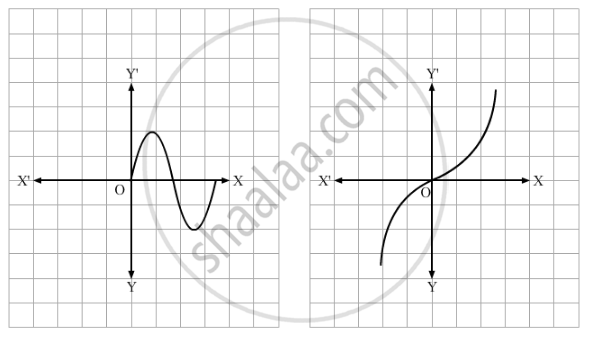
Which of the following graphs represents a one-one function?
If A = {1, 2, 3} and B = {a, b}, write the total number of functions from A to B.
If f(x) = x + 7 and g(x) = x − 7, x ∈ R, write fog (7).
Write the domain of the real function f defined by f(x) = `sqrt (25 -x^2)` [NCERT EXEMPLAR]
\[f : R \to R \text{given by} f\left( x \right) = x + \sqrt{x^2} \text{ is }\]
Let the function
\[f : R - \left\{ - b \right\} \to R - \left\{ 1 \right\}\]
\[f\left( x \right) = \frac{x + a}{x + b}, a \neq b .\text{Then},\]
Let
\[A = \left\{ x \in R : - 1 \leq x \leq 1 \right\} = B\] Then, the mapping\[f : A \to \text{B given by} f\left( x \right) = x\left| x \right|\] is
The range of the function
\[f\left( x \right) =^{7 - x} P_{x - 3}\]
The function f : [-1/2, 1/2, 1/2] → [-π /2,π/2], defined by f (x) = `sin^-1` (3x - `4x^3`), is
Which of the following functions from
\[A = \left\{ x \in R : - 1 \leq x \leq 1 \right\}\]
The inverse of the function
\[f : R \to \left\{ x \in R : x < 1 \right\}\] given by
\[f\left( x \right) = \frac{e^x - e^{- x}}{e^x + e^{- x}}\] is
Let the function f: R → R be defined by f(x) = 4x – 1, ∀ x ∈ R. Then, show that f is one-one.
Show that the function f: R → R defined by f(x) = `x/(x^2 + 1)`, ∀ ∈ + R , is neither one-one nor onto
For sets A, B and C, let f: A → B, g: B → C be functions such that g o f is surjective. Then g is surjective.
Let f: R → R be the functions defined by f(x) = x3 + 5. Then f–1(x) is ______.
The domain of the function `"f"("x") = 1/(sqrt ({"sin x"} + {"sin" ( pi + "x")}))` where {.} denotes fractional part, is
Range of `"f"("x") = sqrt((1 - "cos x") sqrt ((1 - "cos x")sqrt ((1 - "cos x")....infty))`
Raji visited the Exhibition along with her family. The Exhibition had a huge swing, which attracted many children. Raji found that the swing traced the path of a Parabola as given by y = x2.
Answer the following questions using the above information.
- Let f: R → R be defined by f(x) = x2 is:
The domain of the function `cos^-1((2sin^-1(1/(4x^2-1)))/π)` is ______.
Let f(n) = `[1/3 + (3n)/100]n`, where [n] denotes the greatest integer less than or equal to n. Then `sum_(n = 1)^56f(n)` is equal to ______.
Let A = R – {2} and B = R – {1}. If f: A `→` B is a function defined by f(x) = `(x - 1)/(x - 2)` then show that f is a one-one and an onto function.
The function defined by \[\mathrm{f}(x)=\frac{2x+3}{3x+4},x\neq-\frac{4}{3}\] is
The function \(f:\mathbb{N}\to\mathbb{N}\) defined by \(f(x)=5x\) is:
Many students choosing the same favourite subject resembles which type of function?
