Advertisements
Advertisements
प्रश्न
Give examples of two functions f: N → Z and g: Z → Z such that g o f is injective but gis not injective.
(Hint: Consider f(x) = x and g(x) =|x|)
Advertisements
उत्तर
Define f: N → Z as f(x) = x and g: Z → Z as g(x) =|x|.
We first show that g is not injective.
It can be observed that:
g(−1) = `|-1| = 1`
g(1) = `|1| = 1`
∴ g(−1) = g(1), but −1 ≠ 1.
∴ g is not injective.
Now, gof: N → Z is defined as
`gof(x) = g(f(x)) = g(x) = |x|`
Let x, y ∈ N such that gof(x) = gof(y).
⇒ |x| = |y|
Since x and y ∈ N, both are positive.
`:. |x| = |y| => x = y`
Hence, gof is injective
संबंधित प्रश्न
Check the injectivity and surjectivity of the following function:
f : N → N given by f(x) = x2
Show that the function f : R → {x ∈ R : –1 < x < 1} defined by f(x) = `x/(1 + |x|)`, x ∈ R is one-one and onto function.
Find the number of all onto functions from the set {1, 2, 3, ..., n} to itself.
Let R+ be the set of all non-negative real numbers. If f : R+ → R+ and g : R+ → R+ are defined as `f(x)=x^2` and `g(x)=+sqrtx` , find fog and gof. Are they equal functions ?
If f : A → B and g : B → C are onto functions, show that gof is a onto function.
Find fog and gof if : f(x)= x + 1, g (x) = 2x + 3 .
Let f(x) = x2 + x + 1 and g(x) = sin x. Show that fog ≠ gof.
` if f : (-π/2 , π/2)` → R and g : [−1, 1]→ R be defined as f(x) = tan x and g(x) = `sqrt(1 - x^2)` respectively, describe fog and gof.
State with reason whether the following functions have inverse :
f : {1, 2, 3, 4} → {10} with f = {(1, 10), (2, 10), (3, 10), (4, 10)}
Find f −1 if it exists : f : A → B, where A = {0, −1, −3, 2}; B = {−9, −3, 0, 6} and f(x) = 3 x.
Find f −1 if it exists : f : A → B, where A = {1, 3, 5, 7, 9}; B = {0, 1, 9, 25, 49, 81} and f(x) = x2
Consider f : R+ → [−5, ∞) given by f(x) = 9x2 + 6x − 5. Show that f is invertible with `f^-1 (x) = (sqrt (x +6)-1)/3 .`
Which one of the following graphs represents a function?
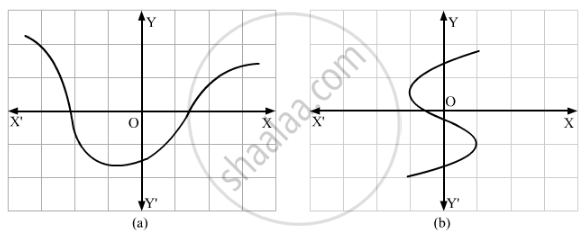
If A = {a, b, c} and B = {−2, −1, 0, 1, 2}, write the total number of one-one functions from A to B.
If f : R → R is defined by f(x) = x2, write f−1 (25)
Let f : R − {−1} → R − {1} be given by\[f\left( x \right) = \frac{x}{x + 1} . \text{Write } f^{- 1} \left( x \right)\]
Let f : R → R, g : R → R be two functions defined by f(x) = x2 + x + 1 and g(x) = 1 − x2. Write fog (−2).
Write the domain of the real function
`f (x) = sqrt([x] - x) .`
If f(x) = x + 7 and g(x) = x − 7, x ∈ R, write fog (7).
If f(x) = 4 −( x - 7)3 then write f-1 (x).
\[f : R \to R \text{given by} f\left( x \right) = x + \sqrt{x^2} \text{ is }\]
Let the function
\[f : R - \left\{ - b \right\} \to R - \left\{ 1 \right\}\]
\[f\left( x \right) = \frac{x + a}{x + b}, a \neq b .\text{Then},\]
The range of the function
\[f\left( x \right) =^{7 - x} P_{x - 3}\]
The function f : [-1/2, 1/2, 1/2] → [-π /2,π/2], defined by f (x) = `sin^-1` (3x - `4x^3`), is
Let
\[A = \left\{ x \in R : x \geq 1 \right\}\] The inverse of the function,
\[f : A \to A\] given by
\[f\left( x \right) = 2^{x \left( x - 1 \right)} , is\]
Let \[f\left(x\right) = x^3\] be a function with domain {0, 1, 2, 3}. Then domain of \[f^{-1}\] is ______.
Using the definition, prove that the function f: A→ B is invertible if and only if f is both one-one and onto
Let A = {1, 2, 3, ...n} and B = {a, b}. Then the number of surjections from A into B is ______.
Let f: R → R be given by f(x) = tan x. Then f–1(1) is ______.
If `f : R -> R^+ U {0}` be defined by `f(x) = x^2, x ∈ R`. The mapping is
Number of integral values of x satisfying the inequality `(3/4)^(6x + 10 - x^2) < 27/64` is ______.
`x^(log_5x) > 5` implies ______.
Let x is a real number such that are functions involved are well defined then the value of `lim_(t→0)[max{(sin^-1 x/3 + cos^-1 x/3)^2, min(x^2 + 4x + 7)}]((sin^-1t)/t)` where [.] is greatest integer function and all other brackets are usual brackets.
Find the domain of sin–1 (x2 – 4).
Let A = R – {2} and B = R – {1}. If f: A `→` B is a function defined by f(x) = `(x - 1)/(x - 2)` then show that f is a one-one and an onto function.
A function is called many-one if two or more different elements of the domain have:
Let \(X=\{-1,2,5,8,11\}\), \(Y=\{4,6,8\}\), and suppose different elements \(2,5,8\) of \(X\) have the same image \(4\). What type of function is it with respect to the one-one property?
Many students choosing the same favourite subject resembles which type of function?
Which condition represents an into function?
