Advertisements
Advertisements
प्रश्न
Give an example of a function which is one-one but not onto ?
Advertisements
उत्तर
which is one-one but not onto.
f: Z → Z given by f(x) = 3x + 2
Injectivity:
Let x and y be any two elements in the domain (Z), such that f(x) = f(y).
f (x)= f(y)
⇒ 3x + 2 =3y + 2
⇒ 3x = 3y
⇒ x = y
⇒ f(x) = f(y) ⇒ x = y
So, f is one-one.
Surjectivity:
Let y be any element in the co-domain (Z), such that f(x) = y for some element x in Z(domain).
f(x) = y
⇒ 3x + 2 = y
⇒ 3x = y - 2
⇒ x= `(y - 2)/3`. It may not be in the domain (Z)
because if we take y = 3,
`x = (y - 2)/3 = (3-2)/3 = 1/3 ∉` domain Z.
So, for every element in the co domain there need not be any element in the domain such that f(x) = y.
Thus, f is not onto.
APPEARS IN
संबंधित प्रश्न
Check the injectivity and surjectivity of the following function:
f : N → N given by f(x) = x3
Which of the following functions from A to B are one-one and onto?
f2 = {(2, a), (3, b), (4, c)} ; A = {2, 3, 4}, B = {a, b, c}
Classify the following function as injection, surjection or bijection : f : N → N given by f(x) = x2
Classify the following function as injection, surjection or bijection :
f : Z → Z, defined by f(x) = x2 + x
Classify the following function as injection, surjection or bijection :
f : R → R, defined by f(x) = sinx
Give examples of two one-one functions f1 and f2 from R to R, such that f1 + f2 : R → R. defined by (f1 + f2) (x) = f1 (x) + f2 (x) is not one-one.
Give examples of two surjective functions f1 and f2 from Z to Z such that f1 + f2 is not surjective.
Find gof and fog when f : R → R and g : R → R is defined by f(x) = x and g(x) = |x| .
Find fog and gof if : f(x)= x + 1, g (x) = 2x + 3 .
Consider f : R → R+ → [4, ∞) given by f(x) = x2 + 4. Show that f is invertible with inverse f−1 of f given by f−1 `(x)= sqrt (x-4)` where R+ is the set of all non-negative real numbers.
Let A and B be two sets, each with a finite number of elements. Assume that there is an injective map from A to B and that there is an injective map from B to A. Prove that there is a bijection from A to B.
Which one of the following graphs represents a function?
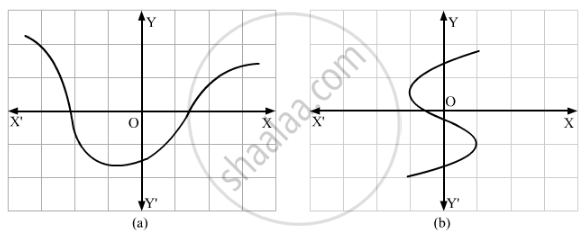
If f : R → R, g : R → are given by f(x) = (x + 1)2 and g(x) = x2 + 1, then write the value of fog (−3).
Let `f : R - {- 3/5}` → R be a function defined as `f (x) = (2x)/(5x +3).`
f-1 : Range of f → `R -{-3/5}`.
Let A = {1, 2, 3}, B = {4, 5, 6, 7} and let f = {(1, 4), (2, 5), (3, 6)} be a function from A to B. State whether f is one-one or not.
If the mapping f : {1, 3, 4} → {1, 2, 5} and g : {1, 2, 5} → {1, 3}, given by f = {(1, 2), (3, 5), (4, 1)} and g = {(2, 3), (5, 1), (1, 3)}, then write fog. [NCERT EXEMPLAR]
\[f : A \to \text{B given by } 3^{ f\left( x \right)} + 2^{- x} = 4\] is a bijection, then
The function
f : A → B defined by
f (x) = - x2 + 6x - 8 is a bijection if
The function f : [-1/2, 1/2, 1/2] → [-π /2,π/2], defined by f (x) = `sin^-1` (3x - `4x^3`), is
If \[f\left( x \right) = \sin^2 x\] and the composite function \[g\left( f\left( x \right) \right) = \left| \sin x \right|\] then g(x) is equal to
Let f: R → R be the function defined by f(x) = 4x – 3 ∀ x ∈ R. Then write f–1
If A = {a, b, c, d} and f = {a, b), (b, d), (c, a), (d, c)}, show that f is one-one from A onto A. Find f–1
Let f: R → R be the function defined by f(x) = 2x – 3 ∀ x ∈ R. write f–1
Let C be the set of complex numbers. Prove that the mapping f: C → R given by f(z) = |z|, ∀ z ∈ C, is neither one-one nor onto.
Let the function f: R → R be defined by f(x) = cosx, ∀ x ∈ R. Show that f is neither one-one nor onto
Let A = R – {3}, B = R – {1}. Let f: A → B be defined by f(x) = `(x - 2)/(x - 3)` ∀ x ∈ A . Then show that f is bijective.
Let f: R – `{3/5}` → R be defined by f(x) = `(3x + 2)/(5x - 3)`. Then ______.
Let f: `[2, oo)` → R be the function defined by f(x) = x2 – 4x + 5, then the range of f is ______.
The function f : A → B defined by f(x) = 4x + 7, x ∈ R is ____________.
Let f : R → R be a function defined by f(x) `= ("e"^abs"x" - "e"^-"x")/("e"^"x" + "e"^-"x")` then f(x) is
The function f: R → R defined as f(x) = x3 is:
Raji visited the Exhibition along with her family. The Exhibition had a huge swing, which attracted many children. Raji found that the swing traced the path of a Parabola as given by y = x2.
Answer the following questions using the above information.
- Let : N → R be defined by f(x) = x2. Range of the function among the following is ____________.
The domain of function is f(x) = `sqrt(-log_0.3(x - 1))/sqrt(x^2 + 2x + 8)` is ______.
A function is a rule that assigns each element of one set to exactly how many elements of another set?
In the function from \(X\) to \(Y\), if \(6\in Y\) is not the image of any element of \(X\), the function is:
For \(f:\mathbb{R}\to\mathbb{R}\) defined by \(f(x)=1+x^2\), which statement is correct?
Many students choosing the same favourite subject resembles which type of function?
Which condition represents an onto (surjective) function?
