Advertisements
Advertisements
Question
Let A = R – {3}, B = R – {1}. Let f: A → B be defined by f(x) = `(x - 2)/(x - 3)` ∀ x ∈ A . Then show that f is bijective.
Advertisements
Solution
Given that,
A = R – {3}, B = R – {1}
f: A → B be defined by f(x) = `(x - 2)/x` – 3 ∀ x ∈ A
∴ f(x) = `(x - 3 + 1)/(x - 3)` = 1 + `1/(x - 3)`
Let f(x1) = f (x2)
⇒ `1 + 1/(x_1 - 3) = 1 + 1/(x_2 - 3)`
⇒ `1/(x_1 - 3) = 1/(x_2 - 3)`
⇒ x1 = x2
So, (x) is an injection function
Now let y = `(x - 2)/(x - 3)`
⇒ x – 2 = xy – 3y
⇒ x(1 – y) = 2 – 3y
⇒ x = `(2 - 3y)/(1 - y)`
⇒ x = `(3y - 2)/(y - 1)`
⇒ y ∈ R – {1} = B
Since y ∈ R – {1} = B for every y ∈ B, there exists an x ∈ A such that f(x) = y.
Therefore, f(x) is surjective (onto).
APPEARS IN
RELATED QUESTIONS
Show that the function f in `A=R-{2/3} ` defined as `f(x)=(4x+3)/(6x-4)` is one-one and onto hence find f-1
In the following case, state whether the function is one-one, onto or bijective. Justify your answer.
f : R → R defined by f(x) = 1 + x2
If the function `f(x) = sqrt(2x - 3)` is invertible then find its inverse. Hence prove that `(fof^(-1))(x) = x`
Classify the following function as injection, surjection or bijection :
f : R → R, defined by f(x) = |x|
Let A = [-1, 1]. Then, discuss whether the following function from A to itself is one-one, onto or bijective : `f (x) = x/2`
If f : R → R be the function defined by f(x) = 4x3 + 7, show that f is a bijection.
Show that the logarithmic function f : R0+ → R given by f (x) loga x ,a> 0 is a bijection.
Give examples of two one-one functions f1 and f2 from R to R, such that f1 + f2 : R → R. defined by (f1 + f2) (x) = f1 (x) + f2 (x) is not one-one.
Give examples of two surjective functions f1 and f2 from Z to Z such that f1 + f2 is not surjective.
Let R+ be the set of all non-negative real numbers. If f : R+ → R+ and g : R+ → R+ are defined as `f(x)=x^2` and `g(x)=+sqrtx` , find fog and gof. Are they equal functions ?
Find fog and gof if : f (x) = ex g(x) = loge x .
if f (x) = `sqrt (x +3) and g (x) = x ^2 + 1` be two real functions, then find fog and gof.
Let
f (x) =`{ (1 + x, 0≤ x ≤ 2) , (3 -x , 2 < x ≤ 3):}`
Find fof.
Find f −1 if it exists : f : A → B, where A = {0, −1, −3, 2}; B = {−9, −3, 0, 6} and f(x) = 3 x.
Let f be a function from R to R, such that f(x) = cos (x + 2). Is f invertible? Justify your answer.
Which of the following graphs represents a one-one function?
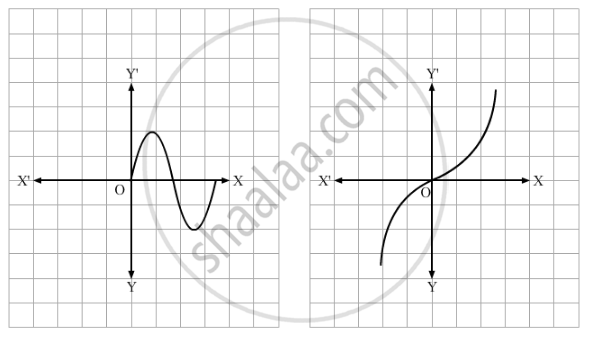
Write the total number of one-one functions from set A = {1, 2, 3, 4} to set B = {a, b, c}.
Let f be a function from C (set of all complex numbers) to itself given by f(x) = x3. Write f−1 (−1).
Write the domain of the real function
`f (x) = 1/(sqrt([x] - x)`.
What is the range of the function
`f (x) = ([x - 1])/(x -1) ?`
If a function\[f : [2, \infty )\text{ to B defined by f}\left( x \right) = x^2 - 4x + 5\] is a bijection, then B =
The function
Which of the following functions from
\[A = \left\{ x \in R : - 1 \leq x \leq 1 \right\}\]
Let
\[f : [2, \infty ) \to X\] be defined by
\[f\left( x \right) = 4x - x^2\] Then, f is invertible if X =
If \[f : R \to \left( - 1, 1 \right)\] is defined by
\[f\left( x \right) = \frac{- x|x|}{1 + x^2}, \text{ then } f^{- 1} \left( x \right)\] equals
If \[f\left( x \right) = \sin^2 x\] and the composite function \[g\left( f\left( x \right) \right) = \left| \sin x \right|\] then g(x) is equal to
Let f: R → R be the function defined by f(x) = 2x – 3 ∀ x ∈ R. write f–1
Are the following set of ordered pairs functions? If so, examine whether the mapping is injective or surjective.
{(a, b): a is a person, b is an ancestor of a}
Let the function f: R → R be defined by f(x) = cosx, ∀ x ∈ R. Show that f is neither one-one nor onto
If f(x) = (4 – (x – 7)3}, then f–1(x) = ______.
Let x is a real number such that are functions involved are well defined then the value of `lim_(t→0)[max{(sin^-1 x/3 + cos^-1 x/3)^2, min(x^2 + 4x + 7)}]((sin^-1t)/t)` where [.] is greatest integer function and all other brackets are usual brackets.
Let f(1, 3) `rightarrow` R be a function defined by f(x) = `(x[x])/(1 + x^2)`, where [x] denotes the greatest integer ≤ x, Then the range of f is ______.
Let f(n) = `[1/3 + (3n)/100]n`, where [n] denotes the greatest integer less than or equal to n. Then `sum_(n = 1)^56f(n)` is equal to ______.
For x ∈ R, x ≠ 0, let f0(x) = `1/(1 - x)` and fn+1 (x) = f0(fn(x)), n = 0, 1, 2, .... Then the value of `f_100(3) + f_1(2/3) + f_2(3/2)` is equal to ______.
If f : R `rightarrow` R is defined by `f(x) = (2x - 7)/4`, show that f(x) is one-one and onto.
The function defined by \[\mathrm{f}(x)=\frac{2x+3}{3x+4},x\neq-\frac{4}{3}\] is
