Advertisements
Advertisements
प्रश्न
Find fog and gof if : f (x) = x2 g(x) = cos x .
Advertisements
उत्तर
f (x) = x2, g(x) = cos x
f : R→ [0, ∞) ; g : R→[−1, 1]
Computing fog :
Clearly, the range of g is not a subset of the domain of f.
⇒ Domain (fog) = {x: x∈domain of g and g (x) ∈domain of f}
⇒ Domain (fog) = x : x ∈ R and cos x ∈ R}
⇒ Domain of (fog) = R
fog : R→ R
(fog) (x) = f (g (x))
= f ( cos x )
= cos2x
Computing gof :
Clearly, the range of f is a subset of the domain of g.
⇒ fog : R→R
(gof) (x) = g (f (x))
= g (x2)
= cos ( x2)
APPEARS IN
संबंधित प्रश्न
Classify the following function as injection, surjection or bijection : f : Z → Z given by f(x) = x2
Classify the following function as injection, surjection or bijection :
f : Z → Z, defined by f(x) = x − 5
Show that f : R→ R, given by f(x) = x — [x], is neither one-one nor onto.
If f : A → B and g : B → C are onto functions, show that gof is a onto function.
Find fog and gof if : f (x) = |x|, g (x) = sin x .
if f (x) = `sqrt (x +3) and g (x) = x ^2 + 1` be two real functions, then find fog and gof.
State with reason whether the following functions have inverse:
h : {2, 3, 4, 5} → {7, 9, 11, 13} with h = {(2, 7), (3, 9), (4, 11), (5, 13)}
Let A = {1, 2, 3, 4}; B = {3, 5, 7, 9}; C = {7, 23, 47, 79} and f : A → B, g : B → C be defined as f(x) = 2x + 1 and g(x) = x2 − 2. Express (gof)−1 and f−1 og−1 as the sets of ordered pairs and verify that (gof)−1 = f−1 og−1.
If A = {1, 2, 3, 4} and B = {a, b, c, d}, define any four bijections from A to B. Also give their inverse functions.
Which one of the following graphs represents a function?
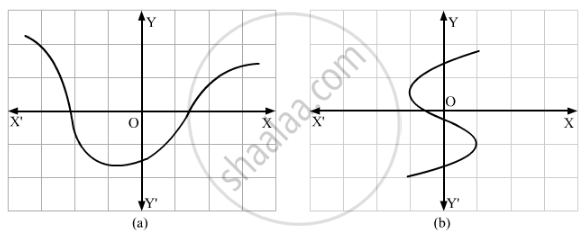
If A = {a, b, c} and B = {−2, −1, 0, 1, 2}, write the total number of one-one functions from A to B.
If f : R → R is given by f(x) = x3, write f−1 (1).
If f : R → R is defined by f(x) = x2, find f−1 (−25).
Let \[f : \left( - \frac{\pi}{2}, \frac{\pi}{2} \right) \to R\] be a function defined by f(x) = cos [x]. Write range (f).
Let \[f : \left[ - \frac{\pi}{2}, \frac{\pi}{2} \right] \to\] A be defined by f(x) = sin x. If f is a bijection, write set A.
The function f : R → R defined by
`f (x) = 2^x + 2^(|x|)` is
Let the function
\[f : R - \left\{ - b \right\} \to R - \left\{ 1 \right\}\]
\[f\left( x \right) = \frac{x + a}{x + b}, a \neq b .\text{Then},\]
Let
\[A = \left\{ x \in R : x \geq 1 \right\}\] The inverse of the function,
\[f : A \to A\] given by
\[f\left( x \right) = 2^{x \left( x - 1 \right)} , is\]
If \[f : R \to R\] is given by \[f\left( x \right) = x^3 + 3, \text{then} f^{- 1} \left( x \right)\] is equal to
Mark the correct alternative in the following question:
Let f : R→ R be defined as, f(x) = \[\begin{cases}2x, if x > 3 \\ x^2 , if 1 < x \leq 3 \\ 3x, if x \leq 1\end{cases}\]
Then, find f( \[-\]1) + f(2) + f(4)
A function f: R→ R defined by f(x) = `(3x) /5 + 2`, x ∈ R. Show that f is one-one and onto. Hence find f−1.
Set A has 3 elements and the set B has 4 elements. Then the number of injective mappings that can be defined from A to B is ______.
The domain of the function f: R → R defined by f(x) = `sqrt(x^2 - 3x + 2)` is ______
For sets A, B and C, let f: A → B, g: B → C be functions such that g o f is injective. Then both f and g are injective functions.
Let X = {1, 2, 3}and Y = {4, 5}. Find whether the following subset of X ×Y are function from X to Y or not
h = {(1,4), (2, 5), (3, 5)}
Let X = {1, 2, 3}and Y = {4, 5}. Find whether the following subset of X ×Y are function from X to Y or not
k = {(1,4), (2, 5)}
Let A = {0, 1} and N be the set of natural numbers. Then the mapping f: N → A defined by f(2n – 1) = 0, f(2n) = 1, ∀ n ∈ N, is onto.
The smallest integer function f(x) = [x] is ____________.
The function f : R → R defined by f(x) = 3 – 4x is ____________.
Let f : R → R be a function defined by f(x) `= ("e"^abs"x" - "e"^-"x")/("e"^"x" + "e"^-"x")` then f(x) is
Let g(x) = x2 – 4x – 5, then ____________.
The function f : R → R given by f(x) = x3 – 1 is ____________.
Let f : [0, ∞) → [0, 2] be defined by `"f" ("x") = (2"x")/(1 + "x"),` then f is ____________.
Raji visited the Exhibition along with her family. The Exhibition had a huge swing, which attracted many children. Raji found that the swing traced the path of a Parabola as given by y = x2.
Answer the following questions using the above information.
- Let f: N → N be defined by f(x) = x2 is ____________.
If f; R → R f(x) = 10x + 3 then f–1(x) is:
The domain of function is f(x) = `sqrt(-log_0.3(x - 1))/sqrt(x^2 + 2x + 8)` is ______.
Find the domain of sin–1 (x2 – 4).
Which condition represents an into function?
