Advertisements
Advertisements
प्रश्न
If a function\[f : [2, \infty )\text{ to B defined by f}\left( x \right) = x^2 - 4x + 5\] is a bijection, then B =
विकल्प
R
[1, ∞)
[4, ∞)
[5, ∞)
Advertisements
उत्तर
Since f is a bijection, co-domain of f = range of f
⇒ B = range of f
\[\text{Given}: f\left( x \right) = x^2 - 4x + 5\]
\[\text{Let}f\left( x \right) = y\]
\[ \Rightarrow y = x^2 - 4x + 5\]
\[ \Rightarrow x^2 - 4x + \left( 5 - y \right) = 0\]
\[ \because \text{Discrimant}, D = b^2 - 4ac \geq 0, \]
\[ \left( - 4 \right)^2 - 4 \times 1 \times \left( 5 - y \right) \geq 0\]
\[ \Rightarrow 16 - 20 + 4y \geq 0\]
\[ \Rightarrow 4y \geq 4\]
\[ \Rightarrow y \geq 1\]
\[ \Rightarrow y \in [1, \infty )\]
\[ \Rightarrow \text{Range of f} = [1, \infty )\]
\[ \Rightarrow B = [1, \infty )\]
So, the answer is (b).
APPEARS IN
संबंधित प्रश्न
Show that the function f in `A=R-{2/3} ` defined as `f(x)=(4x+3)/(6x-4)` is one-one and onto hence find f-1
Show that the function f : R* → R* defined by f(x) = `1/x` is one-one and onto, where R* is the set of all non-zero real numbers. Is the result true, if the domain R* is replaced by N with co-domain being same as R?
Check the injectivity and surjectivity of the following function:
f : Z → Z given by f(x) = x2
Check the injectivity and surjectivity of the following function:
f : R → R given by f(x) = x2
Let S = {a, b, c} and T = {1, 2, 3}. Find F−1 of the following functions F from S to T, if it exists.
F = {(a, 3), (b, 2), (c, 1)}
Classify the following function as injection, surjection or bijection :
f : R → R, defined by f(x) = x3 + 1
Give examples of two surjective functions f1 and f2 from Z to Z such that f1 + f2 is not surjective.
Let A = {a, b, c}, B = {u v, w} and let f and g be two functions from A to B and from B to A, respectively, defined as :
f = {(a, v), (b, u), (c, w)}, g = {(u, b), (v, a), (w, c)}.
Show that f and g both are bijections and find fog and gof.
Let f(x) = x2 + x + 1 and g(x) = sin x. Show that fog ≠ gof.
If f(x) = 2x + 5 and g(x) = x2 + 1 be two real functions, then describe each of the following functions:
(1) fog
(2) gof
(3) fof
(4) f2
Also, show that fof ≠ f2
State with reason whether the following functions have inverse:
h : {2, 3, 4, 5} → {7, 9, 11, 13} with h = {(2, 7), (3, 9), (4, 11), (5, 13)}
If f : Q → Q, g : Q → Q are two functions defined by f(x) = 2 x and g(x) = x + 2, show that f and g are bijective maps. Verify that (gof)−1 = f−1 og −1.
Which one of the following graphs represents a function?
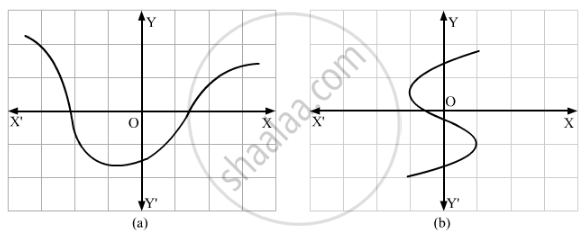
Let `f : R - {- 3/5}` → R be a function defined as `f (x) = (2x)/(5x +3).`
f-1 : Range of f → `R -{-3/5}`.
If f : {5, 6} → {2, 3} and g : {2, 3} → {5, 6} are given by f = {(5, 2), (6, 3)} and g = {(2, 5), (3, 6)}, then find fog. [NCERT EXEMPLAR]
Which one the following relations on A = {1, 2, 3} is a function?
f = {(1, 3), (2, 3), (3, 2)}, g = {(1, 2), (1, 3), (3, 1)} [NCERT EXEMPLAR]
Which of the following functions from
to itself are bijections?
Let
\[A = \left\{ x : - 1 \leq x \leq 1 \right\} \text{and} f : A \to \text{A such that f}\left( x \right) = x|x|\]
Which of the following functions from
\[A = \left\{ x \in R : - 1 \leq x \leq 1 \right\}\]
Let \[f\left( x \right) = \frac{1}{1 - x} . \text{Then}, \left\{ f o \left( fof \right) \right\} \left( x \right)\]
If \[F : [1, \infty ) \to [2, \infty )\] is given by
\[f\left( x \right) = x + \frac{1}{x}, then f^{- 1} \left( x \right)\]
Let A = R − (2) and B = R − (1). If f: A ⟶ B is a function defined by`"f(x)"=("x"-1)/("x"-2),` how that f is one-one and onto. Hence, find f−1.
Write about strcmp() function.
Let the function f: R → R be defined by f(x) = 4x – 1, ∀ x ∈ R. Then, show that f is one-one.
Let R be the set of real numbers and f: R → R be the function defined by f(x) = 4x + 5. Show that f is invertible and find f–1.
The domain of the function f: R → R defined by f(x) = `sqrt(x^2 - 3x + 2)` is ______
If f: R → R is defined by f(x) = x2 – 3x + 2, write f(f (x))
Let f: `[2, oo)` → R be the function defined by f(x) = x2 – 4x + 5, then the range of f is ______.
Let X = {-1, 0, 1}, Y = {0, 2} and a function f : X → Y defiend by y = 2x4, is ____________.
Let f : R → R be a function defined by f(x) `= ("e"^abs"x" - "e"^-"x")/("e"^"x" + "e"^-"x")` then f(x) is
If N be the set of all-natural numbers, consider f: N → N such that f(x) = 2x, ∀ x ∈ N, then f is ____________.
Let f: R → R defined by f(x) = x4. Choose the correct answer
Prove that the function f is surjective, where f: N → N such that `f(n) = {{:((n + 1)/2",", if "n is odd"),(n/2",", if "n is even"):}` Is the function injective? Justify your answer.
Let f: R→R be defined as f(x) = 2x – 1 and g: R – {1}→R be defined as g(x) = `(x - 1/2)/(x - 1)`. Then the composition function f (g(x)) is ______.
Let A = R – {2} and B = R – {1}. If f: A `→` B is a function defined by f(x) = `(x - 1)/(x - 2)` then show that f is a one-one and an onto function.

The given function f : R → R is not ‘onto’ function. Give reason.
A function is called into if:
A perfect one-to-one matching between users and unique IDs is similar to:
Which condition represents a one-one (injective) function?
