Advertisements
Advertisements
प्रश्न
Classify the following function as injection, surjection or bijection :
f : R → R, defined by f(x) = 3 − 4x
Advertisements
उत्तर
f : R → R, defined by f(x) = 3 − 4x
Injection test:
Let x and y be any two elements in the domain (R), such that f(x) = f(y).
f(x) = f(y)
3−4x = 3−4y
−4x = −4y
x = y
So, f is an injection .
Surjection test:
Let y be any element in the co-domain (R), such that f(x) = y for some element x in R (domain).
f(x) = y
3 − 4x = y
4x = 3−y
`x = (3-y)/4`∈ R
So, f is a surjection and f is a bijection.
APPEARS IN
संबंधित प्रश्न
Show that the function f : R* → R* defined by f(x) = `1/x` is one-one and onto, where R* is the set of all non-zero real numbers. Is the result true, if the domain R* is replaced by N with co-domain being same as R?
In the following case, state whether the function is one-one, onto or bijective. Justify your answer.
f : R → R defined by f(x) = 3 – 4x
Let f : R → R be defined as f(x) = 3x. Choose the correct answer.
Let f: R → R be defined as f(x) = 10x + 7. Find the function g: R → R such that g o f = f o g = 1R.
Give an example of a function which is neither one-one nor onto ?
Prove that the function f : N → N, defined by f(x) = x2 + x + 1, is one-one but not onto
Classify the following function as injection, surjection or bijection : f : N → N given by f(x) = x2
Classify the following function as injection, surjection or bijection :
f : Q → Q, defined by f(x) = x3 + 1
Classify the following function as injection, surjection or bijection :
f : R → R, defined by f(x) = 5x3 + 4
Give examples of two surjective functions f1 and f2 from Z to Z such that f1 + f2 is not surjective.
Let A = {a, b, c}, B = {u v, w} and let f and g be two functions from A to B and from B to A, respectively, defined as :
f = {(a, v), (b, u), (c, w)}, g = {(u, b), (v, a), (w, c)}.
Show that f and g both are bijections and find fog and gof.
Find fog and gof if : f (x) = ex g(x) = loge x .
Let f, g, h be real functions given by f(x) = sin x, g (x) = 2x and h (x) = cos x. Prove that fog = go (fh).
State with reason whether the following functions have inverse:
h : {2, 3, 4, 5} → {7, 9, 11, 13} with h = {(2, 7), (3, 9), (4, 11), (5, 13)}
A function f : R → R is defined as f(x) = x3 + 4. Is it a bijection or not? In case it is a bijection, find f−1 (3).
Consider the function f : R+ → [-9 , ∞ ]given by f(x) = 5x2 + 6x - 9. Prove that f is invertible with f -1 (y) = `(sqrt(54 + 5y) -3)/5` [CBSE 2015]
Which one of the following graphs represents a function?
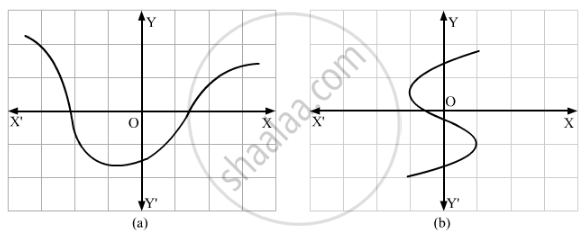
Let f be a function from C (set of all complex numbers) to itself given by f(x) = x3. Write f−1 (−1).
Let f : R − {−1} → R − {1} be given by\[f\left( x \right) = \frac{x}{x + 1} . \text{Write } f^{- 1} \left( x \right)\]
What is the range of the function
`f (x) = ([x - 1])/(x -1) ?`
Which one the following relations on A = {1, 2, 3} is a function?
f = {(1, 3), (2, 3), (3, 2)}, g = {(1, 2), (1, 3), (3, 1)} [NCERT EXEMPLAR]
The function
f : A → B defined by
f (x) = - x2 + 6x - 8 is a bijection if
Let
f : R → R be given by
\[f\left( x \right) = \left[ x^2 \right] + \left[ x + 1 \right] - 3\]
where [x] denotes the greatest integer less than or equal to x. Then, f(x) is
(d) one-one and onto
A function f from the set of natural numbers to integers defined by
`{([n-1]/2," when n is odd" is ),(-n/2,when n is even ) :}`
The function
If \[F : [1, \infty ) \to [2, \infty )\] is given by
\[f\left( x \right) = x + \frac{1}{x}, then f^{- 1} \left( x \right)\]
Let f: R → R be defined by f(x) = x2 + 1. Then, pre-images of 17 and – 3, respectively, are ______.
Let D be the domain of the real valued function f defined by f(x) = `sqrt(25 - x^2)`. Then, write D
Let C be the set of complex numbers. Prove that the mapping f: C → R given by f(z) = |z|, ∀ z ∈ C, is neither one-one nor onto.
Let A = [–1, 1]. Then, discuss whether the following functions defined on A are one-one, onto or bijective:
g(x) = |x|
Let A = [–1, 1]. Then, discuss whether the following functions defined on A are one-one, onto or bijective:
h(x) = x|x|
If the set A contains 5 elements and the set B contains 6 elements, then the number of one-one and onto mappings from A to B is ______.
Let f: R – `{3/5}` → R be defined by f(x) = `(3x + 2)/(5x - 3)`. Then ______.
The function f : R → R defined by f(x) = 3 – 4x is ____________.
Let f : [0, ∞) → [0, 2] be defined by `"f" ("x") = (2"x")/(1 + "x"),` then f is ____________.
If f: R→R is a function defined by f(x) = `[x - 1]cos((2x - 1)/2)π`, where [ ] denotes the greatest integer function, then f is ______.
A function f : [– 4, 4] `rightarrow` [0, 4] is given by f(x) = `sqrt(16 - x^2)`. Show that f is an onto function but not a one-one function. Further, find all possible values of 'a' for which f(a) = `sqrt(7)`.
A function is called one-one if different elements of the domain have:
A function is called bijective if it is both:
If every seat in a classroom is occupied by one student, the situation resembles:
