Advertisements
Advertisements
प्रश्न
\[f : A \to \text{B given by } 3^{ f\left( x \right)} + 2^{- x} = 4\] is a bijection, then
विकल्प
\[A = \left\{ x \in R : - 1 < x < \infty \right\}, B = \left\{ x \in R : 2 < x < 4 \right\}\]
\[A = \left\{ x \in R : - 3 < x < \infty \right\}, B = \left\{ x \in R : 2 < x < 4 \right\}\]
\[A = \left\{ x \in R : - 3 < x < \infty \right\}, B = \left\{ x \in R : 2 < x < 4 \right\}\]
None of these
Advertisements
उत्तर
(d) None of these
\[f: A \to B\]
\[ 3^{f(x)} + 2^{- x} = 4 \]
\[ \Rightarrow 3^{f(x)} = 4 - 2^{- x} \]
\[\text{Taking log on both the sides} , \]
\[f(x) \log 3 = \log \left( 4 - 2^{- x} \right)\]
\[ \Rightarrow f(x) = \frac{\log \left( 4 - 2^{- x} \right)}{\log 3}\]
\[\text{Logaritmic function will only be defined if} 4 - 2^{- x} > 0\]
\[ \Rightarrow 4 > 2^{- x} \]
\[ \Rightarrow 2^2 > 2^{- x} \]
\[ \Rightarrow 2 > - x\]
\[ \Rightarrow - 2 < x\]
\[ \Rightarrow x \in \left( - 2, \infty \right)\]
\[\text{That means A} = \left\{ x \in R: - 2 < x < \infty \right\}\]
\[\text{As we know that}, f(x) = \frac{\log \left( 4 - 2^{- x} \right)}{\log 3}\]
\[\text{ We take } x = 0 \in \left( - 2, \infty \right)\]
\[ \Rightarrow f(x) = 1 \text{which does not belong to any of the options} . \]
APPEARS IN
संबंधित प्रश्न
Classify the following function as injection, surjection or bijection : f : Z → Z given by f(x) = x2
Find gof and fog when f : R → R and g : R → R is defined by f(x) = x2 + 8 and g(x) = 3x3 + 1 .
Let f : R → R and g : R → R be defined by f(x) = x2 and g(x) = x + 1. Show that fog ≠ gof.
Consider f : N → N, g : N → N and h : N → R defined as f(x) = 2x, g(y) = 3y + 4 and h(z) = sin z for all x, y, z ∈ N. Show that ho (gof) = (hog) of.
Find fog and gof if : f (x) = ex g(x) = loge x .
Find fog and gof if : f (x) = |x|, g (x) = sin x .
If f(x) = |x|, prove that fof = f.
if `f (x) = sqrt(1-x)` and g(x) = `log_e` x are two real functions, then describe functions fog and gof.
Show that the function f : Q → Q, defined by f(x) = 3x + 5, is invertible. Also, find f−1
Let A = R - {3} and B = R - {1}. Consider the function f : A → B defined by f(x) = `(x-2)/(x-3).`Show that f is one-one and onto and hence find f-1.
[CBSE 2012, 2014]
If f : R → (−1, 1) defined by `f (x) = (10^x- 10^-x)/(10^x + 10 ^-x)` is invertible, find f−1.
Let f be a function from R to R, such that f(x) = cos (x + 2). Is f invertible? Justify your answer.
Which of the following graphs represents a one-one function?
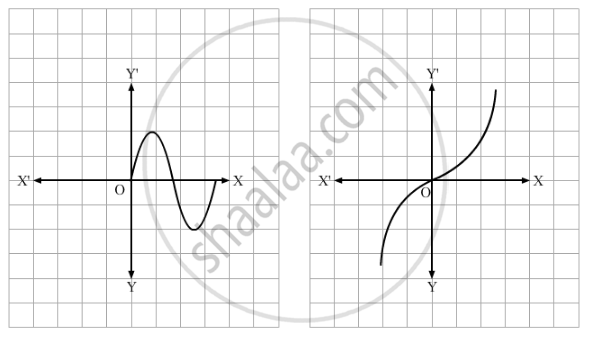
If f : R → R is defined by f(x) = x2, find f−1 (−25).
Let
f : R → R be given by
\[f\left( x \right) = \left[ x^2 \right] + \left[ x + 1 \right] - 3\]
where [x] denotes the greatest integer less than or equal to x. Then, f(x) is
(d) one-one and onto
Which of the following functions form Z to itself are bijections?
If \[F : [1, \infty ) \to [2, \infty )\] is given by
\[f\left( x \right) = x + \frac{1}{x}, then f^{- 1} \left( x \right)\]
The distinct linear functions that map [−1, 1] onto [0, 2] are
If \[f : R \to \left( - 1, 1 \right)\] is defined by
\[f\left( x \right) = \frac{- x|x|}{1 + x^2}, \text{ then } f^{- 1} \left( x \right)\] equals
Let f: R → R be the function defined by f(x) = 4x – 3 ∀ x ∈ R. Then write f–1
Let N be the set of natural numbers and the function f: N → N be defined by f(n) = 2n + 3 ∀ n ∈ N. Then f is ______.
Let f: R → R be defined by f(x) = 3x – 4. Then f–1(x) is given by ______.
Let X = {1, 2, 3}and Y = {4, 5}. Find whether the following subset of X ×Y are function from X to Y or not
f = {(1, 4), (1, 5), (2, 4), (3, 5)}
Let A = [–1, 1]. Then, discuss whether the following functions defined on A are one-one, onto or bijective:
h(x) = x|x|
Let A = {1, 2, 3, ...n} and B = {a, b}. Then the number of surjections from A into B is ______.
Let f: R – `{3/5}` → R be defined by f(x) = `(3x + 2)/(5x - 3)`. Then ______.
Which of the following functions from Z into Z is bijective?
Let g(x) = x2 – 4x – 5, then ____________.
Let f : R → R, g : R → R be two functions such that f(x) = 2x – 3, g(x) = x3 + 5. The function (fog)-1 (x) is equal to ____________.
Raji visited the Exhibition along with her family. The Exhibition had a huge swing, which attracted many children. Raji found that the swing traced the path of a Parabola as given by y = x2.
Answer the following questions using the above information.
- Let f: N → N be defined by f(x) = x2 is ____________.
Raji visited the Exhibition along with her family. The Exhibition had a huge swing, which attracted many children. Raji found that the swing traced the path of a Parabola as given by y = x2.
Answer the following questions using the above information.
- Let : N → R be defined by f(x) = x2. Range of the function among the following is ____________.
If log102 = 0.3010.log103 = 0.4771 then the number of ciphers after decimal before a significant figure comes in `(5/3)^-100` is ______.
The solution set of the inequation log1/3(x2 + x + 1) + 1 > 0 is ______.
The graph of the function y = f(x) is symmetrical about the line x = 2, then ______.
For x ∈ R, x ≠ 0, let f0(x) = `1/(1 - x)` and fn+1 (x) = f0(fn(x)), n = 0, 1, 2, .... Then the value of `f_100(3) + f_1(2/3) + f_2(3/2)` is equal to ______.
A function is called one-one if different elements of the domain have:
For \(f(x)=x^2+x\), if \(y=1\), which two domain elements have the same image?
Which real-life situation resembles a one-one idea when no roll number is repeated?
