Advertisements
Advertisements
प्रश्न
Let X = {1, 2, 3}and Y = {4, 5}. Find whether the following subset of X ×Y are function from X to Y or not
h = {(1,4), (2, 5), (3, 5)}
Advertisements
उत्तर
Given, X = {1, 2, 3} and Y = {4, 5}
So, X × Y = {(1, 4), (1, 5), (2, 4), (2, 5), (3, 4), (3, 5)}
h = {(1,4), (2, 5), (3, 5)}
It’s seen clearly that h is a function as each pre-image with a unique image.
And, function h is many-one as h(2) = h(3) = 5
APPEARS IN
संबंधित प्रश्न
Show that the function f : R* → R* defined by f(x) = `1/x` is one-one and onto, where R* is the set of all non-zero real numbers. Is the result true, if the domain R* is replaced by N with co-domain being same as R?
Check the injectivity and surjectivity of the following function:
f : N → N given by f(x) = x3
Prove that the greatest integer function f : R → R, given by f(x) = [x], is neither one-one nor onto, where [x] denotes the greatest integer less than or equal to x.
Classify the following function as injection, surjection or bijection :
f : R → R, defined by f(x) = |x|
Classify the following function as injection, surjection or bijection :
f : R → R, defined by f(x) = x3 − x
Classify the following function as injection, surjection or bijection :
f : R → R, defined by f(x) = sin2x + cos2x
Classify the following function as injection, surjection or bijection :
f : Q → Q, defined by f(x) = x3 + 1
if `f (x) = sqrt(1-x)` and g(x) = `log_e` x are two real functions, then describe functions fog and gof.
Show that the function f : Q → Q, defined by f(x) = 3x + 5, is invertible. Also, find f−1
Let f : [−1, ∞) → [−1, ∞) be given by f(x) = (x + 1)2 − 1, x ≥ −1. Show that f is invertible. Also, find the set S = {x : f(x) = f−1 (x)}.
If A = {1, 2, 3, 4} and B = {a, b, c, d}, define any four bijections from A to B. Also give their inverse functions.
Which of the following graphs represents a one-one function?
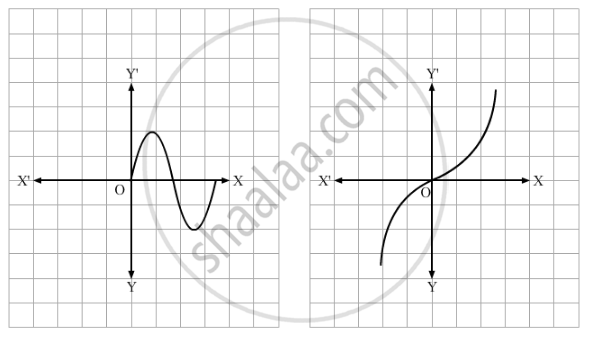
If f : R → R, g : R → are given by f(x) = (x + 1)2 and g(x) = x2 + 1, then write the value of fog (−3).
If f : R → R be defined by f(x) = (3 − x3)1/3, then find fof (x).
Let A = {a, b, c, d} and f : A → A be given by f = {( a,b ),( b , d ),( c , a ) , ( d , c )} write `f^-1`. [NCERT EXEMPLAR]
The range of the function
\[f\left( x \right) =^{7 - x} P_{x - 3}\]
Let
\[f : R \to R\] be a function defined by
A function f from the set of natural numbers to the set of integers defined by
\[f\left( n \right)\begin{cases}\frac{n - 1}{2}, & \text{when n is odd} \\ - \frac{n}{2}, & \text{when n is even}\end{cases}\]
Let
\[A = \left\{ x \in R : x \geq 1 \right\}\] The inverse of the function,
\[f : A \to A\] given by
\[f\left( x \right) = 2^{x \left( x - 1 \right)} , is\]
If \[f\left( x \right) = \sin^2 x\] and the composite function \[g\left( f\left( x \right) \right) = \left| \sin x \right|\] then g(x) is equal to
Let \[f\left(x\right) = x^3\] be a function with domain {0, 1, 2, 3}. Then domain of \[f^{-1}\] is ______.
Mark the correct alternative in the following question:
Let f : R \[-\] \[\left\{ \frac{3}{5} \right\}\] \[\to\] R be defined by f(x) = \[\frac{3x + 2}{5x - 3}\] Then,
Let f: R → R be the function defined by f(x) = 4x – 3 ∀ x ∈ R. Then write f–1
If A = {a, b, c, d} and f = {a, b), (b, d), (c, a), (d, c)}, show that f is one-one from A onto A. Find f–1
Show that the function f: R → R defined by f(x) = `x/(x^2 + 1)`, ∀ ∈ + R , is neither one-one nor onto
Let f: R → R be the function defined by f(x) = 2x – 3 ∀ x ∈ R. write f–1
Let X = {1, 2, 3}and Y = {4, 5}. Find whether the following subset of X ×Y are function from X to Y or not
g = {(1, 4), (2, 4), (3, 4)}
Let A = [–1, 1]. Then, discuss whether the following functions defined on A are one-one, onto or bijective:
f(x) = `x/2`
Let A = [–1, 1]. Then, discuss whether the following functions defined on A are one-one, onto or bijective:
g(x) = |x|
Let A = [–1, 1]. Then, discuss whether the following functions defined on A are one-one, onto or bijective:
h(x) = x|x|
The function f : A → B defined by f(x) = 4x + 7, x ∈ R is ____________.
Sherlin and Danju are playing Ludo at home during Covid-19. While rolling the dice, Sherlin’s sister Raji observed and noted the possible outcomes of the throw every time belongs to set {1,2,3,4,5,6}. Let A be the set of players while B be the set of all possible outcomes.
A = {S, D}, B = {1,2,3,4,5,6}
- Raji wants to know the number of functions from A to B. How many number of functions are possible?
The solution set of the inequation log1/3(x2 + x + 1) + 1 > 0 is ______.
Let a and b are two positive integers such that b ≠ 1. Let g(a, b) = Number of lattice points inside the quadrilateral formed by lines x = 0, y = 0, x = b and y = a. f(a, b) = `[a/b] + [(2a)/b] + ... + [((b - 1)a)/b]`, then the value of `[(g(101, 37))/(f(101, 37))]` is ______.
(Note P(x, y) is lattice point if x, y ∈ I)
(where [.] denotes greatest integer function)
If f : R `rightarrow` R is defined by `f(x) = (2x - 7)/4`, show that f(x) is one-one and onto.
The function defined by \[\mathrm{f}(x)=\frac{2x+3}{3x+4},x\neq-\frac{4}{3}\] is
The function \(f:\mathbb{N}\to\mathbb{N}\) defined by \(f(x)=5x\) is:
Many students choosing the same favourite subject resembles which type of function?
Which condition represents an into function?
Which condition represents a many-one function?
