Advertisements
Advertisements
प्रश्न
A function f from the set of natural numbers to integers defined by
`{([n-1]/2," when n is odd" is ),(-n/2,when n is even ) :}`
विकल्प
neither one-one nor onto
one-one but not onto
onto but not one-one
one-one and onto both
Advertisements
उत्तर
one-one and onto both
Injectivity:
Let x and y be any two elements in the domain (N).
\[\text{Case}-1: \text{Bothxandyare even}.\]
\[\text{Let}f\left( x \right) = f\left( y \right)\]
\[ \Rightarrow \frac{- x}{2} = \frac{- y}{2}\]
\[ \Rightarrow - x = - y\]
\[ \Rightarrow x = y\]
\[\text{Case}-2: \text{Bothxandyare odd}.\]
\[Letf\left( x \right) = f\left( y \right)\]
\[ \Rightarrow \frac{x - 1}{2} = \frac{y - 1}{2}\]
\[ \Rightarrow x - 1 = y - 1\]
\[ \Rightarrow x = y\]
\[Case-3:\text{Let x be even andybe odd}.\]
\[\text{Then},f\left( x \right) = \frac{- x}{2}\text{and}f\left( y \right) = \frac{y - 1}{2}\]
\[\text{Then, clearly}\]
\[x \neq y \]
\[ \Rightarrow f\left( x \right) \neq f\left( y \right)\]
\[\text{From all the cases,f is one-one}.\]
Surjectivity:
\[\text{Co-domain of f} = Z = \left\{ . . . , - 3, - 2, - 1, 0, 1, 2, 3, . . . . \right\}\]
\[\text{Range of f } = \left\{ . . . , \frac{- 3 - 1}{2}, \frac{- \left( - 2 \right)}{2}, \frac{- 1 - 1}{2}, \frac{0}{2}, \frac{1 - 1}{2}, \frac{- 2}{2}, \frac{3 - 1}{2}, . . . \right\}\]
\[ \Rightarrow \text{Range of f} = \left\{ . . . , - 2, 1, - 1, 0, 0, - 1, 1, . . . \right\}\]
\[ \Rightarrow \text{Range of f} = \left\{ . . . , - 2, - 1, 0, 1, 2, . . . . \right\}\]
\[ \Rightarrow \text{Co-domain of f} = \text{Range of f}\]
⇒ f is onto.
APPEARS IN
संबंधित प्रश्न
Check the injectivity and surjectivity of the following function:
f : Z → Z given by f(x) = x2
Classify the following function as injection, surjection or bijection :
f : R → R, defined by f(x) = |x|
Classify the following function as injection, surjection or bijection :
f : R → R, defined by f(x) = `x/(x^2 +1)`
Set of ordered pair of a function ? If so, examine whether the mapping is injective or surjective :{(a, b) : a is a person, b is an ancestor of a}
If f : A → B and g : B → C are onto functions, show that gof is a onto function.
Find f −1 if it exists : f : A → B, where A = {0, −1, −3, 2}; B = {−9, −3, 0, 6} and f(x) = 3 x.
Let A = {1, 2, 3, 4}; B = {3, 5, 7, 9}; C = {7, 23, 47, 79} and f : A → B, g : B → C be defined as f(x) = 2x + 1 and g(x) = x2 − 2. Express (gof)−1 and f−1 og−1 as the sets of ordered pairs and verify that (gof)−1 = f−1 og−1.
If f : R → R be defined by f(x) = x3 −3, then prove that f−1 exists and find a formula for f−1. Hence, find f−1(24) and f−1 (5).
A function f : R → R is defined as f(x) = x3 + 4. Is it a bijection or not? In case it is a bijection, find f−1 (3).
Consider the function f : R+ → [-9 , ∞ ]given by f(x) = 5x2 + 6x - 9. Prove that f is invertible with f -1 (y) = `(sqrt(54 + 5y) -3)/5` [CBSE 2015]
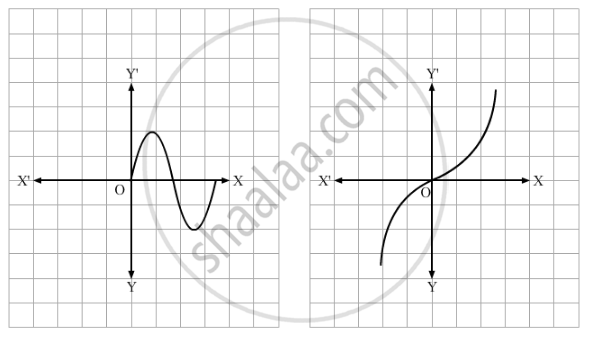
Which of the following graphs represents a one-one function?
Let f : R → R+ be defined by f(x) = ax, a > 0 and a ≠ 1. Write f−1 (x).
Let f : R − {−1} → R − {1} be given by\[f\left( x \right) = \frac{x}{x + 1} . \text{Write } f^{- 1} \left( x \right)\]
What is the range of the function
`f (x) = ([x - 1])/(x -1) ?`
Let f, g : R → R be defined by f(x) = 2x + l and g(x) = x2−2 for all x
∈ R, respectively. Then, find gof. [NCERT EXEMPLAR]
Which of the following functions form Z to itself are bijections?
Let
\[A = \left\{ x : - 1 \leq x \leq 1 \right\} \text{and} f : A \to \text{A such that f}\left( x \right) = x|x|\]
If the function\[f : R \to \text{A given by} f\left( x \right) = \frac{x^2}{x^2 + 1}\] is a surjection, then A =
The function f : [-1/2, 1/2, 1/2] → [-π /2,π/2], defined by f (x) = `sin^-1` (3x - `4x^3`), is
If \[g \left( f \left( x \right) \right) = \left| \sin x \right| \text{and} f \left( g \left( x \right) \right) = \left( \sin \sqrt{x} \right)^2 , \text{then}\]
Let the function f: R → R be defined by f(x) = 4x – 1, ∀ x ∈ R. Then, show that f is one-one.
Let f: R → R be defined by f(x) = x2 + 1. Then, pre-images of 17 and – 3, respectively, are ______.
Let D be the domain of the real valued function f defined by f(x) = `sqrt(25 - x^2)`. Then, write D
Let f: R → R be the function defined by f(x) = 2x – 3 ∀ x ∈ R. write f–1
Are the following set of ordered pairs functions? If so, examine whether the mapping is injective or surjective.
{(a, b): a is a person, b is an ancestor of a}
Let A = [–1, 1]. Then, discuss whether the following functions defined on A are one-one, onto or bijective:
g(x) = |x|
The number of bijective functions from set A to itself when A contains 106 elements is ____________.
Let f : [0, ∞) → [0, 2] be defined by `"f" ("x") = (2"x")/(1 + "x"),` then f is ____________.
Let f : R `->` R be a function defined by f(x) = x3 + 4, then f is ______.
Let A = {1, 2, 3}, B = {4, 5, 6, 7} and let f = {(1, 4), (2, 5), (3, 6)} be a function from A to B. Based on the given information, f is best defined as:
An organization conducted a bike race under 2 different categories-boys and girls. Totally there were 250 participants. Among all of them finally, three from Category 1 and two from Category 2 were selected for the final race. Ravi forms two sets B and G with these participants for his college project. Let B = {b1,b2,b3} G={g1,g2} where B represents the set of boys selected and G the set of girls who were selected for the final race.
Ravi decides to explore these sets for various types of relations and functions.
- Let R: B → G be defined by R = { (b1,g1), (b2,g2),(b3,g1)}, then R is ____________.
Raji visited the Exhibition along with her family. The Exhibition had a huge swing, which attracted many children. Raji found that the swing traced the path of a Parabola as given by y = x2.
Answer the following questions using the above information.
- Let f: N → N be defined by f(x) = x2 is ____________.
A function f: x → y is/are called onto (or surjective) if x under f.
Let the function f: R → R be defined by f(x) = 4x – 1, ∀ x ∈ R then 'f' is
A function is called into if:
For \(f(x)=x^2+x\), if \(y=1\), which two domain elements have the same image?
Which condition represents a one-one (injective) function?
Which condition represents a many-one function?
