Advertisements
Advertisements
प्रश्न
Find fog and gof if : f(x)= x + 1, g (x) = 2x + 3 .
Advertisements
उत्तर
f (x) = x+1, g (x) = 2x + 3
f : R→R ; g : R → R
Computing fog :
Clearly, the range of g is a subset of the domain of f.
⇒ fog : R→ R
(fog) (x) = f (g (x))
= f (2x+3)
= 2x + 3 + 1
= 2x + 4
Computing gof :
Clearly, the range of f is a subset of the domain of g.
⇒ fog : R → R
(gof) (x) = g (f (x))
= g (x+1)
= 2 ( x + 1) + 3
= 2x + 5
APPEARS IN
संबंधित प्रश्न
Show that the modulus function f : R → R, given by f(x) = |x|, is neither one-one nor onto, where |x| is x, if x is positive or 0 and |x| is –x, if x is negative.
In the following case, state whether the function is one-one, onto or bijective. Justify your answer.
f : R → R defined by f(x) = 3 – 4x
Let A = R – {3} and B = R – {1}. Consider the function f : A → B defined by f(x) = `((x - 2)/(x - 3))`. Is f one-one and onto? Justify your answer.
Give examples of two functions f: N → Z and g: Z → Z such that g o f is injective but gis not injective.
(Hint: Consider f(x) = x and g(x) =|x|)
Let A = {−1, 0, 1} and f = {(x, x2) : x ∈ A}. Show that f : A → A is neither one-one nor onto.
Classify the following function as injection, surjection or bijection : f : N → N given by f(x) = x3
If A = {1, 2, 3}, show that a onto function f : A → A must be one-one.
Find gof and fog when f : R → R and g : R → R is defined by f(x) = x2 + 8 and g(x) = 3x3 + 1 .
Find fog (2) and gof (1) when : f : R → R ; f(x) = x2 + 8 and g : R → R; g(x) = 3x3 + 1.
Find fog and gof if : f (x) = ex g(x) = loge x .
If f(x) = sin x and g(x) = 2x be two real functions, then describe gof and fog. Are these equal functions?
Let f, g, h be real functions given by f(x) = sin x, g (x) = 2x and h (x) = cos x. Prove that fog = go (fh).
If f : Q → Q, g : Q → Q are two functions defined by f(x) = 2 x and g(x) = x + 2, show that f and g are bijective maps. Verify that (gof)−1 = f−1 og −1.
Which of the following graphs represents a one-one function?
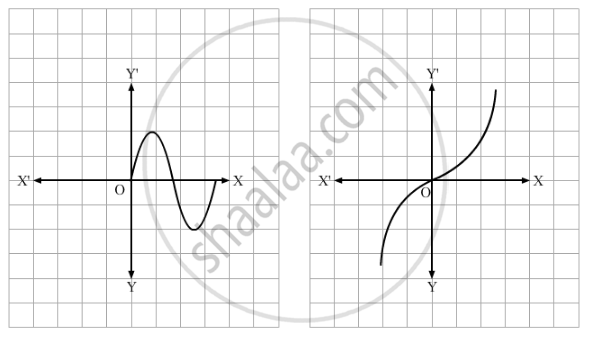
If f : R → R is defined by f(x) = x2, find f−1 (−25).
If f : R → R, g : R → are given by f(x) = (x + 1)2 and g(x) = x2 + 1, then write the value of fog (−3).
Let `f : R - {- 3/5}` → R be a function defined as `f (x) = (2x)/(5x +3).`
f-1 : Range of f → `R -{-3/5}`.
Let A = {1, 2, 3, 4} and B = {a, b} be two sets. Write the total number of onto functions from A to B.
Which of the following functions from
\[A = \left\{ x \in R : - 1 \leq x \leq 1 \right\}\]
\[f : Z \to Z\] be given by
` f (x) = {(x/2, ", if x is even" ) ,(0 , ", if x is odd "):}`
Then, f is
Mark the correct alternative in the following question:
Let A = {1, 2, ... , n} and B = {a, b}. Then the number of subjections from A into B is
Let A = ℝ − {3}, B = ℝ − {1}. Let f : A → B be defined by \[f\left( x \right) = \frac{x - 2}{x - 3}, \forall x \in A\] Show that f is bijective. Also, find
(i) x, if f−1(x) = 4
(ii) f−1(7)
Write about strcmp() function.
Are the following set of ordered pairs functions? If so, examine whether the mapping is injective or surjective.
{(x, y): x is a person, y is the mother of x}
Let A = [–1, 1]. Then, discuss whether the following functions defined on A are one-one, onto or bijective:
g(x) = |x|
Let A = [–1, 1]. Then, discuss whether the following functions defined on A are one-one, onto or bijective:
k(x) = x2
Let f: `[2, oo)` → R be the function defined by f(x) = x2 – 4x + 5, then the range of f is ______.
Let f : R → R be a function defined by f(x) `= ("e"^abs"x" - "e"^-"x")/("e"^"x" + "e"^-"x")` then f(x) is
The function f : R → R given by f(x) = x3 – 1 is ____________.
Number of integral values of x satisfying the inequality `(3/4)^(6x + 10 - x^2) < 27/64` is ______.
`x^(log_5x) > 5` implies ______.
The domain of function is f(x) = `sqrt(-log_0.3(x - 1))/sqrt(x^2 + 2x + 8)` is ______.
Let f(x) be a polynomial function of degree 6 such that `d/dx (f(x))` = (x – 1)3 (x – 3)2, then
Assertion (A): f(x) has a minimum at x = 1.
Reason (R): When `d/dx (f(x)) < 0, ∀ x ∈ (a - h, a)` and `d/dx (f(x)) > 0, ∀ x ∈ (a, a + h)`; where 'h' is an infinitesimally small positive quantity, then f(x) has a minimum at x = a, provided f(x) is continuous at x = a.
Find the domain of sin–1 (x2 – 4).
A function is called bijective if it is both:
Let \(X=\{-1,2,5,8,11\}\), \(Y=\{4,6,8\}\), and suppose different elements \(2,5,8\) of \(X\) have the same image \(4\). What type of function is it with respect to the one-one property?
Which condition represents a one-one (injective) function?
Which condition represents a many-one function?
