Advertisements
Advertisements
प्रश्न
Let f(x) be a polynomial function of degree 6 such that `d/dx (f(x))` = (x – 1)3 (x – 3)2, then
Assertion (A): f(x) has a minimum at x = 1.
Reason (R): When `d/dx (f(x)) < 0, ∀ x ∈ (a - h, a)` and `d/dx (f(x)) > 0, ∀ x ∈ (a, a + h)`; where 'h' is an infinitesimally small positive quantity, then f(x) has a minimum at x = a, provided f(x) is continuous at x = a.
विकल्प
Both (A) and (R) are true and (R) is the correct explanation of (A).
Both (A) and (R) are true but (R) is not the correct explanation of (A).
(A) is true but (R) is false.
(A) is false but (R) is true.
Advertisements
उत्तर
Both (A) and (R) are true and (R) is the correct explanation of (A).
Explanation:
`d/dx (f(x))` = (x – 1)3 (x – 3)2
Assertion : f(x) has a minimum at x = 1 is true as
`d/dx (f(x)) < 0, ∀ x ∈ (1 - h, 1)` and `d/dx (f(x)) > 0, ∀ x ∈ (1, 1 + h)`; where 'h' is an infinitesimally small positive quantity, which is in accordance with the Reason statement.
APPEARS IN
संबंधित प्रश्न
Check the injectivity and surjectivity of the following function:
f : N → N given by f(x) = x3
In the following case, state whether the function is one-one, onto or bijective. Justify your answer.
f : R → R defined by f(x) = 3 – 4x
Let A = {–1, 0, 1, 2}, B = {–4, –2, 0, 2} and f, g : A → B be functions defined by f(x) = x2 – x, x ∈ A and g(x) = `2|x - 1/2| – 1`, x ∈ A. Are f and g equal?
Justify your answer. (Hint: One may note that two functions f : A → B and g : A → B such that f(a) = g(a) ∀ a ∈ A are called equal functions.)
If the function `f(x) = sqrt(2x - 3)` is invertible then find its inverse. Hence prove that `(fof^(-1))(x) = x`
Classify the following function as injection, surjection or bijection : f : N → N given by f(x) = x2
Classify the following function as injection, surjection or bijection :
f : R → R, defined by f(x) = sin2x + cos2x
Classify the following function as injection, surjection or bijection :
f : Q → Q, defined by f(x) = x3 + 1
Let A = [-1, 1]. Then, discuss whether the following functions from A to itself is one-one, onto or bijective : h(x) = x2
Given A = {2, 3, 4}, B = {2, 5, 6, 7}. Construct an example of each of the following:
(i) an injective map from A to B
(ii) a mapping from A to B which is not injective
(iii) a mapping from A to B.
Find fog and gof if : f(x) = sin−1 x, g(x) = x2
Find fog and gof if : f(x)= x + 1, g (x) = 2x + 3 .
Which one of the following graphs represents a function?
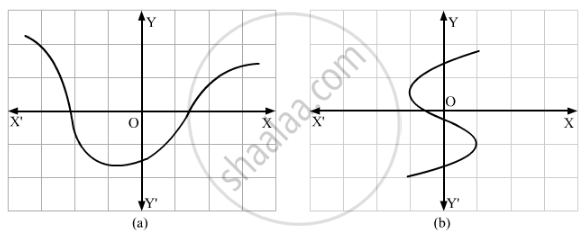
Let f : R → R+ be defined by f(x) = ax, a > 0 and a ≠ 1. Write f−1 (x).
Write the domain of the real function
`f (x) = sqrt([x] - x) .`
Write the domain of the real function f defined by f(x) = `sqrt (25 -x^2)` [NCERT EXEMPLAR]
Let \[f\left( x \right) = \frac{1}{1 - x} . \text{Then}, \left\{ f o \left( fof \right) \right\} \left( x \right)\]
Let A = R − (2) and B = R − (1). If f: A ⟶ B is a function defined by`"f(x)"=("x"-1)/("x"-2),` how that f is one-one and onto. Hence, find f−1.
Write about strlen() function.
If A = {a, b, c, d} and f = {a, b), (b, d), (c, a), (d, c)}, show that f is one-one from A onto A. Find f–1
For sets A, B and C, let f: A → B, g: B → C be functions such that g o f is injective. Then both f and g are injective functions.
For sets A, B and C, let f: A → B, g: B → C be functions such that g o f is surjective. Then g is surjective.
Using the definition, prove that the function f: A→ B is invertible if and only if f is both one-one and onto
Let A = {0, 1} and N be the set of natural numbers. Then the mapping f: N → A defined by f(2n – 1) = 0, f(2n) = 1, ∀ n ∈ N, is onto.
Let f: R → R defined by f(x) = x4. Choose the correct answer
Let f: R → R defined by f(x) = 3x. Choose the correct answer
If `f : R -> R^+ U {0}` be defined by `f(x) = x^2, x ∈ R`. The mapping is
Consider a function f: `[0, pi/2] ->` R, given by f(x) = sinx and `g[0, pi/2] ->` R given by g(x) = cosx then f and g are
If f: R→R is a function defined by f(x) = `[x - 1]cos((2x - 1)/2)π`, where [ ] denotes the greatest integer function, then f is ______.
Let f(x) be a polynomial of degree 3 such that f(k) = `-2/k` for k = 2, 3, 4, 5. Then the value of 52 – 10f(10) is equal to ______.
Find the domain of sin–1 (x2 – 4).
