Advertisements
Advertisements
प्रश्न
Advertisements
उत्तर
\[Let f^{- 1} \left( 1 \right) = x . . . \left( 1 \right)\]
\[ \Rightarrow f\left( x \right) = 1\]
\[ \Rightarrow x^4 = 1\]
\[ \Rightarrow x^4 - 1 = 0\]
\[ \Rightarrow \left( x^2 - 1 \right)\left( x^2 + 1 \right) = 0 \left [ \text{using identity}: a^2 - b^2 = \left( a - b \right)\left( a + b \right) \right]\]
\[ \Rightarrow \left( x - 1 \right)\left( x + 1 \right)\left( x^2 + 1 \right) = 0 \left[ \text{using identity}: a^2 - b^2 = \left( a - b \right)\left( a + b \right) \right]\]
\[ \Rightarrow x = \pm 1 \left[ \text{ as } x \in R \right]\]
\[ \Rightarrow f^{- 1} \left( 1 \right) = \left\{ - 1, 1 \right\} [ \text{from}\left( 1 \right)]\]
APPEARS IN
संबंधित प्रश्न
Check the injectivity and surjectivity of the following function:
f : N → N given by f(x) = x3
In the following case, state whether the function is one-one, onto or bijective. Justify your answer.
f : R → R defined by f(x) = 1 + x2
Show that the function f : R → {x ∈ R : –1 < x < 1} defined by f(x) = `x/(1 + |x|)`, x ∈ R is one-one and onto function.
Let A = {–1, 0, 1, 2}, B = {–4, –2, 0, 2} and f, g : A → B be functions defined by f(x) = x2 – x, x ∈ A and g(x) = `2|x - 1/2| – 1`, x ∈ A. Are f and g equal?
Justify your answer. (Hint: One may note that two functions f : A → B and g : A → B such that f(a) = g(a) ∀ a ∈ A are called equal functions.)
Give an example of a function which is not one-one but onto ?
Which of the following functions from A to B are one-one and onto ?
f3 = {(a, x), (b, x), (c, z), (d, z)} ; A = {a, b, c, d,}, B = {x, y, z}.
Classify the following function as injection, surjection or bijection :
f : Z → Z, defined by f(x) = x2 + x
Show that the function f : R − {3} → R − {2} given by f(x) = `(x-2)/(x-3)` is a bijection.
Consider f : N → N, g : N → N and h : N → R defined as f(x) = 2x, g(y) = 3y + 4 and h(z) = sin z for all x, y, z ∈ N. Show that ho (gof) = (hog) of.
If f(x) = 2x + 5 and g(x) = x2 + 1 be two real functions, then describe each of the following functions:
(1) fog
(2) gof
(3) fof
(4) f2
Also, show that fof ≠ f2
If f(x) = sin x and g(x) = 2x be two real functions, then describe gof and fog. Are these equal functions?
A function f : R → R is defined as f(x) = x3 + 4. Is it a bijection or not? In case it is a bijection, find f−1 (3).
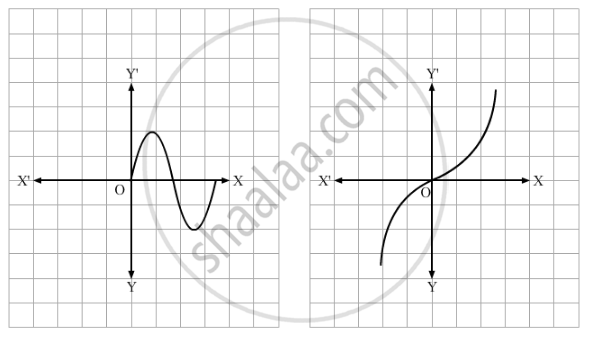
Which of the following graphs represents a one-one function?
If A = {1, 2, 3} and B = {a, b}, write the total number of functions from A to B.
If f : C → C is defined by f(x) = x4, write f−1 (1).
Let \[f : \left( - \frac{\pi}{2}, \frac{\pi}{2} \right) \to R\] be a function defined by f(x) = cos [x]. Write range (f).
If f : R → R is defined by f(x) = 3x + 2, find f (f (x)).
If the mapping f : {1, 3, 4} → {1, 2, 5} and g : {1, 2, 5} → {1, 3}, given by f = {(1, 2), (3, 5), (4, 1)} and g = {(2, 3), (5, 1), (1, 3)}, then write fog. [NCERT EXEMPLAR]
Let
\[f : R \to R\] be a function defined by
Let
\[f : R - \left\{ n \right\} \to R\]
\[f : R \to R\] is defined by
\[f\left( x \right) = \frac{e^{x^2} - e^{- x^2}}{e^{x^2 + e^{- x^2}}} is\]
Let \[f\left( x \right) = x^2 and g\left( x \right) = 2^x\] Then, the solution set of the equation
If \[g \left( f \left( x \right) \right) = \left| \sin x \right| \text{and} f \left( g \left( x \right) \right) = \left( \sin \sqrt{x} \right)^2 , \text{then}\]
Mark the correct alternative in the following question:
Let f : R → R be given by f(x) = tanx. Then, f-1(1) is
Mark the correct alternative in the following question:
Let f : R \[-\] \[\left\{ \frac{3}{5} \right\}\] \[\to\] R be defined by f(x) = \[\frac{3x + 2}{5x - 3}\] Then,
Let A = R − (2) and B = R − (1). If f: A ⟶ B is a function defined by`"f(x)"=("x"-1)/("x"-2),` how that f is one-one and onto. Hence, find f−1.
Let the function f: R → R be defined by f(x) = 4x – 1, ∀ x ∈ R. Then, show that f is one-one.
Let f: R → R be the function defined by f(x) = 2x – 3 ∀ x ∈ R. write f–1
Let C be the set of complex numbers. Prove that the mapping f: C → R given by f(z) = |z|, ∀ z ∈ C, is neither one-one nor onto.
Let the function f: R → R be defined by f(x) = cosx, ∀ x ∈ R. Show that f is neither one-one nor onto
Which of the following functions from Z into Z are bijections?
Let X = {-1, 0, 1}, Y = {0, 2} and a function f : X → Y defiend by y = 2x4, is ____________.
The function f : R → R given by f(x) = x3 – 1 is ____________.
The domain of the function `"f"("x") = 1/(sqrt ({"sin x"} + {"sin" ( pi + "x")}))` where {.} denotes fractional part, is
If f: R → R given by f(x) =(3 − x3)1/3, find f0f(x)
Prove that the function f is surjective, where f: N → N such that `f(n) = {{:((n + 1)/2",", if "n is odd"),(n/2",", if "n is even"):}` Is the function injective? Justify your answer.
Let f(n) = `[1/3 + (3n)/100]n`, where [n] denotes the greatest integer less than or equal to n. Then `sum_(n = 1)^56f(n)` is equal to ______.
If f : R `rightarrow` R is defined by `f(x) = (2x - 7)/4`, show that f(x) is one-one and onto.
Which condition represents a one-one (injective) function?
Which condition represents a many-one function?
