Advertisements
Advertisements
प्रश्न
Give examples of two one-one functions f1 and f2 from R to R, such that f1 + f2 : R → R. defined by (f1 + f2) (x) = f1 (x) + f2 (x) is not one-one.
Advertisements
उत्तर
We know that f1: R → R, given by f1(x)=x, and f2(x)=-x are one-one. Proving f1 is one-one:
Let f1 (x) = f1 (y)
⇒ x = y
So, f1 is one-one.
Proving f2 is one-one:
Let f2 (x)=f2 (y)
⇒ −x = −y
⇒ x = y
So, f2 is one-one.
Proving (f1 + f2) is not one-one:
Given:
(f1 + f2) (x) = f1 (x) + f2 (x)= x + (-x) =0
So, for every real number x, (f1 + f2) (x)=0
So, the image of ever number in the domain is same as 0.
Thus, (f1 + f2) is not one-one.
APPEARS IN
संबंधित प्रश्न
Check the injectivity and surjectivity of the following function:
f : N → N given by f(x) = x2
Prove that the greatest integer function f : R → R, given by f(x) = [x], is neither one-one nor onto, where [x] denotes the greatest integer less than or equal to x.
Classify the following function as injection, surjection or bijection :
f : R → R, defined by f(x) = |x|
Classify the following function as injection, surjection or bijection :
f : R → R, defined by f(x) = `x/(x^2 +1)`
Suppose f1 and f2 are non-zero one-one functions from R to R. Is `f_1 / f^2` necessarily one - one? Justify your answer. Here,`f_1/f_2 : R → R is given by (f_1/f_2) (x) = (f_1(x))/(f_2 (x)) for all x in R .`
Let f : N → N be defined by
`f(n) = { (n+ 1, if n is odd),( n-1 , if n is even):}`
Show that f is a bijection.
[CBSE 2012, NCERT]
Give examples of two functions f : N → N and g : N → N, such that gof is onto but f is not onto.
Find fog and gof if : f (x) = |x|, g (x) = sin x .
Find fog and gof if : f(x) = sin−1 x, g(x) = x2
Let f be any real function and let g be a function given by g(x) = 2x. Prove that gof = f + f.
State with reason whether the following functions have inverse :
f : {1, 2, 3, 4} → {10} with f = {(1, 10), (2, 10), (3, 10), (4, 10)}
Consider f : R+ → [−5, ∞) given by f(x) = 9x2 + 6x − 5. Show that f is invertible with `f^-1 (x) = (sqrt (x +6)-1)/3 .`
If f : R → R be defined by f(x) = x3 −3, then prove that f−1 exists and find a formula for f−1. Hence, find f−1(24) and f−1 (5).
Which of the following graphs represents a one-one function?
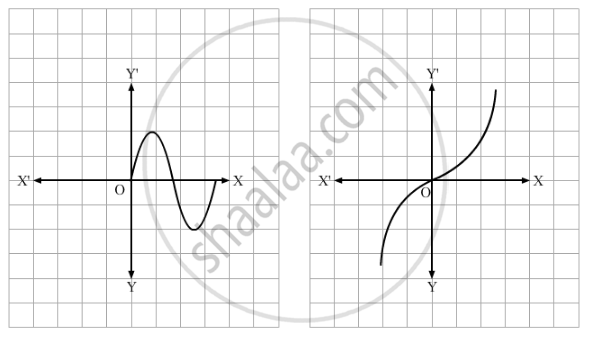
If f : C → C is defined by f(x) = x4, write f−1 (1).
If f : R → R is defined by f(x) = x2, find f−1 (−25).
Let f : R → R+ be defined by f(x) = ax, a > 0 and a ≠ 1. Write f−1 (x).
Let `f : R - {- 3/5}` → R be a function defined as `f (x) = (2x)/(5x +3).`
f-1 : Range of f → `R -{-3/5}`.
Write the domain of the real function
`f (x) = 1/(sqrt([x] - x)`.
Let A = {a, b, c, d} and f : A → A be given by f = {( a,b ),( b , d ),( c , a ) , ( d , c )} write `f^-1`. [NCERT EXEMPLAR]
Which of the following functions from
to itself are bijections?
Which of the following functions from
\[A = \left\{ x \in R : - 1 \leq x \leq 1 \right\}\]
\[f : Z \to Z\] be given by
` f (x) = {(x/2, ", if x is even" ) ,(0 , ", if x is odd "):}`
Then, f is
The inverse of the function
\[f : R \to \left\{ x \in R : x < 1 \right\}\] given by
\[f\left( x \right) = \frac{e^x - e^{- x}}{e^x + e^{- x}}\] is
Mark the correct alternative in the following question:
Let f : R → R be given by f(x) = tanx. Then, f-1(1) is
Let the function f: R → R be defined by f(x) = 4x – 1, ∀ x ∈ R. Then, show that f is one-one.
Let R be the set of real numbers and f: R → R be the function defined by f(x) = 4x + 5. Show that f is invertible and find f–1.
Set A has 3 elements and the set B has 4 elements. Then the number of injective mappings that can be defined from A to B is ______.
If f: R → R is defined by f(x) = x2 – 3x + 2, write f(f (x))
Let X = {1, 2, 3}and Y = {4, 5}. Find whether the following subset of X ×Y are function from X to Y or not
f = {(1, 4), (1, 5), (2, 4), (3, 5)}
Using the definition, prove that the function f: A→ B is invertible if and only if f is both one-one and onto
Let f : R → R be a function defined by f(x) `= ("e"^abs"x" - "e"^-"x")/("e"^"x" + "e"^-"x")` then f(x) is
Let f : R `->` R be a function defined by f(x) = x3 + 4, then f is ______.
Let f: R→R be defined as f(x) = 2x – 1 and g: R – {1}→R be defined as g(x) = `(x - 1/2)/(x - 1)`. Then the composition function f (g(x)) is ______.

The given function f : R → R is not ‘onto’ function. Give reason.
A function is a rule that assigns each element of one set to exactly how many elements of another set?
A function is called into if:
A perfect one-to-one matching between users and unique IDs is similar to:
