Advertisements
Advertisements
प्रश्न
Give examples of two surjective functions f1 and f2 from Z to Z such that f1 + f2 is not surjective.
Advertisements
उत्तर
We know that f1: R → R, given by f1(x) = x, and f2(x) = -x are surjective functions.
Proving f1 is surjective :
Let y be an element in the co-domain (R), such that f1(x) = y.
f1(x) = y
⇒ x = y, which is in R.
So, for every element in the co-domain, there exists some pre-image in the domain.
So, f1is surjective .
Proving f2 is surjective :Let f2(x) = f2(y)−x =−yx = y
Let y be an element in the co domain (R) such that f2(x) = y.
f2(x) = y
⇒ x = y, which is in R.
So, for every element in the co-domain, there exists some pre-image in the domain.
So, f2 is surjective .
Proving (f1 + f2) is not surjective :
Given:
(f1 + f2) (x) = f1 (x) + f2 (x)= x + (-x) =0
So, for every real number x, (f1 + f2) (x)=0
So, the image of every number in the domain is same as 0.
⇒ Range = {0}
Co-domain = R
So, both are not same.
So, f1 + f2 is not surjective.
APPEARS IN
संबंधित प्रश्न
Let f : N → N be defined by f(n) = `{((n+1)/2", if n is odd"),(n/2", if n is even"):}` for all n ∈ N.
State whether the function f is bijective. Justify your answer.
Show that the function f : R → {x ∈ R : –1 < x < 1} defined by f(x) = `x/(1 + |x|)`, x ∈ R is one-one and onto function.
Classify the following function as injection, surjection or bijection :
f : Z → Z, defined by f(x) = x − 5
Classify the following function as injection, surjection or bijection :
f : R → R, defined by f(x) = `x/(x^2 +1)`
Let A = [-1, 1]. Then, discuss whether the following function from A to itself is one-one, onto or bijective : `f (x) = x/2`
If A = {1, 2, 3}, show that a one-one function f : A → A must be onto.
Let f : N → N be defined by
`f(n) = { (n+ 1, if n is odd),( n-1 , if n is even):}`
Show that f is a bijection.
[CBSE 2012, NCERT]
Find gof and fog when f : R → R and g : R → R is defined by f(x) = x2 + 2x − 3 and g(x) = 3x − 4 .
` if f : (-π/2 , π/2)` → R and g : [−1, 1]→ R be defined as f(x) = tan x and g(x) = `sqrt(1 - x^2)` respectively, describe fog and gof.
Let
f (x) =`{ (1 + x, 0≤ x ≤ 2) , (3 -x , 2 < x ≤ 3):}`
Find fof.
State with reason whether the following functions have inverse :
g : {5, 6, 7, 8} → {1, 2, 3, 4} with g = {(5, 4), (6, 3), (7, 4), (8, 2)}
Let A = {1, 2, 3, 4}; B = {3, 5, 7, 9}; C = {7, 23, 47, 79} and f : A → B, g : B → C be defined as f(x) = 2x + 1 and g(x) = x2 − 2. Express (gof)−1 and f−1 og−1 as the sets of ordered pairs and verify that (gof)−1 = f−1 og−1.
If A = {1, 2, 3, 4} and B = {a, b, c, d}, define any four bijections from A to B. Also give their inverse functions.
Which one of the following graphs represents a function?
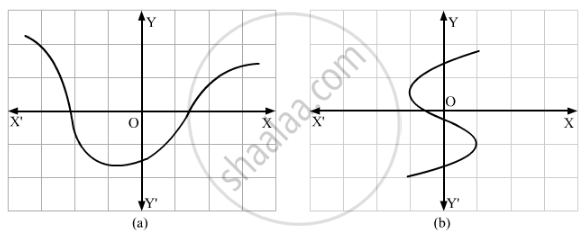
If f : C → C is defined by f(x) = x2, write f−1 (−4). Here, C denotes the set of all complex numbers.
Let A = {1, 2, 3, 4} and B = {a, b} be two sets. Write the total number of onto functions from A to B.
Let A = {1, 2, 3}, B = {4, 5, 6, 7} and let f = {(1, 4), (2, 5), (3, 6)} be a function from A to B. State whether f is one-one or not.
If a function\[f : [2, \infty )\text{ to B defined by f}\left( x \right) = x^2 - 4x + 5\] is a bijection, then B =
The function f : [-1/2, 1/2, 1/2] → [-π /2,π/2], defined by f (x) = `sin^-1` (3x - `4x^3`), is
If \[f : R \to R is given by f\left( x \right) = 3x - 5, then f^{- 1} \left( x \right)\]
If \[F : [1, \infty ) \to [2, \infty )\] is given by
\[f\left( x \right) = x + \frac{1}{x}, then f^{- 1} \left( x \right)\]
Mark the correct alternative in the following question:
Let A = {1, 2, ... , n} and B = {a, b}. Then the number of subjections from A into B is
Mark the correct alternative in the following question:
Let f : R \[-\] \[\left\{ \frac{3}{5} \right\}\] \[\to\] R be defined by f(x) = \[\frac{3x + 2}{5x - 3}\] Then,
Let A = ℝ − {3}, B = ℝ − {1}. Let f : A → B be defined by \[f\left( x \right) = \frac{x - 2}{x - 3}, \forall x \in A\] Show that f is bijective. Also, find
(i) x, if f−1(x) = 4
(ii) f−1(7)
A function f: R→ R defined by f(x) = `(3x) /5 + 2`, x ∈ R. Show that f is one-one and onto. Hence find f−1.
For sets A, B and C, let f: A → B, g: B → C be functions such that g o f is surjective. Then g is surjective.
Let A = [–1, 1]. Then, discuss whether the following functions defined on A are one-one, onto or bijective:
g(x) = |x|
Let f: R – `{3/5}` → R be defined by f(x) = `(3x + 2)/(5x - 3)`. Then ______.
The function f : A → B defined by f(x) = 4x + 7, x ∈ R is ____________.
Let A = {1, 2, 3}, B = {4, 5, 6, 7} and let f = {(1, 4), (2, 5), (3, 6)} be a function from A to B. Based on the given information, f is best defined as:
A general election of Lok Sabha is a gigantic exercise. About 911 million people were eligible to vote and voter turnout was about 67%, the highest ever

Let I be the set of all citizens of India who were eligible to exercise their voting right in the general election held in 2019. A relation ‘R’ is defined on I as follows:
R = {(V1, V2) ∶ V1, V2 ∈ I and both use their voting right in the general election - 2019}
- Three friends F1, F2, and F3 exercised their voting right in general election-2019, then which of the following is true?
An organization conducted a bike race under 2 different categories-boys and girls. Totally there were 250 participants. Among all of them finally, three from Category 1 and two from Category 2 were selected for the final race. Ravi forms two sets B and G with these participants for his college project. Let B = {b1,b2,b3} G={g1,g2} where B represents the set of boys selected and G the set of girls who were selected for the final race.
Ravi decides to explore these sets for various types of relations and functions.
- Ravi wants to find the number of injective functions from B to G. How many numbers of injective functions are possible?
If log102 = 0.3010.log103 = 0.4771 then the number of ciphers after decimal before a significant figure comes in `(5/3)^-100` is ______.
Let x is a real number such that are functions involved are well defined then the value of `lim_(t→0)[max{(sin^-1 x/3 + cos^-1 x/3)^2, min(x^2 + 4x + 7)}]((sin^-1t)/t)` where [.] is greatest integer function and all other brackets are usual brackets.
Let f(x) = ax (a > 0) be written as f(x) = f1(x) + f2(x), where f1(x) is an even function and f2(x) is an odd function. Then f1(x + y) + f1(x – y) equals ______.
Let f(x) be a polynomial function of degree 6 such that `d/dx (f(x))` = (x – 1)3 (x – 3)2, then
Assertion (A): f(x) has a minimum at x = 1.
Reason (R): When `d/dx (f(x)) < 0, ∀ x ∈ (a - h, a)` and `d/dx (f(x)) > 0, ∀ x ∈ (a, a + h)`; where 'h' is an infinitesimally small positive quantity, then f(x) has a minimum at x = a, provided f(x) is continuous at x = a.
ASSERTION (A): The relation f : {1, 2, 3, 4} `rightarrow` {x, y, z, p} defined by f = {(1, x), (2, y), (3, z)} is a bijective function.
REASON (R): The function f : {1, 2, 3} `rightarrow` {x, y, z, p} such that f = {(1, x), (2, y), (3, z)} is one-one.
For \(f(x)=x^2+x\), if \(y=1\), which two domain elements have the same image?
