Advertisements
Advertisements
प्रश्न
Let A = [–1, 1]. Then, discuss whether the following functions defined on A are one-one, onto or bijective:
g(x) = |x|
Advertisements
उत्तर
Given, A = [–1, 1]
Let g(x1) = g(x2)
|x1| = |x2|
x1 = ± x2
So, g(x) is not one-one
Also g(x) = |x| ≥ 0, for all real x
Hence, the range is [0, 1], which is subset of co-domain ‘A’
So, f(x) is not onto.
Therefore, f(x) is not bijective.
APPEARS IN
संबंधित प्रश्न
Prove that the greatest integer function f : R → R, given by f(x) = [x], is neither one-one nor onto, where [x] denotes the greatest integer less than or equal to x.
Show that the modulus function f : R → R, given by f(x) = |x|, is neither one-one nor onto, where |x| is x, if x is positive or 0 and |x| is –x, if x is negative.
Show that the function f : R → R given by f(x) = x3 is injective.
Let S = {a, b, c} and T = {1, 2, 3}. Find F−1 of the following functions F from S to T, if it exists.
F = {(a, 2), (b, 1), (c, 1)}
Which of the following functions from A to B are one-one and onto?
f2 = {(2, a), (3, b), (4, c)} ; A = {2, 3, 4}, B = {a, b, c}
Classify the following function as injection, surjection or bijection : f : N → N given by f(x) = x2
Classify the following function as injection, surjection or bijection : f : Z → Z given by f(x) = x2
Classify the following function as injection, surjection or bijection :
f : R → R, defined by f(x) = |x|
Classify the following function as injection, surjection or bijection :
f : R → R, defined by f(x) = sin2x + cos2x
Show that the logarithmic function f : R0+ → R given by f (x) loga x ,a> 0 is a bijection.
Show that f : R→ R, given by f(x) = x — [x], is neither one-one nor onto.
Let R+ be the set of all non-negative real numbers. If f : R+ → R+ and g : R+ → R+ are defined as `f(x)=x^2` and `g(x)=+sqrtx` , find fog and gof. Are they equal functions ?
If f : A → B and g : B → C are onto functions, show that gof is a onto function.
if `f (x) = sqrt(1-x)` and g(x) = `log_e` x are two real functions, then describe functions fog and gof.
Let A = R - {3} and B = R - {1}. Consider the function f : A → B defined by f(x) = `(x-2)/(x-3).`Show that f is one-one and onto and hence find f-1.
[CBSE 2012, 2014]
Let A and B be two sets, each with a finite number of elements. Assume that there is an injective map from A to B and that there is an injective map from B to A. Prove that there is a bijection from A to B.
Which one of the following graphs represents a function?
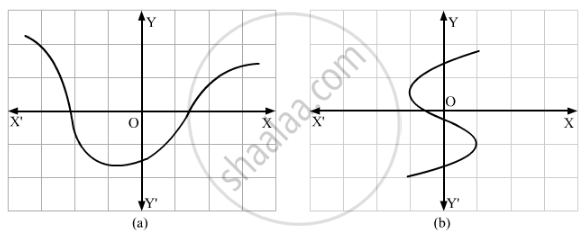
If f : C → C is defined by f(x) = x2, write f−1 (−4). Here, C denotes the set of all complex numbers.
Let \[f : \left( - \frac{\pi}{2}, \frac{\pi}{2} \right) \to R\] be a function defined by f(x) = cos [x]. Write range (f).
If f : R → R is defined by f(x) = 3x + 2, find f (f (x)).
If the mapping f : {1, 3, 4} → {1, 2, 5} and g : {1, 2, 5} → {1, 3}, given by f = {(1, 2), (3, 5), (4, 1)} and g = {(2, 3), (5, 1), (1, 3)}, then write fog. [NCERT EXEMPLAR]
The function f : R → R defined by
`f (x) = 2^x + 2^(|x|)` is
Let
\[A = \left\{ x \in R : - 1 \leq x \leq 1 \right\} = B\] Then, the mapping\[f : A \to \text{B given by} f\left( x \right) = x\left| x \right|\] is
Let
\[f : R - \left\{ n \right\} \to R\]
Which function is used to check whether a character is alphanumeric or not?
If f: R → R is defined by f(x) = x2 – 3x + 2, write f(f (x))
If the set A contains 5 elements and the set B contains 6 elements, then the number of one-one and onto mappings from A to B is ______.
Let X = {-1, 0, 1}, Y = {0, 2} and a function f : X → Y defiend by y = 2x4, is ____________.
Function f: R → R, defined by f(x) = `x/(x^2 + 1)` ∀ x ∈ R is not
Consider a function f: `[0, pi/2] ->` R, given by f(x) = sinx and `g[0, pi/2] ->` R given by g(x) = cosx then f and g are
Prove that the function f is surjective, where f: N → N such that `f(n) = {{:((n + 1)/2",", if "n is odd"),(n/2",", if "n is even"):}` Is the function injective? Justify your answer.
Let x is a real number such that are functions involved are well defined then the value of `lim_(t→0)[max{(sin^-1 x/3 + cos^-1 x/3)^2, min(x^2 + 4x + 7)}]((sin^-1t)/t)` where [.] is greatest integer function and all other brackets are usual brackets.
Let f(x) = ax (a > 0) be written as f(x) = f1(x) + f2(x), where f1(x) is an even function and f2(x) is an odd function. Then f1(x + y) + f1(x – y) equals ______.
A function f : [– 4, 4] `rightarrow` [0, 4] is given by f(x) = `sqrt(16 - x^2)`. Show that f is an onto function but not a one-one function. Further, find all possible values of 'a' for which f(a) = `sqrt(7)`.
Let f: R→Rbe defined as f (x) = `(x^2 + 1)/2`, then ______.
A function is called bijective if it is both:
In the function from \(X\) to \(Y\), if \(6\in Y\) is not the image of any element of \(X\), the function is:
Which real-life situation resembles a one-one idea when no roll number is repeated?
Which condition represents a one-one (injective) function?
