Advertisements
Advertisements
प्रश्न
\[f : R \to R\] is defined by
\[f\left( x \right) = \frac{e^{x^2} - e^{- x^2}}{e^{x^2 + e^{- x^2}}} is\]
विकल्प
one-one but not onto
many-one but onto
one-one and onto
neither one-one nor onto
Advertisements
उत्तर
(d) neither one-one nor onto
\[We have, \]
\[f\left( x \right) = \frac{e^{x^2} - e^{- x^2}}{e^{x^2 + e^{- x^2}}}\]
\[\text{Here}, - 2, 2 \in R\]
\[Now, 2 \neq - 2\]
\[\text{But}, f\left( 2 \right) = f\left( - 2 \right)\]
\[\text{Therefore, function is not one - one} . \]
\[\text{And}, \]
\[\text{The minimum value of the function is 0 and maximum value is} 1\]
\[\text{That is range of the function is} \left[ 0, 1 \right] \text{but the co - domain of the function is given } R . \]
\[\text{Therefore, function is not onto} . \]
\[ \therefore \text{function is neither one - one nor onto} . \]
APPEARS IN
संबंधित प्रश्न
Check the injectivity and surjectivity of the following function:
f : R → R given by f(x) = x2
Let A and B be sets. Show that f : A × B → B × A such that f(a, b) = (b, a) is bijective function.
Show that the function f: ℝ → ℝ defined by f(x) = `x/(x^2 + 1), ∀x in R`is neither one-one nor onto. Also, if g: ℝ → ℝ is defined as g(x) = 2x - 1. Find fog(x)
Which of the following functions from A to B are one-one and onto?
f2 = {(2, a), (3, b), (4, c)} ; A = {2, 3, 4}, B = {a, b, c}
Classify the following function as injection, surjection or bijection : f : N → N given by f(x) = x3
Classify the following function as injection, surjection or bijection :
f : R → R, defined by f(x) = |x|
Classify the following function as injection, surjection or bijection :
f : R → R, defined by f(x) = sinx
Classify the following function as injection, surjection or bijection :
f : R → R, defined by f(x) = x3 − x
Let f = {(1, −1), (4, −2), (9, −3), (16, 4)} and g = {(−1, −2), (−2, −4), (−3, −6), (4, 8)}. Show that gof is defined while fog is not defined. Also, find gof.
Find fog and gof if : f (x) = |x|, g (x) = sin x .
If f(x) = |x|, prove that fof = f.
State with reason whether the following functions have inverse:
h : {2, 3, 4, 5} → {7, 9, 11, 13} with h = {(2, 7), (3, 9), (4, 11), (5, 13)}
Consider the function f : R+ → [-9 , ∞ ]given by f(x) = 5x2 + 6x - 9. Prove that f is invertible with f -1 (y) = `(sqrt(54 + 5y) -3)/5` [CBSE 2015]
Which of the following graphs represents a one-one function?
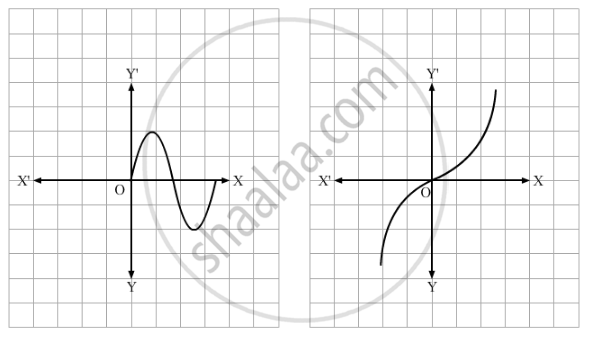
If f : C → C is defined by f(x) = x4, write f−1 (1).
Let f be an invertible real function. Write ( f-1 of ) (1) + ( f-1 of ) (2) +..... +( f-1 of ) (100 )
The range of the function
\[f\left( x \right) =^{7 - x} P_{x - 3}\]
If \[F : [1, \infty ) \to [2, \infty )\] is given by
\[f\left( x \right) = x + \frac{1}{x}, then f^{- 1} \left( x \right)\]
Mark the correct alternative in the following question:
Let f : R → R be given by f(x) = tanx. Then, f-1(1) is
Mark the correct alternative in the following question:
Let f : R→ R be defined as, f(x) = \[\begin{cases}2x, if x > 3 \\ x^2 , if 1 < x \leq 3 \\ 3x, if x \leq 1\end{cases}\]
Then, find f( \[-\]1) + f(2) + f(4)
Let f, g: R → R be two functions defined as f(x) = |x| + x and g(x) = x – x ∀ x ∈ R. Then, find f o g and g o f
For sets A, B and C, let f: A → B, g: B → C be functions such that g o f is surjective. Then g is surjective.
Let A = [–1, 1]. Then, discuss whether the following functions defined on A are one-one, onto or bijective:
f(x) = `x/2`
Let A = [–1, 1]. Then, discuss whether the following functions defined on A are one-one, onto or bijective:
h(x) = x|x|
If the set A contains 5 elements and the set B contains 6 elements, then the number of one-one and onto mappings from A to B is ______.
Let f: R → R be defined by f(x) = `1/x` ∀ x ∈ R. Then f is ______.
If f(x) = (4 – (x – 7)3}, then f–1(x) = ______.
Let f : R → R be a function defined by f(x) `= ("e"^abs"x" - "e"^-"x")/("e"^"x" + "e"^-"x")` then f(x) is
Let R be a relation on the set L of lines defined by l1 R l2 if l1 is perpendicular to l2, then relation R is ____________.
Let f: R→R be defined as f(x) = 2x – 1 and g: R – {1}→R be defined as g(x) = `(x - 1/2)/(x - 1)`. Then the composition function f (g(x)) is ______.
Consider a set containing function A= {cos–1cosx, sin(sin–1x), sinx((sinx)2 – 1), etan{x}, `e^(|cosx| + |sinx|)`, sin(tan(cosx)), sin(tanx)}. B, C, D, are subsets of A, such that B contains periodic functions, C contains even functions, D contains odd functions then the value of n(B ∩ C) + n(B ∩ D) is ______ where {.} denotes the fractional part of functions)
The domain of function is f(x) = `sqrt(-log_0.3(x - 1))/sqrt(x^2 + 2x + 8)` is ______.
Let a function `f: N rightarrow N` be defined by
f(n) = `{:[(2n",", n = 2"," 4"," 6"," 8","......),(n - 1",", n = 3"," 7"," 11"," 15","......),((n + 1)/2",", n = 1"," 5"," 9"," 13","......):}`
then f is ______.
Find the domain of sin–1 (x2 – 4).
Let A = R – {2} and B = R – {1}. If f: A `→` B is a function defined by f(x) = `(x - 1)/(x - 2)` then show that f is a one-one and an onto function.
The trigonometric equation tan–1x = 3tan–1 a has solution for ______.
A function is called one-one if different elements of the domain have:
Many students choosing the same favourite subject resembles which type of function?
Which condition represents a one-one (injective) function?
