Advertisements
Advertisements
प्रश्न
If f : R → R is given by f(x) = x3, write f−1 (1).
Advertisements
उत्तर
Let f−1 (1) = x ... (1)
⇒ f(x)= 1
⇒ x3= 1
⇒ x3−1= 0
⇒ (x−1 (x2+ x + 1 ) = 0 [using the identity:a3−b3 ( a −b ) ( a2+ ab + b2) ]
⇒ x=1 ( as x ∈ R)
⇒ f−1 (1) = {1} [ from (1) ]
APPEARS IN
संबंधित प्रश्न
Let A and B be sets. Show that f : A × B → B × A such that f(a, b) = (b, a) is bijective function.
Give an example of a function which is neither one-one nor onto ?
Classify the following function as injection, surjection or bijection : f : N → N given by f(x) = x3
Classify the following function as injection, surjection or bijection :
f : R → R, defined by f(x) = x3 − x
Classify the following function as injection, surjection or bijection :
f : R → R, defined by f(x) = 5x3 + 4
Classify the following function as injection, surjection or bijection :
f : R → R, defined by f(x) = 3 − 4x
Given A = {2, 3, 4}, B = {2, 5, 6, 7}. Construct an example of each of the following:
(i) an injective map from A to B
(ii) a mapping from A to B which is not injective
(iii) a mapping from A to B.
Find gof and fog when f : R → R and g : R → R is defined by f(x) = 2x + x2 and g(x) = x3
Let A = {a, b, c}, B = {u v, w} and let f and g be two functions from A to B and from B to A, respectively, defined as :
f = {(a, v), (b, u), (c, w)}, g = {(u, b), (v, a), (w, c)}.
Show that f and g both are bijections and find fog and gof.
Let f(x) = x2 + x + 1 and g(x) = sin x. Show that fog ≠ gof.
If f(x) = |x|, prove that fof = f.
` if f : (-π/2 , π/2)` → R and g : [−1, 1]→ R be defined as f(x) = tan x and g(x) = `sqrt(1 - x^2)` respectively, describe fog and gof.
If f, g : R → R be two functions defined as f(x) = |x| + x and g(x) = |x|- x, ∀x∈R" .Then find fog and gof. Hence find fog(–3), fog(5) and gof (–2).
State with reason whether the following functions have inverse :
f : {1, 2, 3, 4} → {10} with f = {(1, 10), (2, 10), (3, 10), (4, 10)}
If f : A → A, g : A → A are two bijections, then prove that fog is an injection ?
If f : A → A, g : A → A are two bijections, then prove that fog is a surjection ?
Which one of the following graphs represents a function?
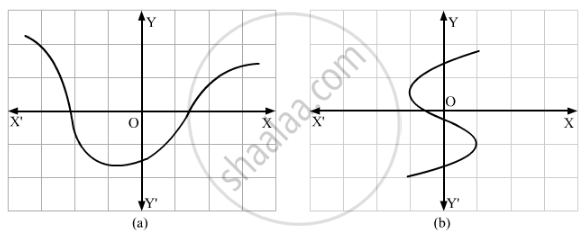
If f : R → R is defined by f(x) = 10 x − 7, then write f−1 (x).
Let A = {x ∈ R : −4 ≤ x ≤ 4 and x ≠ 0} and f : A → R be defined by \[f\left( x \right) = \frac{\left| x \right|}{x}\]Write the range of f.
Let \[f : \left[ - \frac{\pi}{2}, \frac{\pi}{2} \right] \to\] A be defined by f(x) = sin x. If f is a bijection, write set A.
What is the range of the function
`f (x) = ([x - 1])/(x -1) ?`
Let
f : R → R be given by
\[f\left( x \right) = \left[ x^2 \right] + \left[ x + 1 \right] - 3\]
where [x] denotes the greatest integer less than or equal to x. Then, f(x) is
(d) one-one and onto
Which of the following functions form Z to itself are bijections?
Let
\[A = \left\{ x : - 1 \leq x \leq 1 \right\} \text{and} f : A \to \text{A such that f}\left( x \right) = x|x|\]
Mark the correct alternative in the following question:
If the set A contains 7 elements and the set B contains 10 elements, then the number one-one functions from A to B is
Mark the correct alternative in the following question:
Let f : R \[-\] \[\left\{ \frac{3}{5} \right\}\] \[\to\] R be defined by f(x) = \[\frac{3x + 2}{5x - 3}\] Then,
Write about strcmp() function.
Set A has 3 elements and the set B has 4 elements. Then the number of injective mappings that can be defined from A to B is ______.
If the set A contains 5 elements and the set B contains 6 elements, then the number of one-one and onto mappings from A to B is ______.
The function f : R → R given by f(x) = x3 – 1 is ____________.
Given a function If as f(x) = 5x + 4, x ∈ R. If g : R → R is inverse of function ‘f then
An organization conducted a bike race under 2 different categories-boys and girls. Totally there were 250 participants. Among all of them finally, three from Category 1 and two from Category 2 were selected for the final race. Ravi forms two sets B and G with these participants for his college project. Let B = {b1,b2,b3} G={g1,g2} where B represents the set of boys selected and G the set of girls who were selected for the final race.
Ravi decides to explore these sets for various types of relations and functions.
- Let R: B → G be defined by R = { (b1,g1), (b2,g2),(b3,g1)}, then R is ____________.
Raji visited the Exhibition along with her family. The Exhibition had a huge swing, which attracted many children. Raji found that the swing traced the path of a Parabola as given by y = x2.
Answer the following questions using the above information.
- Let f: {1,2,3,....} → {1,4,9,....} be defined by f(x) = x2 is ____________.
Let f: R→R be a continuous function such that f(x) + f(x + 1) = 2, for all x ∈ R. If I1 = `int_0^8f(x)dx` and I2 = `int_(-1)^3f(x)dx`, then the value of I1 + 2I2 is equal to ______.
Let [x] denote the greatest integer ≤ x, where x ∈ R. If the domain of the real valued function f(x) = `sqrt((|[x]| - 2)/(|[x]| - 3)` is (–∞, a) ∪ [b, c) ∪ [4, ∞), a < b < c, then the value of a + b + c is ______.
Difference between the greatest and least value of f(x) = `(1 + (cos^-1x)/π)^2 - (1 + (sin^-1x)/π)^2` is ______.
Find the domain of sin–1 (x2 – 4).
Let f: R→Rbe defined as f (x) = `(x^2 + 1)/2`, then ______.
A function is called many-one if two or more different elements of the domain have:
