Advertisements
Advertisements
प्रश्न
The function f : R → R defined by
`f (x) = 2^x + 2^(|x|)` is
विकल्प
one-one and onto
many-one and onto
one-one and into
many-one and into
Advertisements
उत्तर
(d) many-one and into
Graph for the given function is as follows.
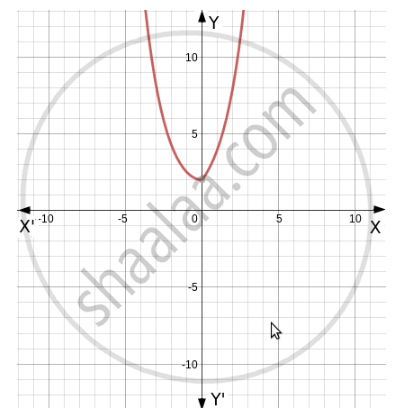
A line parallel to X axis is cutting the graph at two different values.
Therefore, for two different values of x we are getting the same value of y.
That means it is many one function.[2 , ∞ ) and R is the co-domain of the given function.
Hence, Co-domain ≠ Range Therefore, the given function is into.
APPEARS IN
संबंधित प्रश्न
Check the injectivity and surjectivity of the following function:
f : N → N given by f(x) = x3
Prove that the function f : N → N, defined by f(x) = x2 + x + 1, is one-one but not onto
Let A = {−1, 0, 1} and f = {(x, x2) : x ∈ A}. Show that f : A → A is neither one-one nor onto.
Classify the following function as injection, surjection or bijection :
f : R → R, defined by f(x) = sin2x + cos2x
Show that the function f : R − {3} → R − {2} given by f(x) = `(x-2)/(x-3)` is a bijection.
If f : R → R be the function defined by f(x) = 4x3 + 7, show that f is a bijection.
Given A = {2, 3, 4}, B = {2, 5, 6, 7}. Construct an example of each of the following:
(i) an injective map from A to B
(ii) a mapping from A to B which is not injective
(iii) a mapping from A to B.
Show that f : R→ R, given by f(x) = x — [x], is neither one-one nor onto.
Find gof and fog when f : R → R and g : R → R is defined by f(x) = x and g(x) = |x| .
Consider f : R → R given by f(x) = 4x + 3. Show that f is invertible. Find the inverse of f.
Consider f : R+ → [−5, ∞) given by f(x) = 9x2 + 6x − 5. Show that f is invertible with `f^-1 (x) = (sqrt (x +6)-1)/3 .`
If f : Q → Q, g : Q → Q are two functions defined by f(x) = 2 x and g(x) = x + 2, show that f and g are bijective maps. Verify that (gof)−1 = f−1 og −1.
Let f : [−1, ∞) → [−1, ∞) be given by f(x) = (x + 1)2 − 1, x ≥ −1. Show that f is invertible. Also, find the set S = {x : f(x) = f−1 (x)}.
If A = {1, 2, 3, 4} and B = {a, b, c, d}, define any four bijections from A to B. Also give their inverse functions.
If f : C → C is defined by f(x) = x2, write f−1 (−4). Here, C denotes the set of all complex numbers.
If f : R → R is given by f(x) = x3, write f−1 (1).
Write the domain of the real function
`f (x) = sqrtx - [x] .`
What is the range of the function
`f (x) = ([x - 1])/(x -1) ?`
A function f from the set of natural numbers to integers defined by
`{([n-1]/2," when n is odd" is ),(-n/2,when n is even ) :}`
\[f : Z \to Z\] be given by
` f (x) = {(x/2, ", if x is even" ) ,(0 , ", if x is odd "):}`
Then, f is
If \[F : [1, \infty ) \to [2, \infty )\] is given by
\[f\left( x \right) = x + \frac{1}{x}, then f^{- 1} \left( x \right)\]
The distinct linear functions that map [−1, 1] onto [0, 2] are
Mark the correct alternative in the following question:
If the set A contains 5 elements and the set B contains 6 elements, then the number of one-one and onto mappings from A to B is
Let A be a finite set. Then, each injective function from A into itself is not surjective.
For sets A, B and C, let f: A → B, g: B → C be functions such that g o f is surjective. Then g is surjective.
Let A = [–1, 1]. Then, discuss whether the following functions defined on A are one-one, onto or bijective:
h(x) = x|x|
Let f: `[2, oo)` → R be the function defined by f(x) = x2 – 4x + 5, then the range of f is ______.
The smallest integer function f(x) = [x] is ____________.
Let X = {-1, 0, 1}, Y = {0, 2} and a function f : X → Y defiend by y = 2x4, is ____________.
Let f : R `->` R be a function defined by f(x) = x3 + 4, then f is ______.
An organization conducted a bike race under 2 different categories-boys and girls. Totally there were 250 participants. Among all of them finally, three from Category 1 and two from Category 2 were selected for the final race. Ravi forms two sets B and G with these participants for his college project. Let B = {b1,b2,b3} G={g1,g2} where B represents the set of boys selected and G the set of girls who were selected for the final race.
Ravi decides to explore these sets for various types of relations and functions.
- Let R: B → G be defined by R = { (b1,g1), (b2,g2),(b3,g1)}, then R is ____________.
Raji visited the Exhibition along with her family. The Exhibition had a huge swing, which attracted many children. Raji found that the swing traced the path of a Parabola as given by y = x2.
Answer the following questions using the above information.
- Let f: {1,2,3,....} → {1,4,9,....} be defined by f(x) = x2 is ____________.
A function f: x → y is said to be one – one (or injective) if:
Number of integral values of x satisfying the inequality `(3/4)^(6x + 10 - x^2) < 27/64` is ______.
Let a and b are two positive integers such that b ≠ 1. Let g(a, b) = Number of lattice points inside the quadrilateral formed by lines x = 0, y = 0, x = b and y = a. f(a, b) = `[a/b] + [(2a)/b] + ... + [((b - 1)a)/b]`, then the value of `[(g(101, 37))/(f(101, 37))]` is ______.
(Note P(x, y) is lattice point if x, y ∈ I)
(where [.] denotes greatest integer function)
The trigonometric equation tan–1x = 3tan–1 a has solution for ______.
A function is called many-one if two or more different elements of the domain have:
For \(f:\mathbb{R}\to\mathbb{R}\) defined by \(f(x)=1+x^2\), which statement is correct?
If every seat in a classroom is occupied by one student, the situation resembles:
Which condition represents an into function?
