Advertisements
Chapters
1: Sexual Reproduction in Flowering Plants
2: Human Reproduction
3: Reproductive Health
UNIT 2: GENETICS AND EVOLUTION
4: Principles of Inheritance and Variation
▶ 5: Molecular Basis of Inheritance
6: Origin of Life
7: Evidences and Theories of Biological Evolution
8: Human Evolution
UNIT 3: BIOLOGY AND HUMAN WELFARE
9: Human Health and Diseases
10: Microbes in Human Welfare
UNIT 4: BIOTECHNOLOGY AND ITS APPLICATIONS
11: Principles and Processes of Biotechnology
12: Biotechnology and Its Applications
UNIT 5: ECOLOGY AND ENVIRONMENT
13: Organisms and Populations
14: Ecosystem
15: Biodiversity and Its Conservation
![Nootan solutions for Biology [English] Class 12 ISC chapter 5 - Molecular Basis of Inheritance - Shaalaa.com](/images/biology-english-class-12-isc_6:27951a2dacd84a79893ea93197c886ef.jpg "Nootan solutions for Biology [English] Class 12 ISC chapter 5 - Molecular Basis of Inheritance")
Advertisements
Solutions for Chapter 5: Molecular Basis of Inheritance
Below listed, you can find solutions for Chapter 5 of CISCE Nootan for Biology [English] Class 12 ISC.
Nootan solutions for Biology [English] Class 12 ISC 5 Molecular Basis of Inheritance TEST YOUR PROGRESS [Pages 263 - 274]
OBJECTIVE TYPE QUESTIONS Choose the correct answer from the alternatives given.
The experiment which shows that DNA is the genetic material in bacteriophages is the ______.
Meselson-Stahl experiment
Hershey-Chase experiment
Franklin-Wilkins experiment
Watson-Crick experiment
Genetic information in a DNA molecule is coded in the ______.
sequence of nucleotides
base pairings
turning pattern of the helix
proportion of each base present
Which enzyme catalyses the synthesis of a new strand for a DNA molecule by linking nucleotides to the developing strand?
DNA ligase
DNA polymerase
Single-strand binding proteins
Topoisomerase
In DNA replication, the Okazaki fragments on the lagging strand are joined together by ______.
DNA ligase
DNA polymerase
primase
helicase
Transcription is the transfer of genetic code from a DNA molecule to ______.
RNA molecule
second DNA molecule
ribosomal subunit
sequence of amino acids in a protein molecule
Translation is the ______.
transfer of the genetic code to a tRNA molecule
transfer of the genetic code to an mRNA molecule
transfer of the genetic code from an mRNA to a sequence of amino acids in a polypeptide
movement of mRNA through the nuclear membrane
The signal to start translation is the initiator codon, usually AUG, the codon for ______.
Tyrosine
Leucine
Methionine
Tryptophan
If a DNA strand has a nitrogenous base sequence T, A, C, G, A, the sequence of bases on the corresponding mRNA would be ______.
C, T, G, A, T
G, U, A, C, U
A, T, G, C, T
A, U, G, C, U
Transcription involves ______.
synthesising the protein on the ribosome
transferring information contained in the DNA to mRNA
joining amino acids by peptide bonds
transferring information from the mRNA to the tRNA
When DNA replication begins ______.
the two DNA strands unwind from each other
old strands move to find new strands
two DNA molecules bond
the two DNA strands condense for base transfers
Which is not a nucleotide base in DNA?
Cytosine
Thymine
Uracil
Adenine
What are the base-pairing rules for DNA?
A-G, T-C
A-T, G-C
A-U, C-G
A-C, T-G
A DNA strand having the sequence C-G-A-T-T-G would be complementary to the sequence ______.
C-G-A-T-T-G
G-C-T-A-A-C
G-C-T-A-A-G
T-A-G-C-C-T
‘One species’ DNA differs from others in its ______.
phosphate groups
base sequence
sugars
all of these
A RNA molecule is ______.
usually double-stranded
usually single-stranded
always double-stranded
a double helix
A mRNA molecule is produced by ______.
Replication
Transcription
Duplication
Translation
Each codon calls for a specific ______.
carbohydrate
polypeptide
amino acid
protein
Anticodons pair with ______.
amino acids
DNA codons
tRNA anticodons
mRNA codons
In translation, an initiation complex consists of ______.
an initiator tRNA
a large ribosomal subunit
a small ribosomal subunit
the start codon of mRNA
A polysome is ______.
a chromosomal duplication during transcription.
a number of ribosomes on the same transcript.
a mutated ribosome.
the initiation site for translation.
If 30% of an organism’s DNA is thymine, then ______.
70% is purine
30% is adenine
70% is guanine
both (b) and (c)
The double-helix model of DNA resembles a twisted ladder in which the rungs of the ladder are:
sugar-phosphate paired with sugar-phosphate
A paired with G and C paired with T
a purine paired with a pyrimidine
both sugar-phosphate paired with sugar-phosphate and A paired with G and C paired with T.
In a DNA molecule ______.
bases are hydrogen-bonded to one another.
sugars are covalently bonded to the phosphates.
bases are covalently bonded to the sugars.
all of the above.
Which of the following is not a chemical component of deoxyribonucleic acid?
Thymine
A phosphate group
A pentose sugar
Uracil
Which of the following regarding DNA is not true?
Complementary base pairs consist of one purine and one pyrimidine.
‘Side rails’ of the DNA double helix are made of alternating molecules of phosphate and ribose.
Complementary base pairs are joined by hydrogen bonds.
The amount of thymine equals the amount of adenine.
In his work with pneumonia-causing bacteria and mice, Griffith found that ______.
The polysaccharide coat of R cells caused pneumonia.
Some heat-stable chemical from S cells was transferred to R cells to transform them into S cells.
Heat-killed S cells were able to cause pneumonia only when they were transformed by the DNA of R cells.
The protein coat from smooth (S) cells was able to transform rough (R) cells.
E. coli cell grown on 15N medium are transferred to 14N medium and allowed to grow for two generations. DNA extracted from these cells is ultracentrifuged in a cesium chloride density gradient. What density distribution of DNA would you expect in this experiment?
One high and one low density band.
One intermediate density band.
One high and one intermediate density band.
One low and one intermediate density band.
The elongation of the leading strand during DNA synthesis ______.
depends on the action of DNA polymerase
produces Okazaki fragments
occurs in the 3’ → 5’ direction
progresses away from the replication fork
What is the basis for the difference in the synthesis of the leading and lagging strand of DNA molecules?
Origin of replication occurs only at the 5’ end of the molecules.
DNA ligase works only in the 3’ → 5’ direction.
DNA polymerase can join new nucleotides only to the 3’ end of the growing strand.
Helicases and single-strand binding proteins that work at the 5’ end.
In an analysis of the number of different bases in a DNA sample, which result would be consistent with the base pairing rules?
A = G
A = C
A + G = C + T
A + T = G + C
The ‘primer’ required to initiate synthesis of a new DNA strand consists of ______.
an Okazaki fragment
DNA
a structural protein
RNA
A particular gene measures about 1 µm in length along a double-stranded DNA molecule. What is the approximate number of base pairs in this gene?
3000
300
30
3
Extranuclear chromosomes occur within various organelles, including ______.
lysosomes
chloroplasts
endoplasmic reticulum
all of the above.
Which of the following is the correct sequence of event with reference to the central dogma?
Transcription, Translation, Replication
Transcription, Replication, Translation
Duplication, Translation, Transcription
Replication, Transcription, Translation
The base sequence known as the anti-codon is a part of a ______.
Ribosomal RNA
Transfer RNA
Messenger RNA
DNA
If the DNA codons are CAT CAT CAT, and a guanine base is added at the beginning, then which would result?
G CAT CAT CAT
GCA TCA TCA T
Frameshift mutation
Both G CAT CAT CAT and GCA TCA TCA T
The central dogma of molecular biology ______.
states that DNA is a template for all RNA production
pertains only to prokaryotes because humans are unique
states that translation precedes transcription
states that DNA is a template only for DNA replication
If the sequence of bases in DNA is TAGC, then the sequence of bases in RNA would be ______.
AUCG
TAGC
ATCG
GCTA
RNA processing is ______.
the rejection of old, worn-out RNA
an event that occurs after RNA is transcribed
the same as transcription
pertains to the function of tRNA during protein synthesis
During protein synthesis, an anticodon on transfer RNA (tRNA) pairs with ______.
messenger RNA (mRNA) nucleotide bases
ribosomal RNA (rRNA) nucleotide bases
other tRNA nucleotide bases
DNA nucleotide bases
The creation of a RNA molecule from a section of DNA is known as ______.
replication
RNA splicing
transcription
translation
Which of the following is not true of a codon?
It extends from one end of a tRNA molecule.
It never codes for more than one amino acid.
It may code for the same amino acid as another codon does.
It consists of three nucleotides.
RNA polymerase ______.
can produce several polypeptide chains at one time through the creation of polysomes.
starts transcribing at an AUG triplet on one DNA strand.
transcribes both introns and exons.
transcribes both DNA strands, but always in a 5’ → 3’ direction.
The bonds between the anticodon of a tRNA molecule and the complementary codon of mRNA are ______.
catalysed by aminoacyl-tRNA synthetase.
hydrogen bonds that form while the codon is in the A site.
formed by the input of energy from ATP.
catalysed by peptidyl transferase.
The phenomenon known as wobble refers to ______.
The movement of multiple ribosomes along the same mRNA.
The shifting of the reading frame in a deletion or insertion mutation.
The ability of a tRNA to pair with different codons that may differ in the third base.
The movement of a tRNA from the A to the P site.
Which of the following is not true of RNA processing?
Exons are excised and hydrolysed before the mRNA moves out of the nucleus.
An initial RNA transcript is much longer than the final RNA molecule that may leave the nucleus.
RNA splicing may be catalysed by spliceosomes.
The existence of exons and introns may facilitate crossing over between regions of a gene that code for polypeptide domains.
Which of the following mutations would be most likely to have a harmful effect on an organism?
A single base insertion near the start of the coding sequence.
A base-pair substitution.
A single-base deletion near the middle of an intron.
A single base deletion close to the end of the coding sequence.
Which component is not directly involved in the process known as translation?
Ribosomes
tRNA
DNA
mRNA
DNA was first proven to be the transforming factor in bacterial cells by ______.
Meischer
Watson and Crick
Griffith
Avery
Hershey and Chase experimented with radioactively labelled phosphorus and sulfur to determine that DNA and not protein is the genetic material. Which of the following was essential to this confirming experiment?
Sulphur is present in amino acids in the protein coat of bacteria.
Phosphorus is present in high amounts in DNA.
Phosphorus is not present in amino acids in the protein coat of bacteria.
All of the above were critical to demonstrating that DNA is involved in the genetic material.
Which statement is not correct about the results of the Hershey - Chase experiment with T2 bacteriophage?
Radioactively labelled protein was found in the bacteria, not in the phage coats.
Radioactively labelled DNA was found in the bacteria, not in the phage coats.
DNA was labelled with radioactive phosphorus.
Protein was labelled with radioactive sulphur.
Which is not a major function of the genetic material?
Store information
Catalyse chemical reactions
Replicate itself
Undergo mutation
Nucleic acid was first discovered in pus cells in ______.
1869
1912
1931
1953
One of Chargaff’s rules states that:
A + T = G + C
A + G = T + C
A = G, T = C
A = C, T = G
If a species contains 23% adenine in its DNA, what is the percentage of guanine it would contain?
23%
46%
44%
27%
The amount of adenine is always equal to the amount of ______ in DNA.
cytosine
uracil
guanine
thymine
Information from X-ray crystallographic data collected by ______ was used by Watson and Crick in their development of the model of DNA.
Chargaff
Griffith
Franklin
Hershey and Chase
The X-ray diffraction photography of Rosalind Franklin and Maurice Wilkins was critical evidence of DNA:
indicating that DNA has a double helix structure.
showing equal numbers of purines and pyrimidines.
showing the bases of DNA were held together by hydrogen bonds.
revealing the structure of the deoxyribose sugar.
In the Watson and Crick model of DNA, the ‘steps’ of the ladder are composed of ______.
sugars
a purine and a pyrimidine
two purines
a sugar and a phosphate molecule
Which of the following statements about DNA replication is not correct?
Unwinding of DNA molecule occurs as hydrogen bonds break.
Replication occurs as each base is paired with another exactly like it.
Process is known as semi conservative replication because one old strand is conserved in the new molecule.
Complementary base pairs are held together with hydrogen bonds.
Because the original strand of the double-stranded helix is found in each daughter cell, the replication process is called:
proofreading
semiconservative
freeing of DNA
mutation positive
Which does not describe a function of the DNA polymerase molecule?
Recognise the free nucleotide that pairs with the base on the template strand of DNA.
Read the strand of template DNA and recognise the base there.
Proofread to ensure that the proper base has been incorporated.
Make the proper nucleotide to match with the base read on the template strand.
Which statement is not true about DNA replication?
It proceeds in a 5’-to-3’ direction only.
One strand of new DNA is replicated faster than the other strand at the replication fork.
DNA can only replicate at one point on a chromosome at one time.
Replication can only begin at a special origin of replication.
Which statement is not true about DNA replication in prokaryotes?
Replication begins at a single origin of replication.
Replication is bidirectional from the origin(s).
Replication occurs at about 1 million base pairs per minute.
There are numerous different bacterial chromosomes, with replication occurring in each at the same time.
Which statement is ·not true about DNA replication in eukaryotes?
Replication of the entire genome takes about ten minutes.
A replication fork occurs at each growing point of the replicating chromosome.
Eukaryotes have numerous different chromosomes, with replication occurring in each at the same time.
Replication occurs at the rate of about 500-5000 base pairs per minute.
Before the DNA repair enzyme complex has completed its function, approximately how many base pairs are still improperly matched?
1 in 100,000
1 in 1,000,000
1 in 10,000,000
1 in a billion
The evidence that the transformation as described by Griffith’s experiments was due to DNA:
was found by Avery in the laboratory.
proved that neither enzymes that break down proteins or RNAase that digests RNA could not prevent transformation.
DNAase caused the digestion of the transforming substance.
all of the above.
If a species contains 40% guanine in its DNA, what is the percentage of cytosine that is would contain?
60
40
27
30
The DNA model proposed by Watson and Crick:
Combined, many of the findings of other research also studying DNA, such as Rosalind Franklin and Chargaff.
showed the double helix nature of the molecule.
presented a molecule with sugar-phosphate backbones on the outside and paired bases on the inside.
all of the above.
Replication of DNA is:
semiconservative
requires the unwinding of the double helix.
involves new complementary nucleotides forming base pairs and then joining to form new strands.
all of the above.
Genetic mutations are:
more common in bacteria due to their extremely rapid rate of DNA replication
permanent changes in the base sequences of a gene in the DNA strand.
due to errors in DNA replication.
all of the above.
The idea that a single gene coded for a polypeptide rather than an enzyme was evident from the ______.
use of X-rays to make nutritional mutants in bread mold.
transformation of bacteria from rough and non-virulent to smooth and virulent.
presence of a mutation in one chain of haemoglobin but not in the other.
discovery that mutated genes changed enzymes in a biochemical pathway.
Today, it is most appropriate to state that a gene controls:
one enzyme
one protein
one polypeptide chain
one amino acid
The concept of an ‘inborn error of metabolism’ was the first recognition of the relationship between gene activity and metabolic disease, made by ______.
Beadle and Tatum with parasitic molds.
Pauling and ltano with sickle-cell anaemia.
Archibold Garrod from general family inheritance patterns.
Watson and Crick, as a natural outcome of their model of DNA.
Studies by Beadle and Tatum that produced the ‘one-gene one-enzyme hypothesis’ were conducted using the ______.
bread mold Neurospora crassa
bacterium Streptococcus pneumoniae
bacterium Escherichia coli
mushroom Agaricus bisporus
Which of the classes of RNA molecules is found in almost no prokaryotes?
Ribosomal RNA
Transfer RNA
Messenger RNA
Primary mRNA transcript
Which of the classes of RNA molecules is linked with proteins in forming the large and small subunits of a cytoplasmic structure?
Ribosomal RNA
Transfer RNA
Messenger RNA
Primary mRNA transcript
Prior to protein synthesis, DNA ______.
attracts tRNAs with appropriate amino acids.
must first undergo replication.
contains anticodons that must become codons.
serves as a template for the production of mRNA.
Which of the classes of RNA molecules carries the genetic information as it is needed for the construction of a protein?
Ribosomal RNA
Transfer RNA
Messenger RNA
Primary mRNA transcript
Which of the classes of RNA molecules carries the amino acids that are added to the growing polypeptide chain?
Ribosomal RNA
Transfer RNA
Messenger RNA
Primary mRNA transcript
Which of the classes of RNA molecules is never found in the cytosol?
Ribosomal RNA
Transfer RNA
Messenger RNA
Primary mRNA transcript
The first codon to be deciphered was ______ which codes for ______.
AAA, proline
GGG, alanine
UUU, Phenylalanine
TTT, arginine
Transcription of a part of a DNA molecule with a nucleotide sequence of A-A-A-C-A-A-C-T-T results in a mRNA molecule with the complementary sequence of ______.
G-G-G-A-G-A-A-C-C
U-U-U-G-U-U-G-A-A
T-T-T-G-A-A-G-C-C
C-C-C-A-C-C-T-C-C
If one strand of DNA has the base sequence AAGCAA, the complementary strand has which of the following sequences?
UUCGUU
TICGTI
AAGCAA
UTCGTU
Which is the process that synthesises mRNA, tRNA, or rRNA?
Translation
Transcription
Transposition
Transformation
Which of the following nucleotide bases is found only in RNA, not in DNA?
Guanine
Adenine
Thymine
Uracil
Which of the following nucleotide bases is found only in DNA, not in RNA?
Guanine
Adenine
Thymine
Uracil
An intervening sequence in a eukaryotic gene that is not an active part of the gene is called a ______.
exon
intron
replicon
none of these
A ribozyme is ______.
a section of the DNA that is expressed in the mRNA.
a self-splicing intron that acts like an enzyme.
a complex made up of many ribosomes replicating the same strand of mRNA.
one of the small ribosomal subunits.
For translation to take place, which of the following would not be required to be present?
DNA
mRNA
tRNA-amino acid complex
rRNA
Which of the following processes does not take place during translation?
Attachment of a ribosome to mRNA.
Binding of two tRNA molecules per ribosome.
Liberation of polypeptide from the ribosome.
Production of mRNA.
The correct sequence of events in the production of a polypeptide is ______.
initiation, termination, elongation
elongation, termination; initiation
termination, elongation, initiation
initiation, elongation, termination
All of the following are associated with the role of ribosomes except:
several ribosomes are often attached to and translating the same mRNA.
joining amino acids together to form a polypeptide.
prevents the anticodon of tRNA from aligning the associated amino acid in the wrong position in the developing strand.
no protein synthesis within a cell. would occur without ribosomes.
What part of haemoglobin is affected in sickle cell anaemia?
α-polypeptide chains.
β-polypeptide chains.
Both α- and β-polypeptide chains.
None of the above.
An unknown chemical is analysed and found to contain the bases thymine and guanine. The chemical is most likely ______.
tRNA
mRNA
DNA
rRNA
Which is the process by which a protein is constructed?
Translation
Transcription
Transposition
Transformation
In order to produce many copies of a protein fast, the cell uses ______.
DNA replication.
single-unit ribosomes for high-speed translation.
codon-anticodon reciprocal duplication.
many RNA polymerase molecules to produce mRNA transcripts at the same time.
Which is most directly responsible for the sequence of amino acids in a protein?
Sequence of the anticodons.
Number of codons in mRNA.
Proteins associated with rRNA.
The sequence of codons in mRNA.
Which is not true about the genetic code?
It is exactly the same in all organisms.
It is composed of a triplet code of three bases per codon.
It produces 64 different possibilities of base sequences.
It contains start and stop codons as instructions.
Codons are:
triplets coding for a single amino acid.
alphabet of the genetic language.
redundant in their coding for various amino acids.
all of the above.
The portion of the tRNA that permits proper sequencing of amino acids to occur on the mRNA strand ______.
is a codon.
is an anticodon.
is specific for a specific amino acid.
all of the above.
Which statement regarding translation is out of order first?
Ribosomal subunits bind to mRNA.
Ribosome comes to a stop codon on the mRNA.
As a tRNA leaves the ribosome, it passes its amino acid to the growing polypeptide.
The messenger RNA codon binds to the tRNA anticodon.
If you grew bacteria in heavy nitrogen and then switched them to light nitrogen, how many generations after switching would you have some light/light DNA?
Never, because replication is semiconservative.
The first generation.
The second generation.
Only the third generation.
Frederick Griffith has discovered ______.
transposition
transformation
transduction
transcription
To initiate translation, the mRNA first binds to ______.
The smaller ribosomal sub-unit
The larger ribosomal sub-unit
The whole ribosome
No such specificity exists
Which of the following steps in transcription is catalysed by RNA polymerse?
Elongation
Initiation
Termination
All of the above
Both deoxyribose and ribose belong to a class of sugars called ______.
trioses
pentoses
hexoses
heptoses
In a DNA strand the nucleotides are linked together by ______.
phosphodiester bonds
glycosidic bonds
peptide bonds
hydrogen bonds
In some viruses, DNA is synthesised by using RNA as template. Such a DNA is called ______.
cDNA
rDNA
B-DNA
A-DNA
Which of the following are the functions of RNA?
It is a constituent component of ribosomes
It carries amino acids to ribosomes
It is a carrier of genetic information from DNA to ribosomes synthesising polypeptides
All of the above
In a nucleosome, the DNA is wrapped around ______.
polymerase molecules
ribosomes
histones
nucleolus
Which is not true about the chromosomes of a multicellular organism?
They are made up of DNA and protein.
Each chromosome is replicated into two chromatids during the S-phase of interphase.
Each chromosome separates into two daughter chromosomes by binary fission.
All cells contain chromosomes that carry the same genetic information.
The diploid (2n) number of chromosomes for humans is ______.
22
23
44
46
Eukaryotic chromosomes:
consist of both DNA and protein.
may occur as chromatin.
contain histones responsible for packaging DNA to fit into a small space.
all of the above.
Meselson and Stahl’s experiment proved ______.
Transduction
Transformation
DNA is the genetic material.
Semi-conservative nature of DNA replication.
Initiation codon of protein synthesis in Eukaryotes is ______.
GUA
GGA
CCA
AUG
A nucleoside differs from a nucleotide in the absence of ______.
base
sugar
phosphate group
hydroxyl group
Which of the following is true with respect to AUG?
It codes for methionine only
It is an initiation codon
It codes for methionine in both prokaryotes and eukaryotes
All of the above
The first genetic material could be ______.
RNA
DNA
protein
lipid
The amino acid attaches to the tRNA at its ______.
3’-end
5’-end
anti-codon site
none of these.
Length of DNA with 23 base pairs is ______.
78.4 Å
78.2 Å
78 Å
74.8 Å.
Which of the following groups of codons are used for the termination of polypeptide chain synthesis?
AUA, GAU, UGA
AAU, GAU, GUA
AUA, AGU, UAA
UAA, UAG, UGA
Similarity in DNA and RNA is ______.
both are polymer chains of nucleotides.
both have similar sugars.
both have similar pyrimidines.
both are in single stranded polynucleotide chains.
Messenger RNA is produced in ______.
nucleus
ribosome
golgi body
endoplasmic reticulum
Hargbvind Khorana is known for ______.
protein synthesis
synthesis of RNA structure
discovery of DNA structure
discovery of DNA ligase enzyme
An operon is a ______.
Protein that suppresses gene expression.
Protein that accelerates gene expression.
Cluster of structural genes with related function.
Gene that switches other genes on or off
The lac operon is transcribed when ______.
lactose is needed by the cell.
lactose is available to the cell.
lactic acid is needed by the cell.
lactic acid is available to the cell.
Using recombinant DNA technology, genes from a donor cell can be implanted into a bacterium for DNA replication and protein synthesis. The kind of cells that can be used as gene donors are ______.
only bacteria
only eukaryotic cells
only yeast cells
any kind of cells
A restriction enzyme breaks bonds between the ______.
base pairs of a DNA molecule.
sugar and phosphate components of a nucleic acid molecule.
base pairs of a DNA-RNA hybrid molecule.
exons and introns of a DNA molecule.
An eukaryotic chromosome differs from a bacterial chromosome in having ______.
reverse transcriptase
introns
start and stop signals
thymine instead of uracil
Each restriction enzyme cleaves a molecule only at ______.
methyl groups
the ends of genes
the time of DNA replication
a particular nucleotide sequence
In recombinant DNA technology a plasmid vector must be cleaved by ______.
the same enzyme that cleaves the donor gene
modified DNA ligase
a heated alkaline solution
four separate enzymes
About how much of the DNA in a eukaryotic cell is expressed at any one time:
1 per cent
20 per cent
50 per cent
80 per cent
Viral genes are made up of ______.
DNA only
RNA only
either DNA or RNA
either proteins or nucleic acids
Some RNA viruses carry a gene for an enzyme that uses viral RNA as a template in the synthesis of DNA. This enzyme is:
RNA replicase
reverse transcriptase
viral nuclease
RNA polymerase
When lactose is present:
transcription of lac y, lac z, and lac a genes occurs.
repressor is unable to bind to the operator.
repressor is able to bind to the operator.
both transcription of lac y, lac z, and lac a genes occurs and repressor is unable to bind to the operator.
When tryptophan is present:
repressor is unable to bind to the operator.
transcription of structural genes occurs.
repressor is able to bind to the operator.
both repressor are unable to bind to the operator and transcription of structural genes occurs.
Which of these is mismatched?
Post transcriptional control - nucleus
Translational control - cytoplasm
Transcriptional control - nucleus
Post translational control - nucleus
A scientist adds radioactive uridine to a culture of cells and examines an autoradiograph. Which type of chromatin is apt to· be labelled?
Heterochromatin
Euchromatin
Both Heterochromatin and Euchromatin.
Neither Heterochromatin nor Euchromatin.
In prokaryotic but not eukaryotic cells, a ______ precedes the genes of an operon.
lactose molecule
promoter
operator
both promoter and operator
A base sequence signalling the start of a gene is a ______.
activator protein
operator
enhancer
promoter
DNA fragments result when ______ cut DNA molecules at specific sites.
RFLPs
DNA probes
restriction enzymes
DNA polymerase
A bacterial gene that is perpetually active is said to be ______.
inducible
repressible
polycistronic
constitutive
Which of the following information transfers is catalyzed the reverse transcriptase?
RNA → RNA
DNA → RNA
RNA → DNA
DNA → DNA
A mutation that renders the regulatory gene of a repressible operon non-functional would result in:
excessive synthesis of a catabolic activator protein.
irreversible binding of the repressor to the promoter.
inhibition of transcription of the structural genes.
continuous transcription of the structural genes.
Inducible operons differ from repressible operons in that ______.
the operator of inducible operons is switched off by a repressor protein.
inducible operons have an operator that controls binding of RNA polymerase to the promoter region.
inducible operons use activators and positive control to regulate their transcription.
inducible operons usually include structural genes that function in catabolic pathways.
In E.coli, the lac operon gets switched on when ______.
lactose is present and it binds to the repressor.
repressor binds to operator.
RNA polymerase binds to the operator.
lactose is present and it binds to RNA polymerase.
Control of gene expression in prokaryotes takes place at the level of ______.
Transcription
Translation
DNA-replication
None of the above
If the sequence of nitrogen bases of the coding strand of DNA in a transcription unit is 5’ - ATGAATG - 3’ the sequence of bases in its RNA transcript would be ______.
5’ - AUGAAUG - 3’
5’ - UACUUAC - 3’
5’ - CAUUCAU - 3’
5’ - GUAAGUA - 3’
DNA segments are recognised by ______.
northern blotting
southern blotting
western blotting
all of these.
Fill in the blanks with appropriate words.
The genetic code is a sequence of ______ along a sugar-phosphate strand of a DNA molecule.
After RNA processing, an mRNA molecule travels from the ______ to the ______, where it joins with a ______.
Each functioning ribosome is composed of two subunits; the smaller subunit of a ribosome has a binding site for ______, and the larger subunit has two binding sites for two ______ molecules.
After a mRNA has been translated and leaves the ribosome or polysome, it is ______.
In the Meselson-Stahl experiment, it was confirmed that DNA replication is ______, as was predicted by the Watson and Crick double-helix model.
The genes that code for polypeptides are called ______ genes, whereas the genes that activate or inactivate other genes are called ______ genes.
In general, bacterial genes are regulated at the time of ______.
When an end product of a metabolic pathway activates the repressor of the operon that produces enzymes for the pathway, it is called ______.
Most RNA viruses carry a gene for an enzyme that uses viral RNA as a template in the synthesis of more viral RNA. This enzyme is ______.
State whether the following statement is true or false.
In 1964, Marshall Nirenberg broke the genetic code by showing that UUU is the mRNA codon for the amino acid glycine.
State whether the following statement is true or false.
Meselson and Stahl showed clearly that DNA replication was semiconservative.
State whether the following statement is true or false.
Translation of the genetic code takes place on the ribosome.
State whether the following statement is true or false.
All DNA polymerases can only extend polynucleotide chains; they cannot initiate new chains.
State whether the following statement is true or false.
The 5’ end of the coding segment in mRNA corresponds to the amino terminus of its nascent polypeptide chain.
State whether the following statement is true or false.
The eukaryotic chromosome contains nucleosome spools.
State whether the following statement is true or false.
The primary transcript is much longer than mature mRNA because of the presence of introns in the former.
State whether the following statement is true or false.
Introns are found in the circular chromosomes of prokaryotes.
State whether the following statement is true or false.
All the structural genes of the operon are transcribed on a single long mRNA.
State whether the following statement is true or false.
In repressible operons, an inactive repressor is normally produced that is activated by the metabolic product (corepressor) of the reaction controlled by the operon enzymes.
VERY SHORT ANSWER TYPE QUESTIONS
Name the scientists who were awarded the Nobel Prize for deciphering the DNA structure.
Who proposed the theory of semi-conservative replication of DNA?
Name an organism in which RNA acts as a genetic material.
If the base sequence of one strand of DNA is CAT TAG TAC GAC, what will be the base sequence of the complementary DNA strand?
If the base sequence of one strand of DNA is CAT TAG TAC GAC, what will be the base sequence of the complementary RNA strand?
Name the anticodon required to recognize the following codon: AAU.
Name the anticodon required to recognize the following codon: CGA
Name the anticodon required to recognize the following codon: UAU
Name the anticodon required to recognize the following codon: GCA.
How many triplet codons can be made from the four ribonucleotides A, U, G, and C containing no uracils?
How many triplet codons can be made from the four ribonucleotides A, U, G, and C containing one or more uracils?
Where are the genes located in a cell?
Name the scientist who performed transformation experiments on Diplococcus pneumoniae and in which year.
What is transformation?
Name the organism on which Hershey and Chase conducted their genetic experiments.
Name the scientists who first demonstrated that RNA is the genetic material.
Name the scientists who provided evidence in support of the semi-conservative model of DNA replication.
What is a genetic code?
Name the chain initiation codons.
Name the chain termination codons.
Mention two functions of the codon AUG.
Give reasons:
Genetic code is ‘universal’.
Which one out of the Rho factor and the sigma factor acts as the initiation factor during transcription in a prokaryote?
Which of the two subunits of the ribosome encounters an mRNA?
Name the enzyme that joins the small fragments of DNA of a lagging strand during DNA replication.
Which property of the DNA double helix led Watson and Crick to hypothesise a semi-conservative mode of DNA replication?
Name the scientist who postulated the presence of an adapter molecule that can assist in protein synthesis.
Why tRNA is called an adapter molecule?
- Name the scientist who suggested that the genetic code should be made of a combination of three nucleotides.
- Explain the basis on which he arrived at this conclusion.
Name the specific components and the linkage between them that form deoxyadenosine.
If a double stranded DNA has 20 per cent of cytosine, calculate the per cent of adenine in the DNA.
Who coined the term ‘nucleosomes’?
Who coined the term cistron, recon and muton?
Name the scientist who first regarded tRNA as an adapter molecule.
What is a cistron?
Why is hnRNA required to undergo splicing?
Name the positively charged proteins around which the negatively charged DNA is wrapped.
How do histones acquire a positive charge?
Name the two basic amino acids that provide positive charges to histone proteins.
Name the transcriptionally active region of chromatin in a nucleus.
What is the central dogma?
Give the scientific term for the following:
The smallest unit of DNA can mutate.
Give an example of a codon having a dual function.
Who discovered the phenomenon of RNA splicing?
Who coined the term ‘gene’?
State the difference between the structural genes in a Transcription Unit of Prokaryotes and Eukaryotes.
Mention the two additional processing which hnRNA needs to undergo after splicing so as to become functional.
The amino acids become attached to which end of the RNA?
Which scientist gave the nucleosome concept?
Define the term ‘house-keeping genes.’
Name the scientists who proposed the operon model.
Who discovered bacteriophages?
In which condition does the phenomenon of feedback repression operate in E. coli?
Name the scientists who first discovered the phenomenon of reverse transcription.
Who proposed the gene battery model to explain gene expression in eukaryotes?
Retroviruses have no DNA. However, the DNA of the infected host cell does possess viral DNA. How is it possible?
State the best-known contribution of Alec Jeffrey.
Write the scientific importance of the single-nucleotide polymorphism identified. in the human genome.
State any three goals of the human genome project.
Which human chromosome has the maximum number of genes?
Which human chromosome has the fewest genes?
Expand the following abbreviation: BAC
Expand ‘YAC’.
SHORT/LONG ANSWER TYPE QUESTIONS
What is the general idea behind the following expression?
DNA → RNA → Protein.
In which direction, 5’-3’ or 3’-5’, are the new strands of DNA formed during replication?
In 1928, the bacteriologist Frederick Griffith conducted transformation experiments. How did these experiments contribute to the history of molecular genetics?
A segment of DNA, GCCAGGGGATG, was translated into the oligopeptide arginine-serine- praline-tyrosine.
- What was the base sequence in the mRNA transcribed from the DNA segment?
- What are the codons for the 4 amino acids?
- If the first adenine in the DNA segment gets substituted by guanine, what will be the:
- mRNA transcript?
- sequence of amino acids in the new oligopeptide?
- anticodons on tRNA for the amino acids?
A hypothetical mRNA, AUG CGC CUA AAG AGG, codes for five amino acids. What will happen if you delete the first ‘C’? Will five amino acids still be coded for? Give reasons.
The genetic code is said to be a triplet code. What does this mean and why is it important?
What properties of the bacteriophages made them ideal material for solving the controversy that which is the genetic material, protein or DNA?
How did the Meselson-Stahl experiment confirm that DNA replication is semi-conservative?
How are errors that occur during DNA replication repaired?
How do a code, codon, and anticodon differ?
A tRNA molecule has four active sites. Where are these sites and what does each do?
What is the difference between the P-site and A-site of a ribosome?
Why are there 64 different codons for 20 different amino acids?
What is the evidence that indicates DNA is the primary genetic material?
What is a codon?
How many codons serve as stop (nonsense) codons?
How many codons serve as initiating codons?
In genetics, a reference is made to an abbreviated expression ‘AUG’. Write any three points of scientific information embodied in this combination of three letters.
Write about the transfer RNAs as follows:
Any two characteristics in their structure.
Write about the transfer RNAs as follows:
Part of the cell where they are located.
Write about the transfer RNAs as follows:
The technical name for the set of bases that are complementary to the triplet code on the mRNA.
Write the transcribed mRNA of a DNA strand with the base sequence GAT CAT ACT. What is the name and the specific role of the last codon of the transcribed mRNA in this case?
The base sequence on one of the strands of DNA is TAC TAG GAT.
- Give the base sequence of its complementary strand.
- What is the distance maintained between the two consecutive paired bases in the DNA molecule?
- Who contributed the base complementarity rule?
- Categorise these bases using their full names.
- What holds these base pairs together?
How is the wrong base removed before proceeding to add new bases in the 5’ - 3’ direction during DNA replication?
A U G G A C C U G A U A U U U U G A is the base sequence in a strand of mRNA.
- Write the base sequence of the DNA strand from which it has been transcribed.
- Upon translation, how many amino acids will the resulting peptide have?
An mRNA strand has a series of codons out of which three are mentioned below:
- AUG
- UUU
- UAG
- What will these codons be translated into?
- What are the DNA codons that would have transcribed these RNA codons?
A tRNA is charged with the amino acid phenylalanine.
- At what end of tRNA is this amino acid attached?
- What is the mRNA codon that codes for phenylalanine?
- What is its anticodon?
- Name the enzyme responsible for this attachment.
The DNA is contained within the nucleus of a eukaryotic cell; the proteins for which it codes are needed within the cytoplasm. Explain the roles of the following in the translation of the genetic code into an active enzyme in the cytoplasm:
DNA, mRNA, tRNA, rRNA, and polysomes.
What is the central dogma in molecular biology?
Name the two processes represented in the central dogma in molecular biology.
How has the central dogma in molecular biology been modified with the discovery of retroviruses?
Give an account of the Hershey-Chase experiment proving that DNA and not the protein coat of the virus is the infecting agent.
How is transformation different from transduction?
Give a brief account of the different steps involved in the translation of mRNA into a polypeptide in prokaryotes.
Explain the experiment performed by Griffith on Streptococcus pneumoniae. What did he conclude from this experiment?
Name the three scientists who followed up on Griffith’s experiments. What did they conclude and how?
What are introns?
What are exons?
What ensures a linear arrangement of amino acids, although the genes are discontinuous?
In E. coli, three enzymes, β-galactosidase, permease, and transacetylase, began to be produced as soon as lactose was added. Explain why the enzymes were not forming in the absence of lactose.
What is meant by an operon?
How does an excess of tryptophan cause a ‘switching-off’ of the tryptophan operon?
How is the functioning of the lac operon different from that of the try operon?
All the cells in a multicellular organism have the same genetic constitution, yet they function differently. How would you account for this?
Explain the following term in connection with the concept of the lac operon in E.coli:
Structural genes
Explain the following term in connection with the concept of the lac operon in E.coli:
Operon
Explain the following term in connection with the concept of the lac operon in E.coli:
Cistron
Explain the following term in connection with the concept of the lac operon in E.coli:
Polycistron
Explain the following term in connection with the concept of the lac operon in E.coli:
Repressor
What is ‘reverse transcription’?
Mention the term used for the group of viruses which show reverse kind of transcription.
Distinguish between structural gene, regulatory gene and operator gene.
Explain how the structural genes of the lac operon start transcription on the addition of lactose.
Differentiate between induction and repression.
When and in what system do the phenomena of induction operate in a cell system?
When and in what system do the phenomena of feedback repression operate in a cell system?
What is ‘reverse transcription’?
Explain how the single-stranded RNA of viruses give rise to double-stranded DNA.
What is ‘feedback inhibition’?
Compare feedback inhibition with the mechanism of regulation based on the operon model.
Mention the differences between the mechanisms of the regulation of gene activity in the lac operon and the try operon in E. coli.
How has the sequencing of the human genome opened new windows for the treatment of various genetic disorders?
A low level of expression of the lac operon occurs at all times. Can you explain the logic behind this phenomenon?
Nootan solutions for Biology [English] Class 12 ISC 5 Molecular Basis of Inheritance BOARD EXAMINATION QUESTIONS [Page 274]
What is a genetic code?
Mention the essential qualities for a universal genetic code.
How did Hershey and Chase prove that DNA is the genetic material?
Describe the experiment performed by Griffith. What conclusions did he infer from his observations?
Explain the mechanism of transcription in a prokaryotic cell.
Describe Avery, McLeod and McCarty’s experiment. State its significance.
Describe the structure of a nucleosome.
Which one of the following is NOT a structural part of a transcription unit in DNA?
Promoter
Structural gene
Terminator
Inducer
The final proof for DNA as the genetic material came from the experiments conducted by ______.
Watson and Crick
Hershey and Chase
Franklin and Wilkins
Har Gobind Khorana
The codons used in chain termination are ______.
UAG, UAA, AUG
GAT, AAT, AGT
AGT, TAG, UGA
UAA, UAG, UGA
The abbreviation hnRNA stands for ______.
Heterogeneous nucleic Ribose nucleic acid
Heterogeneous nuclear Ribonucleic acid
Heterogeneous nucleus Ribose nucleic acid
Homogeneous nucleic Ribose nucleic acid
The human genome contains more than ______ nucleotide pairs.
6 million
3 billion
4 million
5 billion
Assertion: Nucleosome consists of a strand of DNA coiled around a core of histone proteins.
Reason: The histone proteins forming the core of nucleosome are of four major types, viz, H1, H2, H3 and H4.
Both assertion and reason are true, and reason is the correct explanation of the assertion.
Both assertion and reason are true, but reason is not the correct explanation of the assertion.
Assertion is true but reason is false.
Both assertion and reason are false.
Study the diagram given below and answer the questions that follow:
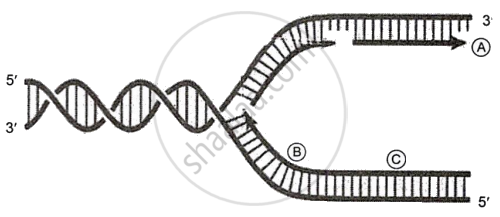
- Identify the part labelled as ‘A’:
- Leading strand
- Lagging strand
- DNA template
- RNA template
- The enzyme which joins the small fragments of newly synthesised DNA on the 5’ → 3’ template strand is:
- Helicase
- Topoisomerase
- DNA ligase
- RNA polymerase
- The overall process of DNA replication is:
- Continuous
- Lagging
- Discontinuous
- Semi-discontinuous
- The alphabet ‘B’ and ‘C’ represent:
- mRNA
- mRNA
- Okazaki fragments
- Single-strand binding protein
- The role of the enzyme DNA polymerase is to:
- unwind the DNA helix
- synthesis mRNA
- cause the polymerisation of the complementary daughter strand
- synthesise RNA primer
Nootan solutions for Biology [English] Class 12 ISC 5 Molecular Basis of Inheritance HIGHER ORDER THINKING SKILLS QUESTIONS (HOTS) [Pages 275 - 276]
If the following is the sequence of nucleotides in mRNA, predict the sequence of amino acids coded by it:
AUG UUU UUC UUC UUU UUU UUC.
Can you now correlate which two properties of the genetic code you have learnt?
Correlate the codons of the mRNA strand with the amino acids of the polypeptide translated.
5’ AUG ACC UUU CACU UCG UGU AA3’ → mRNA
Met - Thr - Phe - His - Phe - Val → Translated polypeptide
Infer any three properties of the genetic code with examples from the above information.
Depending upon the chemical nature of the template (DNA or RNA) and the nature of nucleic acids synthesised from it (DNA or RNA), list the types of nucleic acid polymerases.
How did Hershey and Chase differentiate between DNA and protein in their experiment while proving that DNA is the genetic material?
List two essential roles of ribosomes during translation.
Name the parts ‘A’ and ‘B’ of the transcription unit shown below.
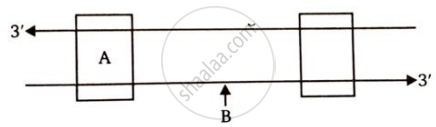
Draw a schematic representation of the structure of a transcription unit and show the following in it.
- Direction in which the transcription occurs.
- Polarity of the two strands involved.
- Template strand.
- Terminator gene.
Mention the function of the promoter gene in transcription.
Look at the given figure and answer the questions:
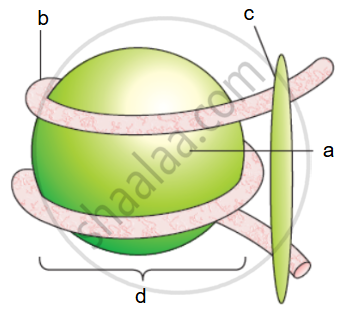
- What is this diagram representing?
- Name the parts a, b, c, and d.
- In the eukaryotes, the DNA molecules are organised within the nucleus. How is the DNA molecule organised in a bacterial cell in the absence of a nucleus?
Explain the processing the hnRNA needs to undergo before becoming functional mRNA in eukaryotes.
Describe post-transcriptional processing of RNA in eukaryotes.
Write the dual purpose served by deoxyribonucleoside triphosphates in the polymerisation.
Although a prokaryotic cell has no defined nucleus, yet DNA is not scattered throughout the cell. Explain.
State the ‘Central dogma’ as proposed by Francis Crick. Are there any exceptions to it? Support your answer with a reason and an example.
Study the given figure and answer the following:
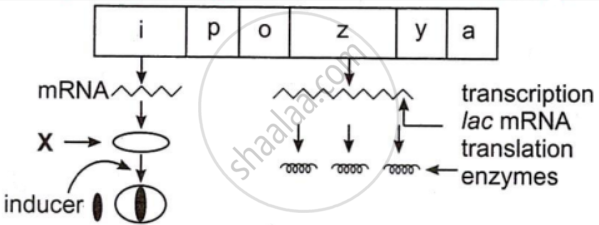
- Name the molecule ‘X’ synthesised by the ‘i’ gene. How does this molecule get inactivated?
- Which one of the structural genes codes for β-galactosidase?
- When will the transcription of this gene stop?
Study the given figure and answer the questions:
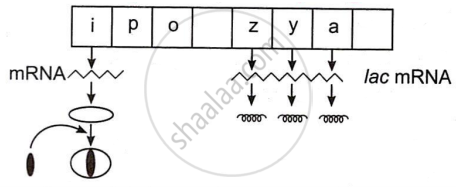
- How does the repressor molecule get inactivated?
- When does the transcription of lac mRNA stop?
- Name the enzyme transcribed by the gene ‘z’.
Retroviruses have no DNA. However, the DNA of the infected host cell does possess viral DNA. How is it possible?
Nootan solutions for Biology [English] Class 12 ISC 5 Molecular Basis of Inheritance NCERT EXERCISES [Pages 277 - 278]
Group the following as nitrogenous bases and nucleosides:
Adenine, Cytidine, Thymine, Guanosine, Uracil and Cytosine.
If a double stranded DNA has 20 per cent of cytosine, calculate the per cent of adenine in the DNA.
If the sequence of one strand of DNA is written as follows:
5’- ATG CATG CATG CATG CATG CATGC - 3’
Write down the sequence of the complementary strand in 5’ → 3’ direction.
If the sequence of the coding strand in a transcription unit is written as follows:
5’ - ATGC ATGC ATGC ATGC ATGC ATGC ATGC - 3’
Write down the sequence of mRNA.
Which property of DNA double helix led Watson and Crick to hypothesise semi-conservative mode of DNA replication? Explain.
Depending upon the chemical nature of the template (DNA or RNA) and the nature of nucleic acids synthesised from it (DNA or RNA), list the types of nucleic acid polymerases.
How did Hershey and Chase differentiate between DNA and protein in their experiment while proving that DNA is the genetic material?
Differentiate between the following:
mRNA and tRNA
Differentiate between the following:
Template strand and Coding strand
List two essential roles of ribosomes during translation.
Explain (in one or two lines) the function of the following:
tRNA
Briefly describe the following:
Transcription
Briefly describe the following:
Translation
In the medium where E. coli was growing, lactose was added, which induced the lac operon. Then, why does lac operon shut down some time after addition of lactose in the medium?
Explain (in one or two lines) the function of the following:
Promoter
Explain (in one or two lines) the function of the following:
Exons
Why is the Human Genome project called a mega project?
What is DNA fingerprinting?
Give the applications of DNA fingerprinting technique.
Briefly describe the following:
Bioinformatics
Differentiate between the following:
Repetitive DNA and Satellite DNA
Nootan solutions for Biology [English] Class 12 ISC 5 Molecular Basis of Inheritance VALUE BASED QUESTIONS [Pages 278 - 279]
Study the flow chart given below and answer the questions that follow:
- S-strain → into mice → mice die
- R-strain → into mice → mice live
- Heat-killed S-strain + live R-strain → into mice → ‘A’
- Heat-killed S-strain + DNAase + live R-strain → into mice → ‘B’
- Name the organism and differentiate between its two strains, R and S, respectively.
- Write the results ‘A’ and ‘B’ obtained in steps (c) and (d), respectively.
- Name the scientist who performed the steps (a), (b) and (c).
- Write the specific conclusion drawn from step (d).
“A very small sample of tissue or even a drop of blood can help determine paternity”. Provide a scientific explanation to substantiate the statement.
Name and describe the technique that will help in solving a case of paternity dispute over the custody of a child by two different families.
Following a severe accident, many charred, disfigured bodies are recovered from the site, making the identification of the dead very difficult. Name and explain the technique that would help the authorities establish the identity of the dead to be able to hand over the dead to their respective relatives.
In a hospital, two babies one boy and the other girl are borne simultaneously and somehow got exchanged. Both the women claimed to be the mother of baby boy and ultimately the matter went to the court. The judge asked to conduct certain tests to settle the issue of the paternity. Answer the following:
- Name the test that the judge ordered to conduct.
- How is it helpful in deciding paternity issues?
What do ‘Y’ and ‘B’ stand for in ‘YAC’ and ‘BAC’ used in the Human Genome Project (HGP)? Mention their role in the project.
Write the percentage of the total human genome that codes for proteins and the percentage of discovered genes whose functions are known as observed during HGP.
Expand the ‘SNPs’ identified by scientists in HGP.
Nootan solutions for Biology [English] Class 12 ISC 5 Molecular Basis of Inheritance DIFFERENTIATE BETWEEN [Page 279]
Differentiate between Cistron, muton and recon.
Differentiate between Conservative and dispersive replication of DNA.
Differentiate between Euchromatin and Heterochromatin.
Differentiate between Exons and introns.
Differentiate between Leading stand and lagging strand.
Differentiate between the following:
mRNA and tRNA
Differentiate between the one gene-one enzyme hypothesis and the one gene-one polypeptide hypothesis.
Differentiate between prokaryotic and eukaryotic replication.
Differentiate between promoter and terminator in a transcription unit.
Differentiate between RNA polymerase I, RNA polymerase II and RNA polymerase III.
Differentiate between sense and anti-sense DNA strands.
Differentiate between the following:
Template strand and Coding strand
Distinguish between the following.
Transcription and Translation
Differentiate between unambiguous and degenerate codons.
Solutions for 5: Molecular Basis of Inheritance
Nootan solutions for Biology [English] Class 12 ISC chapter 5 - Molecular Basis of Inheritance
Shaalaa.com has the CISCE Mathematics Biology [English] Class 12 ISC CISCE solutions in a manner that help students grasp basic concepts better and faster. The detailed, step-by-step solutions will help you understand the concepts better and clarify any confusion. Nootan solutions for Mathematics Biology [English] Class 12 ISC CISCE 5 (Molecular Basis of Inheritance) include all questions with answers and detailed explanations. This will clear students' doubts about questions and improve their application skills while preparing for board exams.
Further, we at Shaalaa.com provide such solutions so students can prepare for written exams. Nootan textbook solutions can be a core help for self-study and provide excellent self-help guidance for students.
Concepts covered in Biology [English] Class 12 ISC chapter 5 Molecular Basis of Inheritance are Protein Synthesis, Prokaryotic DNA Vs Eukaryotic DNA, ssDNA vs dsDNA, Ribonucleic acid (RNA), Ribosomal RNA (rRNA), Messenger RNA (mRNA), Concept of Genes, Nature of Genes, Properties of Genetic Material, Indirect Evidences for DNA as the Genetic Material, DNA Vs RNA, Tobacco Mosaic Virus (TMV), The RNA World, Biomolecules in the Cell > Nucleic Acids, Purines Vs Pyrimidines, Chargaff's Rules for Base Pairing in DNA, Deoxyribonucleic Acid (DNA), Variants of Double Helix DNA, Structure of Polynucleotide Chain, Transcription Unit and the Gene, Griffith’s Experiment, Avery, McCarty and MacLeod’s Experiment, The Hershey-Chase Experiment, Transfer RNA (tRNA), Prokaryotic mRNA Vs Eukaryotic mRNA, Various Other Types of RNA, DNA Replication, Conservative Replication, Dispersive Replication, Semi-Conservative Replication, Meselson and Stahl’s Experiment, Enzymes used in DNA Replication, Mechanism of DNA Replication, Leading Strand Vs Lagging Strand, Errors in DNA Replication and Its Repair, Reverse Transcription (Teminism), Transcription, Translation, Protein Synthesis in Prokaryotes and Eukaryotes, Genetic Code, Characteristics of the Genetic Code, Chain Initiation and Chain Termination Codons, Mechanism of Translation, Mutations and Protein Structure, Packaging of DNA Helix, Regulation of Gene Expression, Induction and Repression, Operon Concept, The Lac Operon, Human Genome Project, DNA Fingerprinting, Rice Genome Project, Post-transcriptional Processing of RNAs, Protein Synthesis, Prokaryotic DNA Vs Eukaryotic DNA, ssDNA vs dsDNA, Ribonucleic acid (RNA), Ribosomal RNA (rRNA), Messenger RNA (mRNA), Concept of Genes, Nature of Genes, Properties of Genetic Material, Indirect Evidences for DNA as the Genetic Material, DNA Vs RNA, Tobacco Mosaic Virus (TMV), The RNA World, Biomolecules in the Cell > Nucleic Acids, Purines Vs Pyrimidines, Chargaff's Rules for Base Pairing in DNA, Deoxyribonucleic Acid (DNA), Variants of Double Helix DNA, Structure of Polynucleotide Chain, Transcription Unit and the Gene, Griffith’s Experiment, Avery, McCarty and MacLeod’s Experiment, The Hershey-Chase Experiment, Transfer RNA (tRNA), Prokaryotic mRNA Vs Eukaryotic mRNA, Various Other Types of RNA, DNA Replication, Conservative Replication, Dispersive Replication, Semi-Conservative Replication, Meselson and Stahl’s Experiment, Enzymes used in DNA Replication, Mechanism of DNA Replication, Leading Strand Vs Lagging Strand, Errors in DNA Replication and Its Repair, Reverse Transcription (Teminism), Transcription, Translation, Protein Synthesis in Prokaryotes and Eukaryotes, Genetic Code, Characteristics of the Genetic Code, Chain Initiation and Chain Termination Codons, Mechanism of Translation, Mutations and Protein Structure, Packaging of DNA Helix, Regulation of Gene Expression, Induction and Repression, Operon Concept, The Lac Operon, Human Genome Project, DNA Fingerprinting, Rice Genome Project, Post-transcriptional Processing of RNAs.
Using Nootan Biology [English] Class 12 ISC solutions Molecular Basis of Inheritance exercise by students is an easy way to prepare for the exams, as they involve solutions arranged chapter-wise and also page-wise. The questions involved in Nootan Solutions are essential questions that can be asked in the final exam. Maximum CISCE Biology [English] Class 12 ISC students prefer Nootan Textbook Solutions to score more in exams.
Get the free view of Chapter 5, Molecular Basis of Inheritance Biology [English] Class 12 ISC additional questions for Mathematics Biology [English] Class 12 ISC CISCE, and you can use Shaalaa.com to keep it handy for your exam preparation.
