Advertisements
Advertisements
Question
If a double stranded DNA has 20 per cent of cytosine, calculate the per cent of adenine in the DNA.
Advertisements
Solution
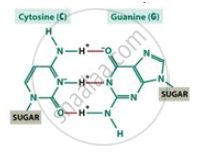
According to Chargaff’s rule, the DNA molecule should have an equal ratio of pyrimidine (cytosine and thymine) and purine (adenine and guanine). It means that the number of adenine molecules is equal to thymine molecules and the number of guanine molecules is equal to cytosine molecules.
% A = % T and % G = % C
If double stranded DNA has 20% of cytosine, then according to the law, it would have 20% of guanine.
Thus, percentage of G + C content = 40%
The remaining 60% represents both A + T molecules. Since adenine and guanine are always present in equal numbers, the percentage of adenine molecule is 30%.
RELATED QUESTIONS
Both deoxyribose and ribose belong to a class of sugars called ______.
If 30 percent of an organism’s DNA is thymine, then ______.
H-bonds between Cytosine and Guanine are ______.
There is no DNA in ______.
DNA is made of two chains that twist about one another in the shape of a ______.
______ occurs in RNA instead of the nitrogenous base thymine found in DNA.
Which ratio is constant for DNA?
In the polynucleotide chain of DNA, a nitrogenous base is linked to the -OH of ______
Retroviruses do not follow central Dogma. Comment.
A short piece of DNA, having 20 base pairs, was analyzed to find the number of nucleotide bases in each of the polynucleotide strands. Some of the results are shown in the table.
| Number of nucleotide bases | ||||
| Adenine | Cytosine | Guanine | Thymine | |
| Strand 1 | 4 | 4 | ||
| Strand 2 | 5 | |||
How many nucleotides containing Adenine were present in strand 2?
Which of the following nitrogenous bases is classified as a purine with a double-ring structure?
What type of bond connects a nitrogenous base to the pentose sugar in a nucleotide?
Which end of a polynucleotide chain contains a free phosphate group?
What is the significance of the 2′-OH group in ribose compared to deoxyribose?
Why is the name 'deoxyribonucleic acid' appropriate for DNA?
A nucleotide is the monomer unit of a nucleic acid. Which of the following correctly identifies the three components of a nucleotide?
Which of the following nitrogenous bases is classified as a purine with a double-ring structure?
What structural difference exists between the pentose sugar found in DNA and the pentose sugar found in RNA?
What type of bond connects a nitrogenous base to the pentose sugar in a nucleotide?
In a polynucleotide chain, nucleotides are linked together by which type of bond?
Which end of a polynucleotide chain contains a free phosphate group?
The 3′ end of a polynucleotide chain is characterized by the presence of:
The backbone of a polynucleotide chain is formed by which components?
In a DNA double helix, what is the spatial relationship between the two polynucleotide strands?
In a DNA double helix, where are the nitrogenous bases located?
Why is the name 'deoxyribonucleic acid' appropriate for DNA?
