Topics
Reproduction in Organisms
Sexual Reproduction in Flowering Plants
- Flower
- Pre-fertilisation in Flowering Plant: Structures and Events
- Structure and Development of Anther
- Microsporogenesis
- Structure and Development of Male Gametophyte
- Pollen Viability and Storage
- Structure and Development of Ovule
- Megasporogenesis
- Development of Female Gametophyte or Embryo Sac
- Pollination
- Autogamy
- Geitonogamy
- Cross-pollination
- Agents of Pollination
- Anemophily
- Hydrophily
- Animal-Mediated Pollination (Zoophily)
- Outbreeding Devices
- Pollen Pistil Interaction
- Artificial Hybridization or Artificial Fertilization
- Double Fertilization and Triple Fusion
- Events in Sexual Reproduction > Post-Fertilization Structures and Events
- Endosperm
- Dicotyledonous Embryo
- Monocotyledonous Embryo
- The Seed
- Apomixis
- Polyembryony
Reproduction
Genetics and Evolution
Human Reproduction
- Human Reproduction
- The Male Reproductive System
- The Female Reproductive System
- Gametogenesis
- Spermatogenesis
- Structure of Sperm
- Spermiogenesis
- Oogenesis
- Menstrual Cycle (Ovarian Cycle)
- Major Events of Menstrual Cycle
- Menstrual Hygiene
- Fertilization in Humans
- Implantation in Human
- Pregnancy and Embryonic Development
- Parturition (Birth) in Human
- Lactation in Human
Biology and Human Welfare
Reproductive Health
- Concept of Reproductive Health
- Population Explosion and Control Measures
- Birth Control
- Natural Contraceptive Methods
- Artificial Contraceptive Methods
- Induced Abortion or Medical Termination of Pregnancy (MTP)
- Sexually Transmitted Diseases (STD) or Sexually Transmitted Infections (STI)
- Infertility
- Assisted Reproductive Technology (ART)
- Amniocentesis
- Genetic Counselling
Biotechnology
Environmental Issues
- Controlling Vehicular Air Pollution: a Case Study of Delhi
- Effects of Domestic Sewage and Industrial Effluents on Water
- Solid Wastes
- Radioactive Wastes
- Greenhouse Effect and Climate Change
- Ozone Depletion in the Stratosphere
- Degradation by Improper Resource Utilisation and Maintenance
- Radioactive Waste Management and E-waste
Principles of Inheritance and Variation
- Heredity and Variation
- Gregor Johann Mendel – Father of Genetics
- Mendel's Experiments on Inheritance
- Monohybrid Cross
- Punnett Square
- Back Cross and Test Cross
- Mendel's Laws > The Law of Dominance
- Mendel's Laws > The Law of Segregation (Law of Purity of Gametes)
- Exceptions to Mendel's Principles > Incomplete Dominance
- Exceptions to Mendel's Principles > Co-Dominance
- Dihybrid Cross
- Mendel's Laws > The Law of Independent Assortment
- Chromosomal Theory of Inheritance
- Linkage and Recombination
- Polygenic Inheritance
- Exceptions to Mendel's Principles > Pleiotropy
- Sex Determination
- Sex Determination in Humans
- Sex Determination in Honey Bees
- Mutations
- Pedigree Analysis
- Mendelian Disorders in Humans
- Chromosomal Disorders or Abnormalities
Molecular Basis of Inheritance
- Deoxyribonucleic Acid (DNA)
- Structure of Polynucleotide Chain
- Packaging of DNA Helix
- Search for Genetic Material
- Griffith’s Experiment
- Avery, McCarty and MacLeod’s Experiment
- The Hershey-Chase Experiment
- Properties of Genetic Material
- The RNA World
- DNA Replication
- Conservative Replication
- Dispersive Replication
- Semi-Conservative Replication
- Meselson and Stahl’s Experiment
- Enzymes used in DNA Replication
- Mechanism of DNA Replication
- Protein Synthesis
- Reverse Transcription (Teminism)
- Transcription
- Transcription Unit and the Gene
- Process of Transcription in Bacteria
- Process of Transcription in Eukaryotes
- Genetic Code
- Characteristics of the Genetic Code
- Mutations and Genetic Code
- Transfer RNA (tRNA)
- Translation
- Regulation of Gene Expression
- The Lac Operon
- Human Genome Project
- DNA Fingerprinting
Ecology
Evolution
- Origin of Life on Earth
- Urey and Miller’s Experiment
- Evolution of Life Forms - a Theory
- Evidences Supporting the Theory of Evolution
- Adaptive Radiation
- Theories and Mechanism of Evolution
- Theories and Mechanism of Evolution
- Hardy Weinberg’s Principle
- Types of Selection
- Brief Account of Evolution
- Human Evolution
Human Health and Diseases
- Concept and Determinants of Health
- Modes of Transmission of Diseases through Pathogens
- Diseases Caused by Bacteria > Typhoid
- Diseases Caused by Bacteria > Pneumonia
- Diseases Caused by Viruses > Common Cold
- Diseases Caused by Protozoa > Malaria
- Diseases Caused by Protozoa > Amoebiasis (Amoeboic dysentery)
- Diseases Caused by Helminths > Ascariasis
- Diseases Caused by Helminths > Filariasis (Elephantiasis)
- Diseases Caused by Fungi > Ringworm
- Prevention and Control of Infectious Diseases
- Immunity
- Types of Immunity > Innate Immunity
- Types of Immunity > Acquired Immunity
- Vaccination and Immunization
- Allergies
- Autoimmunity
- The Immune System
- Acquired Immuno Deficiency Syndrome (AIDS)
- Cancer
- Causes of Cancer
- Symptoms and Diagnosis of Cancer
- Prevention/Treatment of Cancer
- Drugs and Alcohol Abuse
- Addiction and Dependence
- Effects of Drug and Alcohol Abuse
- Prevention and Control of Drugs and Alcohol Abuse
Microbes in Human Welfare
Strategies for Enhancement in Food Production
Biotechnology - Principles and Processes
Biotechnology and Its Application
Organisms and Populations
- Organisms and Their Environment
- Population and Population Attributes
- Population Growth
- Life History Variation
- Population Interactions
- Negative Interactions > Predation
- Negative Interactions > Competition
- Negative Interactions > Parasitism
- Positive Interactions > Commensalism
- Positive Interactions > Mutualism (Symbiosis)
Ecosystem
Biodiversity and Its Conservation
Estimated time: 13 minutes
CBSE: Class 12
Structure of a Nucleotide
Nucleotide: The monomer unit of a nucleic acid (DNA or RNA). Each nucleotide consists of three components joined together.
Three Components of a Nucleotide
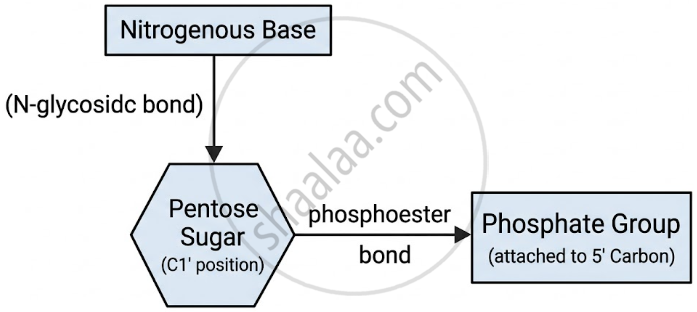
1. Nitrogenous Base:
There are two types of nitrogenous bases:
Purines (Double-ring structure): Adenine (A) and Guanine (G) - present in both DNA and RNA
Pyrimidines (Single-ring structure): Cytosine (C), Thymine (T), Uracil (U)
- Cytosine is common to both DNA and RNA
- Thymine is present only in DNA
- Uracil is present only in RNA (in place of Thymine)
2. Pentose Sugar:
| Nucleic Acid | Sugar Present |
|---|---|
| DNA | Deoxyribose (lacks 2′-OH group) |
| RNA | Ribose (has a 2′-OH group) |
The presence of the 2′-OH group in ribose makes RNA more reactive and less stable than DNA.
3. Phosphate Group
- Phosphate is attached to the 5′ carbon of the pentose sugar via a phosphoester bond
- It gives nucleic acids their acidic nature (hence the name deoxyribonucleic acid)
CBSE: Class 12
CISCE: Class 12
CISCE: Class 12
Definition: Polynucleotide
A polynucleotide is a long chain formed by the joining of many nucleotide monomers.
CBSE: Class 12
CISCE: Class 12
CISCE: Class 12
Formation of a Polynucleotide Chain
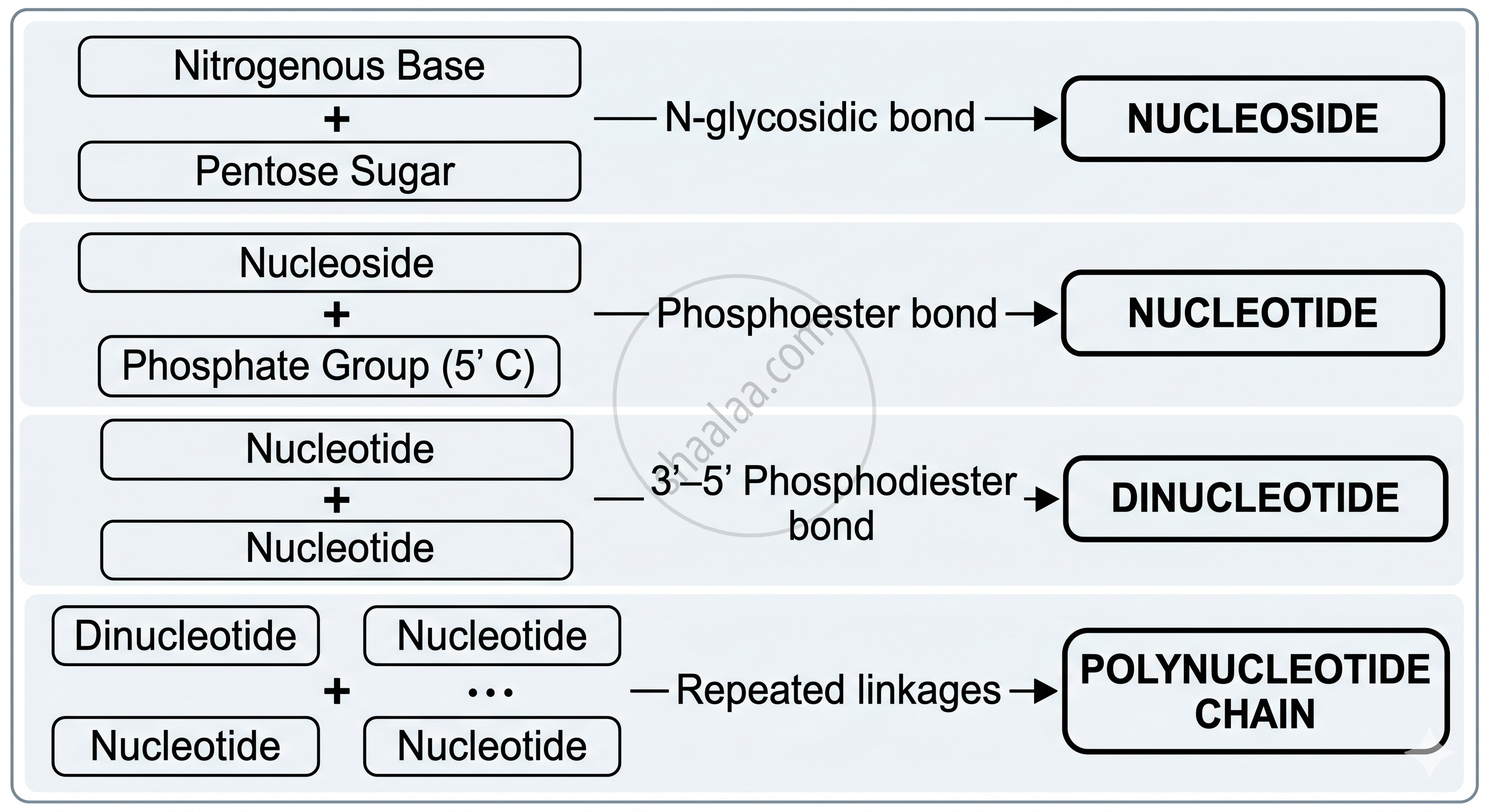
The 3′–5′ Phosphodiester Bond:
- Two nucleotides are linked via a 3′–5′ phosphodiester bond
- The phosphate group at the 5′ carbon of one nucleotide forms an ester bond with the 3′-OH of the adjacent nucleotide
- This process repeats to form a long polynucleotide chain
- The bond is called a 'phosphodiester bond' because phosphate forms ester linkages at both the 3′ and 5′ carbons
CBSE: Class 12
CISCE: Class 12
CISCE: Class 12
Polarity of Polynucleotide Chain
A polynucleotide chain has directionality (polarity):
- 5′ end: Has a free phosphate group attached to the 5′ carbon of the sugar – this is the starting end
- 3′ end: Has a free –OH group attached to the 3′ carbon of the sugar – this is the terminating end
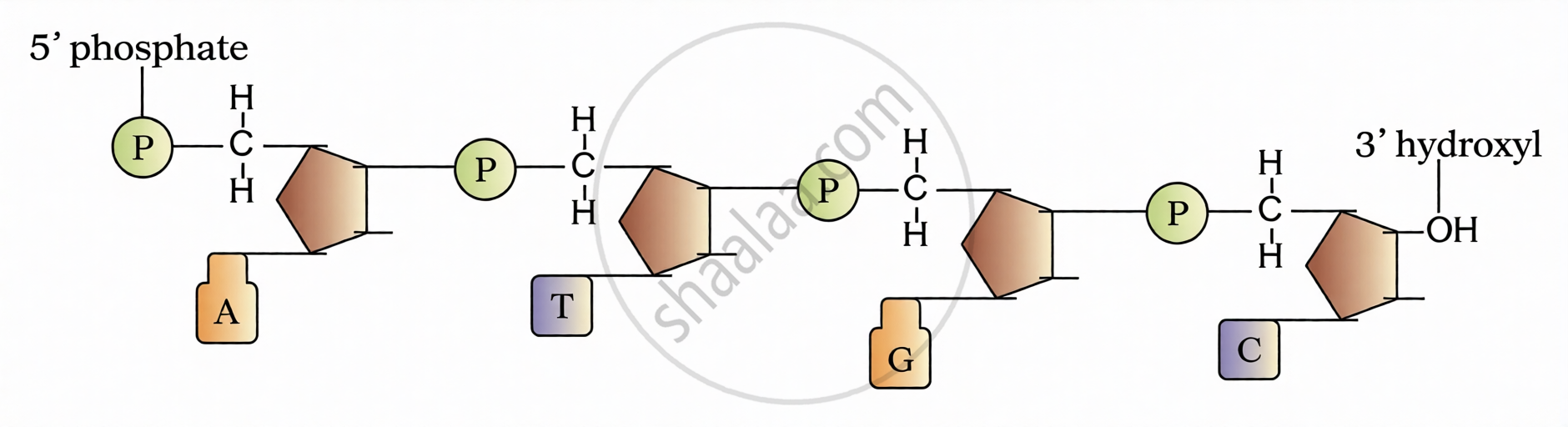
A Polynucleotide chain
CBSE: Class 12
CISCE: Class 12
CISCE: Class 12
Structure of the Backbone
- The backbone of a polynucleotide chain is formed by the sugar and phosphate groups
- The nitrogenous bases are linked to the sugar and project from the backbone
- In a DNA double helix, the two strands are antiparallel – one runs 5′→3′ and the other 3′→5′
- The bases face inward (toward each other) in a double helix and pair via hydrogen bonds
CBSE: Class 12
CISCE: Class 12
CISCE: Class 12
Key Points: Structure of Polynucleotide Chain
- A nucleotide has three parts: a nitrogenous base, a pentose sugar and a phosphate group.
- Sugars differ → RNA has ribose; DNA has deoxyribose.
- Two types of bases:
- Purines → Adenine (A), Guanine (G)
- Pyrimidines → Cytosine (C), Thymine (T), Uracil (U)
- Cytosine is common to both DNA and RNA; thymine is in DNA, and uracil is in RNA.
- Nucleoside = base + sugar; nucleotide = nucleoside + phosphate group.
- Nucleotides join by 3′–5′ phosphodiester bonds to form a polynucleotide chain.
- The chain has a 5′ end (free phosphate), a 3′ end (free OH), and a backbone made of sugar and phosphate.
