Advertisements
Advertisements
Question
A nucleoside differs from a nucleotide. It lacks the ______.
Options
phosphate group
hydroxyl group
sugar
base
Advertisements
Solution
A nucleoside differs from a nucleotide. It lacks the phosphate group.
APPEARS IN
RELATED QUESTIONS
Chargaff’s rules are applicable to ______.
How far is each base pair from the next one in DNA double helix model?
If 30 percent of an organism’s DNA is thymine, then ______.
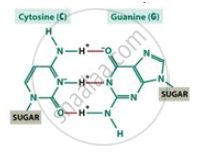
H-bonds between Cytosine and Guanine are ______.
Which ratio is constant for DNA?
In the polynucleotide chain of DNA, a nitrogenous base is linked to the -OH of ______
Polymerase chain reaction (PCR) amplifies DNA following the equation.
A nucleotide is the monomer unit of a nucleic acid. Which of the following correctly identifies the three components of a nucleotide?
What structural difference exists between the pentose sugar found in DNA and the pentose sugar found in RNA?
What type of bond connects a nitrogenous base to the pentose sugar in a nucleotide?
The backbone of a polynucleotide chain is formed by which components?
A nucleotide is the monomer unit of a nucleic acid. Which of the following correctly identifies the three components of a nucleotide?
What structural difference exists between the pentose sugar found in DNA and the pentose sugar found in RNA?
The phosphate group in a nucleotide is attached to which carbon of the pentose sugar?
In a polynucleotide chain, nucleotides are linked together by which type of bond?
The 3′ end of a polynucleotide chain is characterized by the presence of:
In a DNA double helix, what is the spatial relationship between the two polynucleotide strands?
Pyrimidines differ from purines in their basic structural feature. Which statement is correct?
