Advertisements
Advertisements
Question
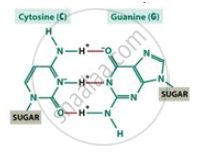
The fact that a purine base always paired through hydrogen bonds with a pyrimidine base leads to, in the DNA double helix ______.
Options
uniform width throughout DNA
uniform length in all DNA
the semiconservative nature
the antiparallel nature
Advertisements
Solution
The fact that a purine base always paired through hydrogen bonds with a pyrimidine base leads to, in the DNA double helix uniform width throughout DNA.
APPEARS IN
RELATED QUESTIONS
If a double stranded DNA has 20% of cytosine, what will be the percentage of adenine in it?
Both deoxyribose and ribose belong to a class of sugars called ______.
While analysing the DNA of an organism a total number of 5386 nucleotides were found out of which the proportion of different bases were: Adenine = 29%, Guanine = 17%, Cytosine = 32%, Thymine = 17%. Considering the Chargaff’s rule it can be concluded that ______.
What is the nature of the strands of the DNA duplex?
H-bonds between Cytosine and Guanine are ______.
A peptide chain assumes secondary structure through the formation of ______.
Which of the following is a purine?
What is the smallest part of a DNA molecule that can be changed by a point mutation?
Polymerase chain reaction (PCR) amplifies DNA following the equation.
Which of the following nitrogenous bases is classified as a purine with a double-ring structure?
In a DNA double helix, what is the spatial relationship between the two polynucleotide strands?
Why is the name 'deoxyribonucleic acid' appropriate for DNA?
A dinucleotide is formed by linking two nucleotides together. The bond formed between them is:
Which of the following nitrogenous bases is classified as a purine with a double-ring structure?
The phosphate group in a nucleotide is attached to which carbon of the pentose sugar?
In a polynucleotide chain, nucleotides are linked together by which type of bond?
Which end of a polynucleotide chain contains a free phosphate group?
Pyrimidines differ from purines in their basic structural feature. Which statement is correct?
