CBSE: Class 12
Maharashtra State Board: Class 10
CISCE: Class 12
Definition: Transcription
The process of synthesising mRNA from the complementary nucleotide sequence of one DNA strand, in which uracil replaces thymine, is called transcription.
or
The process of copying genetic information from one strand of the DNA into RNA is termed as transcription.
CBSE: Class 12
Maharashtra State Board: Class 12
CISCE: Class 12
Transcription
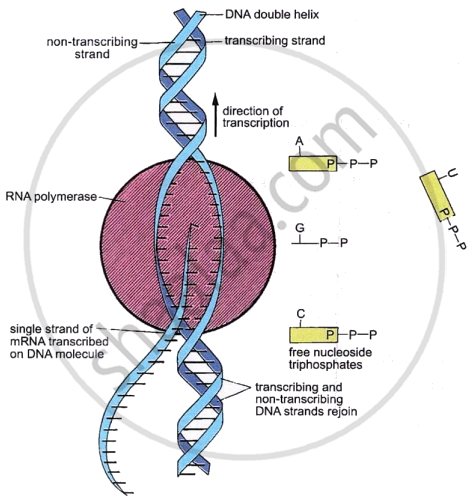
- Transcription is the process of copying genetic information from one DNA strand into RNA.
- In this process, uracil replaces thymine, and base pairing follows the complementarity rule.
- Only one DNA strand acts as the template strand during transcription; the other is the coding strand.
- Transcription is carried out by the enzyme RNA polymerase.
- It occurs in the nucleoid of prokaryotes and in the nucleus of eukaryotes.
- A transcription unit has three parts: promoter, structural gene, and terminator.
- The process takes place in three stages: initiation, elongation, and termination.
- In eukaryotes, the primary RNA formed is hnRNA, which becomes mature mRNA after capping, tailing, and splicing.
- Both DNA strands are not copied because that would produce different RNAs and might form double-stranded RNA, which cannot be translated properly.
CBSE: Class 12
Maharashtra State Board: Class 12
CISCE: Class 12
Key Points: Transcription
- Transcription is the process by which genetic information from one DNA strand (the template strand) is copied into RNA using RNA polymerase.
- It occurs in the nucleoid in prokaryotes and in the nucleus in eukaryotes; mRNA then moves to the cytoplasm for translation.
- A transcription unit has three parts: promoter (start site), structural gene, and terminator (stop site).
- The process occurs in three stages: initiation (RNA polymerase binds the promoter), elongation (the RNA chain is formed), and termination (RNA polymerase detaches).
- Only one DNA strand acts as a template (3′→5′), while the other is the coding strand (5′→3′).
- In eukaryotes, primary RNA (hnRNA) is processed by capping, tailing, and splicing to form mature mRNA.
