Advertisements
Advertisements
Question
Describe the process of transcription in bacteria
Advertisements
Solution
Transcription has three steps—initiation, elongation, and termination.
Initiation:
RNA polymerase binds with the promoter to initiate the process of transcription. Association with the initiation factor (σ) alters the specificity of RNA polymerase to initiate transcription.
Elongation:
RNA polymerase uses nucleoside triphosphate as the substrate, and polymerisation occurs according to complementarity.
Termination:
Termination occurs when the termination factor (rho) alters the specificity of RNA polymerase to terminate transcription. As the RNA polymerase proceeds to perform elongation, a short stretch of RNA remains bound to the enzyme. As the enzyme reaches the termination region, this nascent RNA falls off and transcription is terminated.

APPEARS IN
RELATED QUESTIONS
State the aim and describe Messelson and Stahl’s experiment.
Initiation codon of protein synthesis in Eukaryotes is ______.
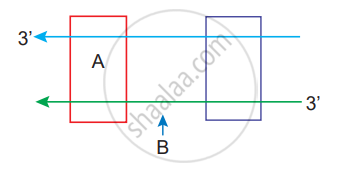
Name the parts marked ‘A’ and ‘B’ in the given transcription unit:
How is the two stage process of protein synthesis advantageous?
The process of transfer of genetic information from DNA to RNA/formation of RNA from DNA is ______.
Reverse transcriptase is ______.
The process of copying genetic information from one strand of DNA to RNA is termed as ______.
A transcription unit consists of how many major parts?
What occurs during the elongation stage of transcription?
Which three post-transcriptional modifications convert hnRNA into mature mRNA in eukaryotes?
