Advertisements
Advertisements
Question
Explain the mechanism of transcription in a prokaryotic cell.
Advertisements
Solution
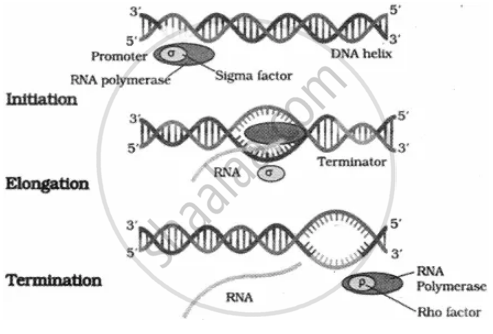
Transcription is the process of copying genetic information from the sense strand of DNA into RNA. Only a segment of DNA is transcribed, and only one of the two strands is copied. In prokaryotes, transcription occurs in contact with the cytoplasm as their DNA lies in the cytoplasm. Transcription requires a DNA-dependent enzyme, RNA polymerase. Prokaryotes have only one RNA polymerase, which synthesises all types of RNAs. The transcription includes the following steps:
- Activation of nucleotides in the nucleoplasm through phosphorylation. These are ATP, GTP, UTP and CTP.
- A single RNA polymerase binds to the promoter site/region of the DNA template. Chain opening of the DNA segment by uncoiling occurs from the site of polymerase binding.
- Initiation of transcription occurs by the complementary pairing of free activated ribonucleotides with the nitrogen bases of the DNA template.
- Activated ribonucleotide triphosphate acts as a substrate and also provides energy for polymerisation on a template following the rule of complementarity.
- As the RNA chain formation initiates, the sigma(cr) factor of RNA polymerase separates. RNA polymerase moves along the DNA template, causing elongation of the RNA chain.
- RNA synthesis stops as soon as the polymerase reaches the terminator region. Rho(p) factor is required for this. The Terminator region has a stop signal.
- The Rho factor helps the release of nascent RNA, and RNA polymerase falls off. It is the termination of transcription.
- In prokaryotes, the n-RNA synthesis does not require any processing to become active, and both transcription and translation occur in the same cytosol.
- Translation can start well before the mRNA is fully transcribed, i.e., transcription and translation can be coupled.
APPEARS IN
RELATED QUESTIONS
Name the enzyme responsible for the transcription of tRNA and the amino acid the initiator tRNA gets linked with.
What is the central dogma?
The process of transfer of genetic information from DNA to RNA/formation of RNA from DNA is ______.
Match List I with List II.
| List I | List II |
| A. RNA polymerase III | I. snRNPs |
| B. Termination of transcription | II. Promotor |
| C. Splicing of Exons | III. Rho factor |
| D. TATA box | IV. SnRNAs, tRNA |
Choose the correct answer from the options given below:
Which nucleotide replaces thymine during the transcription process when RNA is synthesized?
In eukaryotes, where does transcription occur?
Which part of a transcription unit serves as the stop site for transcription?
How many stages does transcription occur in?
What happens during the initiation stage of transcription?
What happens during the termination stage of transcription?
