Advertisements
Advertisements
Question
How is the two stage process of protein synthesis advantageous?
Advertisements
Solution
The split gene feature of eukaryotic genes is almost entirely absent in prokaryotes. Originally each exon may have coded for a single polypeptide chain with a specific function. Since exon arrangement and intron removal are flexible, the exon coding for these polypeptide subunits act as domains combining in various ways to form new genes. Single genes can produce different functional proteins by arranging their exons in several different ways through alternate splicing patterns, a mechanism known to play an important role in generating both protein and functional diversity in animals.
Introns would have arose before or after the evolution of the eukaryotic gene. If introns arose late how did they enter the eukaryotic gene? Introns are mobile DNA sequences that can splice themselves out of, as well as into, specific ‘target sites’ acting like mobile transposon-like elements (that mediate transfer of genes between organisms - Horizontal Gene Transfer - HGT). HGT occurs between lineages of prokaryotic cells, or from prokaryotic to eukaryotic cells, and between eukaryotic cells. HGT is now hypothesized to have played a major role in the evolution of life on Earth.
RELATED QUESTIONS
How do m-RNA, t-RNA and ribosomes help in the process of translation?
- Name the scientist who suggested that the genetic code should be made of a combination of three nucleotides.
- Explain the basis on which he arrived at this conclusion.
State the aim and describe Messelson and Stahl’s experiment.
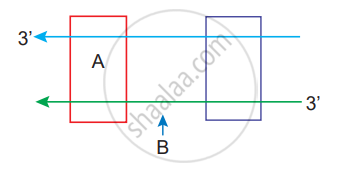
Name the parts marked ‘A’ and ‘B’ in the given transcription unit:
DNA template sequence of CTGATAGC is transcribed over mRNA as ______.
Match List I with List II.
| List I | List II |
| A. RNA polymerase III | I. snRNPs |
| B. Termination of transcription | II. Promotor |
| C. Splicing of Exons | III. Rho factor |
| D. TATA box | IV. SnRNAs, tRNA |
Choose the correct answer from the options given below:
What is the direction of the coding strand?
Which part of a transcription unit serves as the stop site for transcription?
What occurs during the elongation stage of transcription?
In eukaryotes, what is the name of the primary RNA product immediately after transcription?
