Advertisements
Advertisements
प्रश्न
Describe the process of transcription in bacteria
Advertisements
उत्तर
Transcription has three steps—initiation, elongation, and termination.
Initiation:
RNA polymerase binds with the promoter to initiate the process of transcription. Association with the initiation factor (σ) alters the specificity of RNA polymerase to initiate transcription.
Elongation:
RNA polymerase uses nucleoside triphosphate as the substrate, and polymerisation occurs according to complementarity.
Termination:
Termination occurs when the termination factor (rho) alters the specificity of RNA polymerase to terminate transcription. As the RNA polymerase proceeds to perform elongation, a short stretch of RNA remains bound to the enzyme. As the enzyme reaches the termination region, this nascent RNA falls off and transcription is terminated.

APPEARS IN
संबंधित प्रश्न
Briefly describe the following:
Transcription
How is Prokaryotic Transcription process different in eukaryotes?
Explain the processing the hnRNA needs to undergo before becoming functional mRNA in eukaryotes.
What are introns?
A mRNA molecule is produced by ______.
Which of the following is the correct sequence of event with reference to the central dogma?
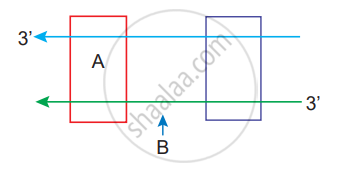
Name the parts marked ‘A’ and ‘B’ in the given transcription unit:
In the processing of hnRNA in eukaryotic cell, the primary transcripts are processed in the following sequence.
How many DNA strands serve as the template strand during transcription?
How many stages does transcription occur in?
