Advertisements
Advertisements
प्रश्न
Explain the processing the hnRNA needs to undergo before becoming functional mRNA in eukaryotes.
Advertisements
उत्तर
In eukaryotes, the hnRNA (heterogeneous nuclear RNA) is the direct product of transcription and contains both coding exons and non-coding introns. To become functional mRNA, it must undergo three essential processing steps within the nucleus:
- Splicing: This is the most critical step, where the non-functional introns are removed, and the functional exons are joined together in a specific order. This process is carried out by a complex called the spliceosome.
- Capping: A unique nucleotide, methyl guanosine triphosphate, is added to the 5’ end of the hnRNA. This “cap” protects the RNA from degradation and helps the ribosome recognise it during translation.
- Tailing (Polyadenylation): About 200–300 adenylate residues are added to the 3’ end of the RNA, forming what is known as a poly-A tail. This tail assists in the export of the mRNA from the nucleus and further stabilises the molecule.
Once these three modifications are complete, the processed transcript is called mature mRNA and is then transported out of the nucleus into the cytoplasm for protein synthesis.
संबंधित प्रश्न
How do m-RNA, t-RNA and ribosomes help in the process of translation?
What are introns?
Initiation codon of protein synthesis in Eukaryotes is ______.
What is the central dogma?
Which of the following is the correct sequence of event with reference to the central dogma?
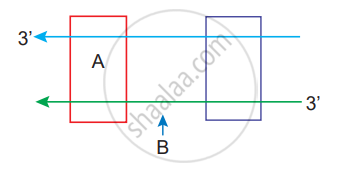
Name the parts marked ‘A’ and ‘B’ in the given transcription unit:
How is the two stage process of protein synthesis advantageous?
The process of transfer of genetic information from DNA to RNA/formation of RNA from DNA is ______.
Which is not involved in protein synthesis?
In a cell, DNA transcription is halted when ______
Read the following and answer from given below:
The translation is the process of polymerization of amino acids to form a polypeptide. The order and sequence of amino acids are defined by the sequence bases in the mRNA. The amino acids are joined by a bond called a peptide bond. The ribosome is the site of protein synthesis.
Which ion is essential for the association of both units of the ribosome at the time of protein formation?
In the processing of hnRNA in eukaryotic cell, the primary transcripts are processed in the following sequence.
Which nucleotide replaces thymine during the transcription process when RNA is synthesized?
In prokaryotes, where does transcription occur?
How many DNA strands serve as the template strand during transcription?
What is the direction of the coding strand?
What happens during the initiation stage of transcription?
What happens during the termination stage of transcription?
