Advertisements
Advertisements
Question
Briefly describe the following:
Transcription
Advertisements
Solution
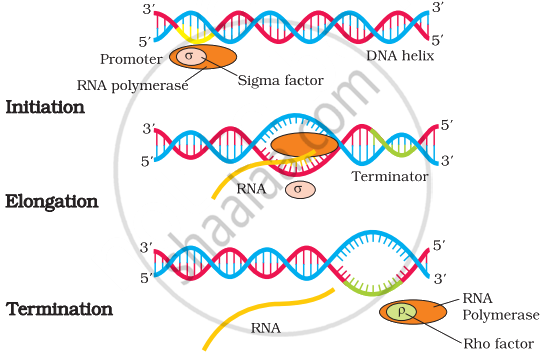
Transcription is the process of synthesising RNA from a DNA template. A segment of DNA gets copied into mRNA during the process. The process of transcription starts at the promoter region of the template DNA and terminates at the terminator region. The segment of DNA between these two regions is known as a transcription unit. The transcription requires RNA polymerase enzyme, a DNA template, four types of ribonucleotides, and certain cofactors such as Mg2+.
The three important events that occur during the process of transcription are as follows.
- Initiation
- Elongation
- Termination
The DNA-dependent RNA polymerase and certain initiation factors (σ) bind at the double-stranded DNA at the promoter region of the template strand and initiate the process of transcription. RNA polymerase moves along the DNA and leads to the unwinding of the DNA duplex into two separate strands. Then, one of the strands, called the sense strand, acts as a template for mRNA synthesis. The enzyme RNA polymerase uses nucleoside triphosphates (dNTPs) as raw materials and polymerises them to form mRNA according to the complementary bases present on the template DNA. This process of opening of helix and elongation of polynucleotide chain continues until the enzyme reaches the terminator region. As RNA polymerase reaches the terminator region, the newly synthesised mRNA transcript along with the enzyme is released. Another factor called terminator factor (ρ) is required for the termination of the transcription.
APPEARS IN
RELATED QUESTIONS
Describe the process of transcription in bacteria
Explain the process of transcription in prokaryotes.
Name the enzyme responsible for the transcription of tRNA and the amino acid the initiator tRNA gets linked with.
How is Prokaryotic Transcription process different in eukaryotes?
Explain the processing the hnRNA needs to undergo before becoming functional mRNA in eukaryotes.
What are introns?
Transcription is the transfer of genetic code from a DNA molecule to ______.
A mRNA molecule is produced by ______.
If the coding sequence in a transcription unit is written as follows:
5' TGCATGCATGCATGCATGCATGCATGC 3'
Write down the sequence of mRNA.
How is the two stage process of protein synthesis advantageous?
The process of transfer of genetic information from DNA to RNA/formation of RNA from DNA is ______.
Reverse transcriptase is ______.
The process of copying genetic information from one strand of DNA to RNA is termed as ______.
In a cell, DNA transcription is halted when ______
The process of copying genetic information from one strand of the DNA into RNA is termed as ______
Match List I with List II.
| List I | List II |
| A. RNA polymerase III | I. snRNPs |
| B. Termination of transcription | II. Promotor |
| C. Splicing of Exons | III. Rho factor |
| D. TATA box | IV. SnRNAs, tRNA |
Choose the correct answer from the options given below:
In the processing of hnRNA in eukaryotic cell, the primary transcripts are processed in the following sequence.
Which enzyme is responsible for catalyzing the transcription process?
What is the direction of the template strand during transcription?
A transcription unit consists of how many major parts?
What occurs during the elongation stage of transcription?
What happens during the termination stage of transcription?
Which three post-transcriptional modifications convert hnRNA into mature mRNA in eukaryotes?
