Advertisements
Advertisements
Question
State the aim and describe Messelson and Stahl’s experiment.
Advertisements
Solution
Messelson and Stahl in 1958 aimed at proving that the DNA replicates in a semi-conservative fashion. The semi-conservative DNA replication suggests that after the completion of replication, each DNA molecule will have one parental and one newly-synthesised strand.
Experimental proof
(1) E.coli was grown in a medium containing 15NH4Cl (15N is the heavy isotope of nitrogen) as the only nitrogen source for many generations. As a result, 15N was incorporated into
the newly-synthesised DNA. This heavy DNA could be distinguished by centrifugations in CsCl density gradient.
(2) Then, these E. coli cells were transferred to a medium with normal 14NH4 Cl and the DNA was extracted as double-stranded helix. The various samples were separated on CsCl gradients for measuring the density of DNA.
(3) After 40 minutes, the DNA of the second generation was extracted from the
14NH4Cl medium and was found to have equal amounts of hybrid and light DNA.

APPEARS IN
RELATED QUESTIONS
Following are the features of genetic codes. What does each one indicate?
Stop codon; Unambiguous codon; Degenerate codon; Universal codon.
Which of the following is the correct sequence of event with reference to the central dogma?
Name the parts marked ‘A’ and ‘B’ in the given transcription unit:
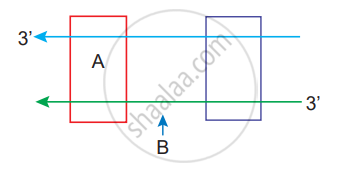
If the coding sequence in a transcription unit is written as follows:
5' TGCATGCATGCATGCATGCATGCATGC 3'
Write down the sequence of mRNA.
Which is not involved in protein synthesis?
If the sequence of bases in DNA is ATTCGATG, then the sequence of bases in its transcript will be ______.
Which factor is important for termination of transcription?
Which part of a transcription unit serves as the start site for transcription?
What occurs during the elongation stage of transcription?
What happens during the termination stage of transcription?
