Topics
Reproduction in Organisms
Sexual Reproduction in Flowering Plants
- Flower
- Pre-fertilisation in Flowering Plant: Structures and Events
- Structure and Development of Anther
- Microsporogenesis
- Structure and Development of Male Gametophyte
- Pollen Viability and Storage
- Structure and Development of Ovule
- Megasporogenesis
- Development of Female Gametophyte or Embryo Sac
- Pollination
- Autogamy
- Geitonogamy
- Cross-pollination
- Agents of Pollination
- Anemophily
- Hydrophily
- Animal-Mediated Pollination (Zoophily)
- Outbreeding Devices
- Pollen Pistil Interaction
- Artificial Hybridization or Artificial Fertilization
- Double Fertilization and Triple Fusion
- Events in Sexual Reproduction > Post-Fertilization Structures and Events
- Endosperm
- Dicotyledonous Embryo
- Monocotyledonous Embryo
- The Seed
- Apomixis
- Polyembryony
Reproduction
Genetics and Evolution
Human Reproduction
- Human Reproduction
- The Male Reproductive System
- The Female Reproductive System
- Gametogenesis
- Spermatogenesis
- Structure of Sperm
- Spermiogenesis
- Oogenesis
- Menstrual Cycle (Ovarian Cycle)
- Major Events of Menstrual Cycle
- Menstrual Hygiene
- Fertilization in Humans
- Implantation in Human
- Pregnancy and Embryonic Development
- Parturition (Birth) in Human
- Lactation in Human
Reproductive Health
- Concept of Reproductive Health
- Population Explosion and Control Measures
- Birth Control
- Natural Contraceptive Methods
- Artificial Contraceptive Methods
- Induced Abortion or Medical Termination of Pregnancy (MTP)
- Sexually Transmitted Diseases (STD) or Sexually Transmitted Infections (STI)
- Infertility
- Assisted Reproductive Technology (ART)
- Amniocentesis
- Genetic Counselling
Biology and Human Welfare
Biotechnology
Environmental Issues
- Controlling Vehicular Air Pollution: a Case Study of Delhi
- Effects of Domestic Sewage and Industrial Effluents on Water
- Solid Wastes
- Radioactive Wastes
- Greenhouse Effect and Climate Change
- Ozone Depletion in the Stratosphere
- Degradation by Improper Resource Utilisation and Maintenance
- Radioactive Waste Management and E-waste
Principles of Inheritance and Variation
- Heredity and Variation
- Gregor Johann Mendel – Father of Genetics
- Mendel's Experiments on Inheritance
- Monohybrid Cross
- Punnett Square
- Back Cross and Test Cross
- Mendel's Laws > The Law of Dominance
- Mendel's Laws > The Law of Segregation (Law of Purity of Gametes)
- Exceptions to Mendel's Principles > Incomplete Dominance
- Exceptions to Mendel's Principles > Co-Dominance
- Dihybrid Cross
- Mendel's Laws > The Law of Independent Assortment
- Chromosomal Theory of Inheritance
- Linkage and Recombination
- Polygenic Inheritance
- Exceptions to Mendel's Principles > Pleiotropy
- Sex Determination
- Sex Determination in Humans
- Sex Determination in Honey Bees
- Mutations
- Pedigree Analysis
- Mendelian Disorders in Humans
- Chromosomal Disorders or Abnormalities
Molecular Basis of Inheritance
- Deoxyribonucleic Acid (DNA)
- Structure of Polynucleotide Chain
- Packaging of DNA Helix
- Search for Genetic Material
- Griffith’s Experiment
- Avery, McCarty and MacLeod’s Experiment
- The Hershey-Chase Experiment
- Properties of Genetic Material
- The RNA World
- DNA Replication
- Conservative Replication
- Dispersive Replication
- Semi-Conservative Replication
- Meselson and Stahl’s Experiment
- Enzymes used in DNA Replication
- Mechanism of DNA Replication
- Protein Synthesis
- Reverse Transcription (Teminism)
- Transcription
- Transcription Unit and the Gene
- Process of Transcription in Bacteria
- Process of Transcription in Eukaryotes
- Genetic Code
- Characteristics of the Genetic Code
- Mutations and Genetic Code
- Transfer RNA (tRNA)
- Translation
- Regulation of Gene Expression
- The Lac Operon
- Human Genome Project
- DNA Fingerprinting
Ecology
Evolution
- Origin of Life on Earth
- Urey and Miller’s Experiment
- Evolution of Life Forms - a Theory
- Evidences Supporting the Theory of Evolution
- Adaptive Radiation
- Theories and Mechanism of Evolution
- Theories and Mechanism of Evolution
- Hardy Weinberg’s Principle
- Types of Selection
- Brief Account of Evolution
- Human Evolution
Human Health and Diseases
- Concept and Determinants of Health
- Modes of Transmission of Diseases through Pathogens
- Diseases Caused by Bacteria > Typhoid
- Diseases Caused by Bacteria > Pneumonia
- Diseases Caused by Viruses > Common Cold
- Diseases Caused by Protozoa > Malaria
- Diseases Caused by Protozoa > Amoebiasis (Amoeboic dysentery)
- Diseases Caused by Helminths > Ascariasis
- Diseases Caused by Helminths > Filariasis (Elephantiasis)
- Diseases Caused by Fungi > Ringworm
- Prevention and Control of Infectious Diseases
- Immunity
- Types of Immunity > Innate Immunity
- Types of Immunity > Acquired Immunity
- Vaccination and Immunization
- Allergies
- Autoimmunity
- The Immune System
- Acquired Immuno Deficiency Syndrome (AIDS)
- Cancer
- Causes of Cancer
- Symptoms and Diagnosis of Cancer
- Prevention/Treatment of Cancer
- Drugs and Alcohol Abuse
- Addiction and Dependence
- Effects of Drug and Alcohol Abuse
- Prevention and Control of Drugs and Alcohol Abuse
Microbes in Human Welfare
Strategies for Enhancement in Food Production
Biotechnology - Principles and Processes
Biotechnology and Its Application
Organisms and Populations
- Organisms and Their Environment
- Population and Population Attributes
- Population Growth
- Life History Variation
- Population Interactions
- Negative Interactions > Predation
- Negative Interactions > Competition
- Negative Interactions > Parasitism
- Positive Interactions > Commensalism
- Positive Interactions > Mutualism (Symbiosis)
Ecosystem
Biodiversity and Its Conservation
CISCE: Class 12
Introduction
Recombinant DNA technology is the technique of joining DNA from two different sources and introducing it into a host organism to produce useful products.
- It helps produce useful substances such as insulin, hormones, vaccines, and enzymes.
- It allows scientists to multiply a selected gene in large amounts.
- It supports medicine, agriculture, diagnostics, and research.
CISCE: Class 12
Step 1: Isolation of genetic material (DNA)
The first step is to isolate DNA containing the required gene. Since DNA is enclosed within membranes, the cell has to be broken open. This process is called lysis.
How cells are broken
- Bacterial cells are treated with lysozyme.
- Plant cells are treated with cellulase.
- Fungal cells are treated with chitinase.
CISCE: Class 12
Step 2: Cutting of DNA at specific locations
Purified DNA is cut at specific sites using restriction enzymes. These enzymes act like molecular scissors. They recognise particular DNA sequences and cut the DNA precisely.
Why this step matters
- It helps remove the desired gene from the source DNA.
- It also allows the vector DNA to be cut at a suitable site.
CISCE: Class 12
Step 3: Separation of DNA fragments by gel electrophoresis
After cutting, DNA fragments of different lengths are formed. These fragments are separated by gel electrophoresis. DNA molecules move in an electric field through agarose gel.
Principle:
- DNA is negatively charged.
- Therefore, it moves towards the positive electrode.
- Smaller fragments move faster than larger fragments.
Identification of fragments:
- DNA fragments are stained and seen as bands under ultraviolet light.
- The desired DNA band is cut out from the gel and purified.
- This recovery of DNA from the gel is called elution.
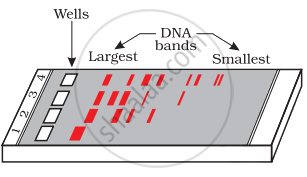
A typical agarose gel electrophoresis showing the migration of undigested (lane 1) and a digested set of DNA fragments (lane 2 to 4)
CISCE: Class 12
Step 4: Amplification of gene of interest using PCR
The desired gene is often present in a very small amount. Therefore, it is amplified using Polymerase Chain Reaction (PCR). PCR produces many copies of the selected DNA segment.
Main requirements for PCR:
- template DNA
- two primers
- DNA nucleotides
- thermostable DNA polymerase
Enzyme used: Taq polymerase, which remains active at high temperatures.
Main steps of PCR:
- Denaturation – DNA strands separate on heating.
- Annealing – primers attach to complementary sequences.
- Extension – Taq polymerase synthesises new DNA strands.
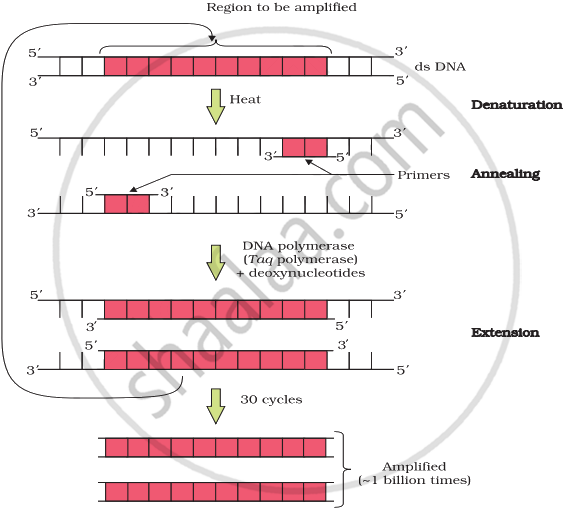
Polymerase chain reaction (PCR): Each cycle has three steps: (i) Denaturation; (ii) Primer annealing; and (iii) Extension of primers
CISCE: Class 12
Step 5: Insertion of recombinant DNA into the vector
The desired gene is joined with the vector DNA. This joining is done by DNA ligase. The resulting DNA is called recombinant DNA.
About vectors:
- A vector is a carrier DNA molecule.
- It carries the desired gene into the host cell.
- Common vectors include plasmids.
Why ligation is necessary:
- Restriction enzymes cut DNA.
- DNA ligase joins DNA fragments.
- Both actions are essential and must not be confused.
CISCE: Class 12
Step 6: Introduction of recombinant DNA into host cells
The recombinant DNA is introduced into a suitable host cell. This process is called 'transformation' when bacteria take up the recombinant DNA.
How host cells are made ready:
- Cells are first made competent so that they can take up foreign DNA.
- In bacteria, treatment with calcium ions followed by heat shock facilitates DNA entry into cells.
Other methods that may be used:
- electroporation
- microinjection
- biolistics or gene gun
CISCE: Class 12
Step 7: Obtaining the foreign gene product
Once inside the host, the foreign gene may replicate and express itself. The host then begins to produce the desired protein or product. This useful substance is called the foreign gene product.
Example:
Microorganisms carrying a useful human gene can be used to produce therapeutic proteins.
CISCE: Class 12
Step 8: Production in bioreactors
Small-scale production is not sufficient for commercial use. Therefore, the transformed host cells are grown in large vessels called bioreactors. These provide ideal conditions for growth and product formation.
Features of a bioreactor:
- large vessel for culturing cells
- system for mixing or agitation
- oxygen supply
- foam control
- temperature control
- pH control
- sampling ports
Common type: A stirred-tank bioreactor is widely used.
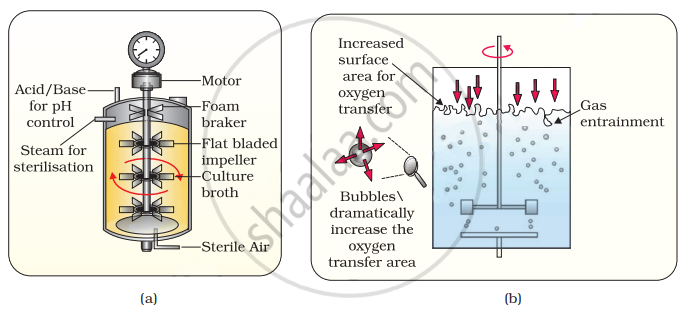
(a) Simple stirred-tank bioreactor; (b) Sparged stirred-tank bioreactor through which sterile air bubbles are sparged
CISCE: Class 12
Step 9: Downstream processing
The product formed in the bioreactor is not immediately ready for use. It must be separated, purified, and processed. These final steps are together called downstream processing.
It may include:
- separation of product from cells or medium
- purification of the product
- formulation and packaging
- quality testing
CISCE: Class 12
Key Points: Processes of Recombinant DNA Technology
- Cells are first broken open using specific enzymes (such as lysozyme for bacteria) to successfully isolate the genetic material.
- The purified DNA is precisely cut at specific locations using restriction enzymes, which act as "molecular scissors" to extract the desired gene.
- The resulting DNA fragments are separated by size using gel electrophoresis, and the specific target sequence is extracted.
- The desired gene is then amplified into millions of copies using the polymerase chain reaction (PCR) technique.
- The amplified gene is joined to a carrier vector using the enzyme DNA ligase to construct a new molecule called recombinant DNA.
- This recombinant DNA is introduced into a chemically treated, competent host cell (such as a bacterium) through a process known as transformation.
- For commercial use, these transformed host cells are cultured on a massive scale inside large, environmentally controlled vessels called bioreactors.
- The final therapeutic product undergoes downstream processing, which involves rigorous separation, purification, and quality testing before packaging.
