Topics
Reproduction in Organisms
Sexual Reproduction in Flowering Plants
- Flower
- Pre-fertilisation in Flowering Plant: Structures and Events
- Structure and Development of Anther
- Microsporogenesis
- Structure and Development of Male Gametophyte
- Pollen Viability and Storage
- Structure and Development of Ovule
- Megasporogenesis
- Development of Female Gametophyte or Embryo Sac
- Pollination
- Autogamy
- Geitonogamy
- Cross-pollination
- Agents of Pollination
- Anemophily
- Hydrophily
- Animal-Mediated Pollination (Zoophily)
- Outbreeding Devices
- Pollen Pistil Interaction
- Artificial Hybridization or Artificial Fertilization
- Double Fertilization and Triple Fusion
- Events in Sexual Reproduction > Post-Fertilization Structures and Events
- Endosperm
- Dicotyledonous Embryo
- Monocotyledonous Embryo
- The Seed
- Apomixis
- Polyembryony
Reproduction
Genetics and Evolution
Human Reproduction
- Human Reproduction
- The Male Reproductive System
- The Female Reproductive System
- Gametogenesis
- Spermatogenesis
- Structure of Sperm
- Spermiogenesis
- Oogenesis
- Menstrual Cycle (Ovarian Cycle)
- Major Events of Menstrual Cycle
- Menstrual Hygiene
- Fertilization in Humans
- Implantation in Human
- Pregnancy and Embryonic Development
- Parturition (Birth) in Human
- Lactation in Human
Reproductive Health
- Concept of Reproductive Health
- Population Explosion and Control Measures
- Birth Control
- Natural Contraceptive Methods
- Artificial Contraceptive Methods
- Induced Abortion or Medical Termination of Pregnancy (MTP)
- Sexually Transmitted Diseases (STD) or Sexually Transmitted Infections (STI)
- Infertility
- Assisted Reproductive Technology (ART)
- Amniocentesis
- Genetic Counselling
Biology and Human Welfare
Biotechnology
Environmental Issues
- Controlling Vehicular Air Pollution: a Case Study of Delhi
- Effects of Domestic Sewage and Industrial Effluents on Water
- Solid Wastes
- Radioactive Wastes
- Greenhouse Effect and Climate Change
- Ozone Depletion in the Stratosphere
- Degradation by Improper Resource Utilisation and Maintenance
- Radioactive Waste Management and E-waste
Principles of Inheritance and Variation
- Heredity and Variation
- Gregor Johann Mendel – Father of Genetics
- Mendel's Experiments on Inheritance
- Monohybrid Cross
- Punnett Square
- Back Cross and Test Cross
- Mendel's Laws > The Law of Dominance
- Mendel's Laws > The Law of Segregation (Law of Purity of Gametes)
- Exceptions to Mendel's Principles > Incomplete Dominance
- Exceptions to Mendel's Principles > Co-Dominance
- Dihybrid Cross
- Mendel's Laws > The Law of Independent Assortment
- Chromosomal Theory of Inheritance
- Linkage and Recombination
- Polygenic Inheritance
- Exceptions to Mendel's Principles > Pleiotropy
- Sex Determination
- Sex Determination in Humans
- Sex Determination in Honey Bees
- Mutations
- Pedigree Analysis
- Mendelian Disorders in Humans
- Chromosomal Disorders or Abnormalities
Molecular Basis of Inheritance
- Deoxyribonucleic Acid (DNA)
- Structure of Polynucleotide Chain
- Packaging of DNA Helix
- Search for Genetic Material
- Griffith’s Experiment
- Avery, McCarty and MacLeod’s Experiment
- The Hershey-Chase Experiment
- Properties of Genetic Material
- The RNA World
- DNA Replication
- Conservative Replication
- Dispersive Replication
- Semi-Conservative Replication
- Meselson and Stahl’s Experiment
- Enzymes used in DNA Replication
- Mechanism of DNA Replication
- Protein Synthesis
- Reverse Transcription (Teminism)
- Transcription
- Transcription Unit and the Gene
- Process of Transcription in Bacteria
- Process of Transcription in Eukaryotes
- Genetic Code
- Characteristics of the Genetic Code
- Mutations and Genetic Code
- Transfer RNA (tRNA)
- Translation
- Regulation of Gene Expression
- The Lac Operon
- Human Genome Project
- DNA Fingerprinting
Ecology
Evolution
- Origin of Life on Earth
- Urey and Miller’s Experiment
- Evolution of Life Forms - a Theory
- Evidences Supporting the Theory of Evolution
- Adaptive Radiation
- Theories and Mechanism of Evolution
- Theories and Mechanism of Evolution
- Hardy Weinberg’s Principle
- Types of Selection
- Brief Account of Evolution
- Human Evolution
Human Health and Diseases
- Concept and Determinants of Health
- Modes of Transmission of Diseases through Pathogens
- Diseases Caused by Bacteria > Typhoid
- Diseases Caused by Bacteria > Pneumonia
- Diseases Caused by Viruses > Common Cold
- Diseases Caused by Protozoa > Malaria
- Diseases Caused by Protozoa > Amoebiasis (Amoeboic dysentery)
- Diseases Caused by Helminths > Ascariasis
- Diseases Caused by Helminths > Filariasis (Elephantiasis)
- Diseases Caused by Fungi > Ringworm
- Prevention and Control of Infectious Diseases
- Immunity
- Types of Immunity > Innate Immunity
- Types of Immunity > Acquired Immunity
- Vaccination and Immunization
- Allergies
- Autoimmunity
- The Immune System
- Acquired Immuno Deficiency Syndrome (AIDS)
- Cancer
- Causes of Cancer
- Symptoms and Diagnosis of Cancer
- Prevention/Treatment of Cancer
- Drugs and Alcohol Abuse
- Addiction and Dependence
- Effects of Drug and Alcohol Abuse
- Prevention and Control of Drugs and Alcohol Abuse
Microbes in Human Welfare
Strategies for Enhancement in Food Production
Biotechnology - Principles and Processes
Biotechnology and Its Application
Organisms and Populations
- Organisms and Their Environment
- Population and Population Attributes
- Population Growth
- Life History Variation
- Population Interactions
- Negative Interactions > Predation
- Negative Interactions > Competition
- Negative Interactions > Parasitism
- Positive Interactions > Commensalism
- Positive Interactions > Mutualism (Symbiosis)
Ecosystem
Biodiversity and Its Conservation
Introduction
Evidence for evolution has come from many different observations. These include fossils, embryology, comparative anatomy and morphology, biochemical similarities, selective breeding, and natural selection seen in living populations.
Together, these observations show that life forms changed over time and that new forms appeared at different stages in Earth’s history.
Fossil Evidence
- Fossils are remains of hard parts of life forms found in rocks.
- Rocks form sediments, and the arrangement of these sediments in Earth’s crust shows layers formed over a long geological history.
- Different-aged sedimentary layers contain fossils of different life forms that died during the formation of those layers.
- Some fossils resemble modern organisms, while others represent extinct organisms such as dinosaurs.
A study of fossils in different sedimentary layers indicates the geological period in which those organisms lived. This study also shows that life forms varied over time and that certain forms were restricted to particular geological time spans.
Therefore, new forms of life arose at different times in the history of Earth. This evidence is called palaeontological evidence.
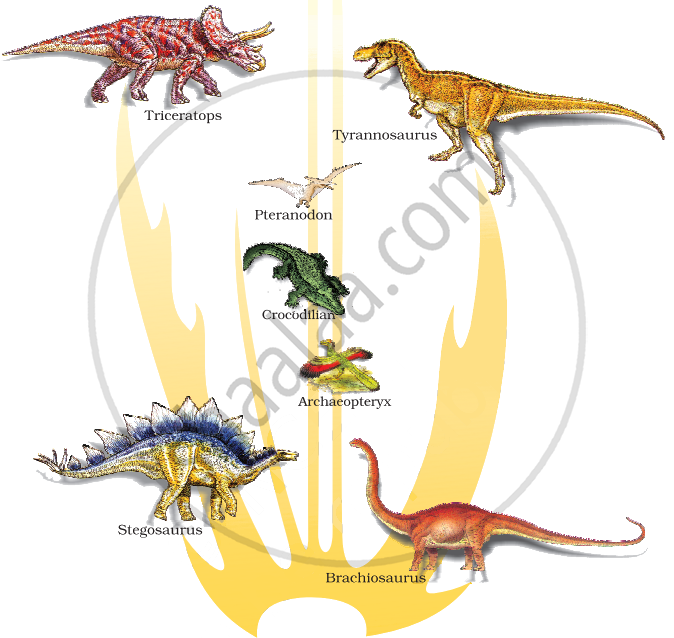
A family tree of dinosaurs and their living modern day counterpart organisms, like crocodiles and birds
Embryological Evidence
Embryological support for evolution was proposed on the basis of common features seen during the embryonic stages of vertebrates.
- For example, embryos of all vertebrates, including humans, develop a row of vestigial gill slits just behind the head.
- These gill slits are functional only in fish and are not found as functional organs in other adult vertebrates.
- This observation was proposed by Ernst Haeckel as support for evolution.
- However, this proposal was later disproved after careful study by Karl Ernst von Baer. He noted that embryos do not pass through the adult stages of other animals.
Comparative Anatomy and Morphology
Comparative anatomy and morphology show similarities and differences among present-day organisms and those that existed earlier. These similarities can be used to infer whether organisms share a common ancestor.
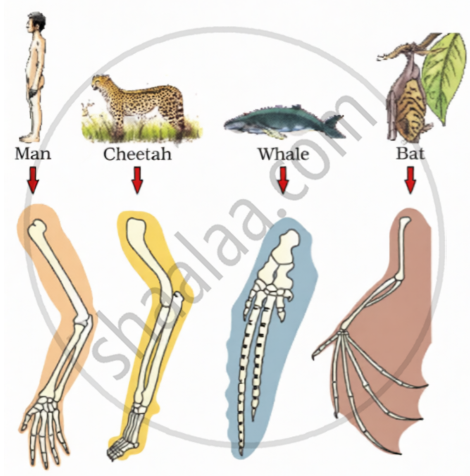
- A major example is seen in the forelimbs of whales, bats, cheetahs, and humans.
- Although these forelimbs perform different functions, they have the same basic arrangement of bones: humerus, radius, ulna, carpals, metacarpals, and phalanges.
- In these animals, the same basic structure developed in different directions due to adaptations to different needs. This is called divergent evolution. Such organs are called homologous organs.
- Homology indicates common ancestry. Other examples include vertebrate hearts and brains.
Homology in Plants
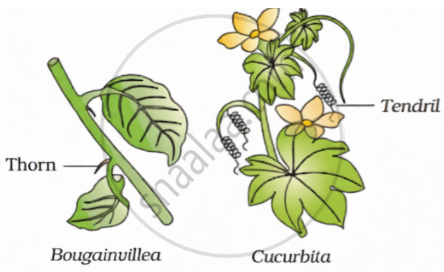
- In plants, homology is seen in different modified structures.
- Thorns of Bougainvillaea and tendrils of Cucurbita are examples of homologous organs.
- These structures have a common origin but perform different functions.
Analogy and Convergent Evolution
- Analogy refers to a condition opposite to homology.
- The wings of butterflies and birds look alike and serve the same function, but they are not anatomically similar structures. Such structures are called analogous organs.
- Analogous organs are the result of convergent evolution.
- In convergent evolution, different structures evolve for the same function and therefore show similarity.
- Other examples include the eye of an octopus and those of mammals.
- The flippers of penguins and dolphins are also analogous.
- Sweet potato and potato form another example because sweet potato is a root modification, whereas potato is a stem modification.
- Similar habitats may lead to the selection of similar adaptive features in different groups of organisms for the same function.
Biochemical Evidence
- Similarities in proteins and genes that perform a given function across diverse organisms provide clues to common ancestry.
- These biochemical similarities support the shared ancestry suggested by structural similarities.
Selective Breeding by Humans
- Humans have bred selected plants and animals for agriculture, horticulture, sport, and security.
- Many wild animals and crops have been domesticated.
- Intensive breeding programmes have created breeds that differ from one another, such as different dog breeds, though they still belong to the same group.
- This suggests that if humans can create new breeds within hundreds of years, nature could produce larger changes over millions of years.
Peppered Moth and Natural Selection
- Another observation supporting evolution by natural selection came from England.
- In collections made in the 1850s, before industrialisation, more white-winged moths than dark-winged moths were seen on trees.
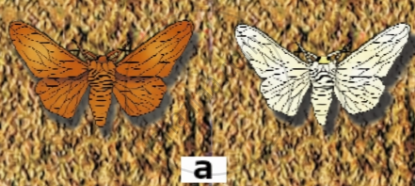
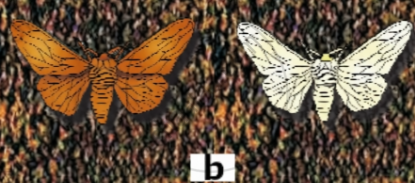
Figure showing white - winged moth and dark - winged moth (melanised) on a tree trunk (a) In unpolluted area (b) In polluted area
- In collections from the same area after industrialisation, around 1920, more dark-winged moths were found, and the earlier proportion was reversed.
- The explanation was that predators can easily spot a moth against a contrasting background.
- After industrialisation, tree trunks became dark due to industrial smoke and soot.
- Under these conditions, white-winged moths were more easily seen and did not survive well, while dark-winged moths survived better.
- Before industrialisation, tree trunks were covered by a thick growth of almost white-coloured lichens.
- In that background, white-winged moths survived better, while dark-coloured moths were picked out by predators.
- Moths that could camouflage themselves in the background survived.
- In rural areas where industrialisation did not occur, the number of melanic moths remained low.
- This showed that in a mixed population, those organisms that are better adapted survive and increase in population size.
- No variant is completely wiped out.
Anthropogenic Action and Resistant Forms
- Excessive use of herbicides and pesticides has resulted in the selection of resistant varieties within a much shorter time scale.
- A similar effect is seen in microbes against which antibiotics are used, and in eukaryotic organisms or cells against which drugs are used.
- Resistant organisms or cells may appear within months or years rather than centuries.
- These are examples of evolution by anthropogenic action.
Nature of Evolution
- Evolution is not a directed process in the sense of determinism.
- It is a stochastic process based on chance events in nature and chance mutation in organisms.
Homology and Analogy
| Feature | Homology | Analogy |
|---|---|---|
| Meaning | Same origin, different function. | Different origin, same function. |
| Main idea | Indicates common ancestry. | Indicates similarity due to the same function. |
| Animal examples | Forelimbs of whale, bat, cheetah, and human. | Wings of butterflies and birds; eyes of octopuses and mammals; flippers of penguins and dolphins. |
| Plant examples | Thorn of Bougainvillaea and tendrils of Cucurbita. | Sweet potato and potato. |
| Type of evolution | Divergent evolution. | Convergent evolution. |
Key Points: Evidences Supporting the Theory of Evolution
- Fossils: Remains in sedimentary rocks prove life changed over time; age is determined by radioactive dating.
- Embryology: All vertebrate embryos share gill slits in early stages, indicating common ancestry (Haeckel).
- Comparative Anatomy: Similar body structures across species indicate shared ancestors.
- Biochemical Evidence: Same proteins and genes across diverse organisms = common ancestry.
- Anthropogenic Evidence: Selective breeding by humans (e.g., dog breeds) over centuries proves that nature can do more over millions of years.
- Natural Selection (Peppered Moth): White moths survived pre-industrialisation; dark moths post-industrialisation - better adaptation = better survival.
- Evolution is Random: Based on chance mutations rather than direction, better-adapted organisms survive and thrive.
